


Aquafeed Market to Reach USD 123.6 Billion by 2036 as Conventional Aquafeed Leads and Aquaculture Output Rises
Aquafeed Market Conventional Aquafeed Leads Nature Category at 90.0%
The global aquafeed market is forecast to increase from USD 66.7 billion in 2026 to USD 123.6 billion by 2036, expanding at a 6.4% CAGR during the 2026-2036 forecast period, according to Future Market Insights. The market stood at USD 62.7 billion in 2025. Growth is being supported by commercial aquaculture operations’ recurring feed requirements, with producers seeking formulations that balance nutrient density, feed conversion, survival, and feed cost across stocked production cycles.
Get detailed market forecasts, competitive benchmarking, and pricing trends:
https://www.futuremarketinsights.com/reports/sample/rep-gb-4540
Regional Segment Leaders
As this is a global Aquafeed Market report, the segment analysis reflects feed nature, species categories, production requirements, and regional aquaculture demand across commercial farming markets.
- Conventional Aquafeed - 90.0% of Nature Category demand in 2026: Conventional aquafeed continues to dominate due to broader ingredient choices that provide formulators with greater substitution flexibility while meeting the nutritional requirements of commercial aquaculture.
- Fish - 36.0% of Species Category demand in 2026: Fish represents the leading species category as commercial finfish farms require species- and production-stage-specific nutrition to support growth, survival, feed conversion, and overall production performance.
- Recurring Commercial Farm Demand: Commercial farms purchase aquafeed repeatedly during stocked production cycles, making feed cost, formulation consistency, biological performance, and supply reliability important factors in supplier selection.
Market Growth Context
The Aquafeed Market is developing around the expansion of commercial aquaculture and the recurring requirement for formulated diets throughout stocked production cycles. Commercial finfish and crustacean farms depend on feed to provide controlled nutrient delivery while managing feed conversion, survival, growth rates, and production economics.
The Food and Agriculture Organization reported in June 2026 that aquaculture produced approximately 103 million tonnes of aquatic animals during 2024. The scale of aquaculture production creates recurring procurement requirements for formulated feed, with suppliers developing diets that can support different species, production stages, and farming environments.
Conventional aquafeed is estimated to account for 90.0% of nature category demand in 2026. Its leading position is supported by broad ingredient availability and the flexibility to substitute formulation inputs according to nutritional requirements, ingredient prices, and production conditions.
Species-specific nutrition is another important factor shaping demand. Fish is projected to represent 36.0% of the species category in 2026. Commercial fish farms require diets tailored to species, growth stages, water conditions, and production systems. Formulators therefore need to balance nutrient density with practical feed cost and measurable biological performance.
Production systems and species mix are also creating different formulation requirements across regional markets. Japan is projected to grow at a 7.9% CAGR through 2036, compared with 5.0% growth in Germany. Japanese aquaculture operations manage a broader marine finfish mix, creating demand for species-specific diet design and technical formulation support.
Germany's aquaculture market has a different production profile. Destatis reported in June 2026 that German aquaculture produced approximately 16,600 tonnes of fish during 2025, with trout and char representing 59.5% of that output. This production structure keeps a significant portion of German aquafeed demand concentrated on cold-water nutrition requirements.
Feed economics remain central to supplier selection. Farms are evaluating functional and system-specific diets against measurable benefits in health, water management, feed conversion, and production performance. Higher-priced formulations need to demonstrate a corresponding biological or operating benefit to justify additional feed expenditure.
Commercial success through 2036 is expected to depend on formulation consistency, feed conversion performance, species-specific nutrition, ingredient flexibility, supply reliability, technical support, and the ability to demonstrate measurable value within commercial farm operations.
Competitive Landscape
The competitive landscape features global animal nutrition companies, specialized aquafeed producers, and regional feed manufacturers serving commercial aquaculture operations.
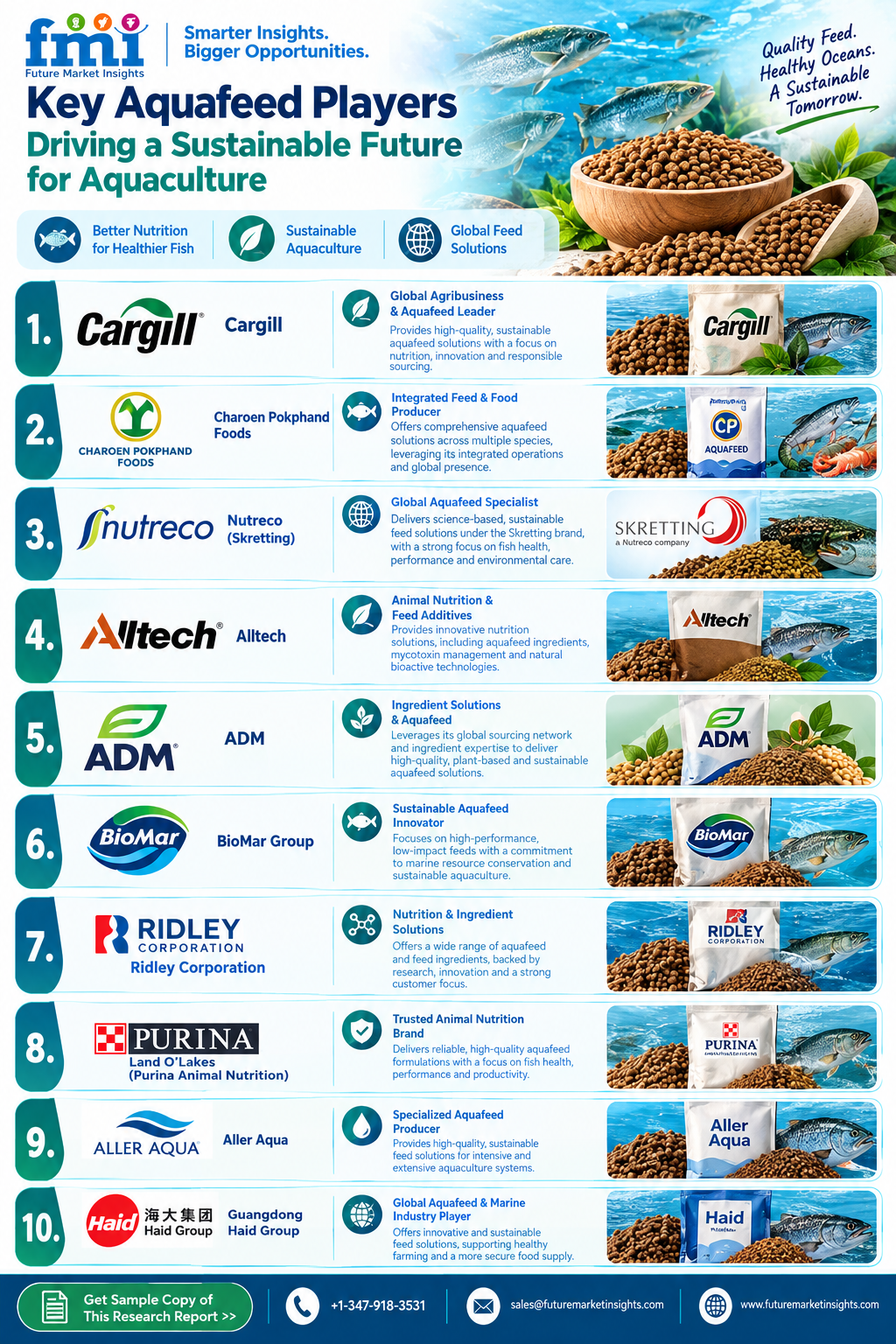
- Key Aquafeed Players: Cargill, Charoen Pokphand Foods, Nutreco (Skretting), Alltech, ADM, BioMar Group, Ridley Corporation, Land O'Lakes (Purina Animal Nutrition), Aller Aqua, and Guangdong Haid Group are among the key companies identified in the market.
Competitive differentiation depends on feed formulation, species-specific nutrition, ingredient sourcing, feed conversion performance, technical support, production capacity, and the ability to provide reliable feed supplies throughout farming cycles.
Supplier switching can also be constrained by farm economics and performance requirements. Producers may be reluctant to change established feed programs when a new formulation requires additional testing or carries uncertainty around feed conversion, survival, growth, or harvest economics.
Functional and system-specific diets are creating additional opportunities for suppliers that can demonstrate measurable benefits under commercial production conditions. However, feed cost remains an important consideration, particularly when feed represents a significant component of the cost of producing harvested aquatic animals.
Companies that can combine consistent formulation quality with technical support and evidence of repeatable biological performance may strengthen relationships with commercial aquaculture producers through 2036.
Get the Complete Story - Read More About the Aquafeed Market: https://www.futuremarketinsights.com/reports/aquafeed-market
Analyst Perspective
"Aquafeed suppliers are earning repeat business by proving conversion performance in the farm system that uses each diet. Ingredient novelty matters less than repeatable biological results once feed price becomes a material share of production cost." - Nandini Roy Choudhury, Principal Consultant, Future Market Insights
Explore More Research Reports by FMI
Yerba Mate Market https://www.futuremarketinsights.com/reports/yerba-mate-market
Collagen Casings Market https://www.futuremarketinsights.com/reports/collagen-casings-market
Autism Selective-Eating Nutrition Market https://www.futuremarketinsights.com/reports/autism-selective-eating-nutrition-market
Bakery Xylanase Market https://www.futuremarketinsights.com/reports/bakery-xylanase-market
Basbousa & Semolina Cakes Market https://www.futuremarketinsights.com/reports/basbousa-and-semolina-cakes-market
About Future Market Insights (FMI)
Future Market Insights, Inc. (FMI) is an ESOMAR-certified, ISO 9001:2015 market research and consulting organization, trusted by Fortune 500 clients and global enterprises. With operations in the U.S., UK, India, and Dubai, FMI provides data-backed insights and strategic intelligence across 30+ industries and 1200 markets worldwide.
For Press & Corporate Inquiries
Rahul Singh
AVP - Marketing and Growth Strategy
Future Market Insights, Inc.
+91 8600020075
For Sales: sales@futuremarketinsights.com
For Media: Rahul.singh@futuremarketinsights.com
For Web: https://www.futuremarketinsights.com/

 English
 Arabic
 French
 Spanish
 Portuguese
 Deutsch
 Turkish
 Dutch
Dutch
 Italiano
 Russian
 Portuguese (Brazil)
 Greek
Greek