


Full Guide to SAP Modules Lists: Functions and Business Use Cases
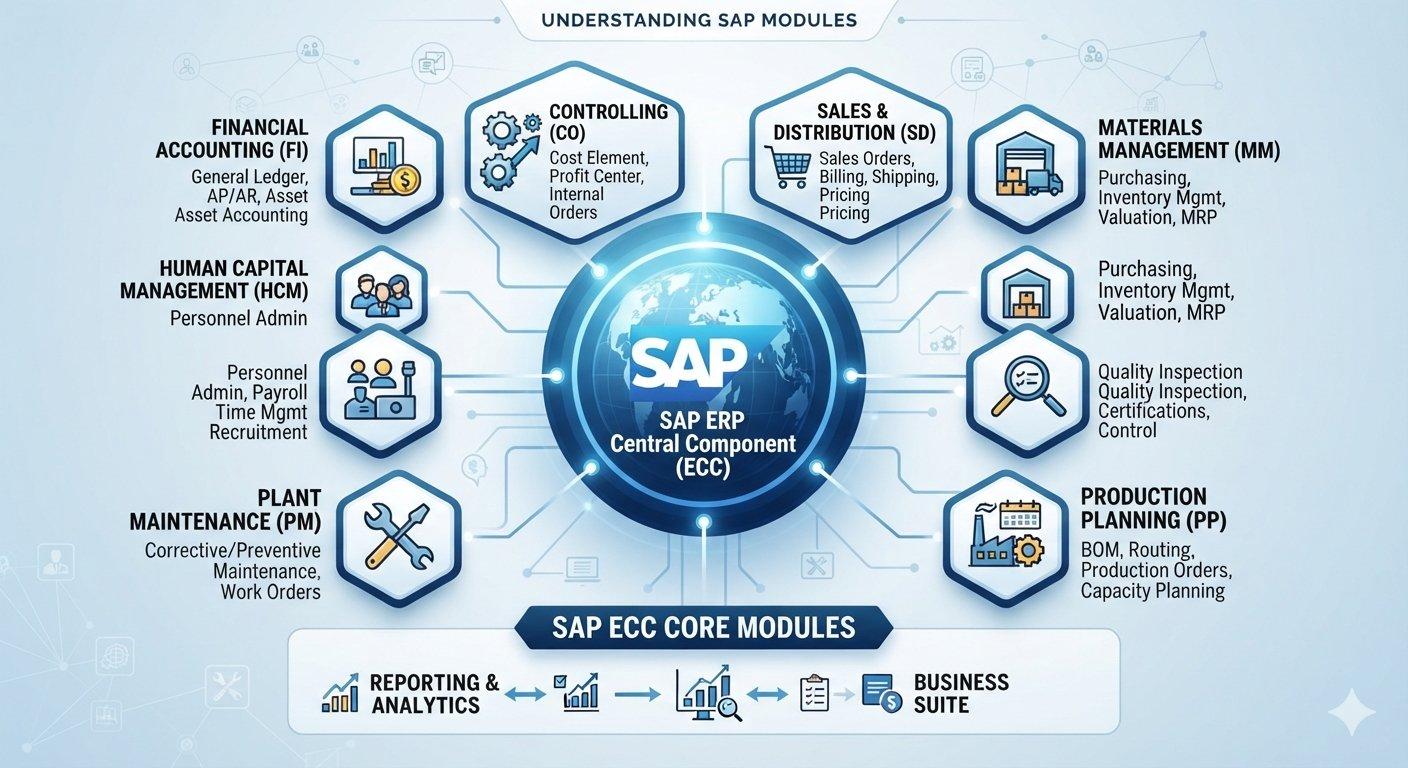
Explore the full SAP modules list with functions, business use cases, advanced SAP modules, and tips for choosing a top SAP FICO course. Beginner-friendly.
SAP modules are integrated software components that run specific business functions. Core ERP modules include FI, CO, MM, SD, PP, QM, PM, PS, and HCM, while advanced SAP modules extend into analytics, supply chain, procurement, and cloud. Each module shares data in one system, so finance, logistics, and operations stay aligned.
What Are SAP Modules?
An SAP module is a functional building block of the SAP ERP system. Finance has its own module, so do purchasing, sales, production, and HR. All of them read from and write to a shared database.
That shared data is the whole point. When a warehouse clerk posts a goods receipt, inventory updates in MM and the accounting entry lands in FI automatically. Nobody re-keys anything between departments.
Most companies don't turn on every module. They activate the ones that match how they operate, and add more as they grow.
Core SAP Modules List: Functions and Use Cases
| Module | Full Name | Main Function | Typical Business Use |
|---|---|---|---|
| FI | Financial Accounting | General ledger, accounts payable/receivable, asset accounting | Statutory reporting, month-end close |
| CO | Controlling | Cost centers, profit centers, product costing | Internal cost tracking, margin analysis |
| MM | Materials Management | Procurement, inventory, invoice verification | Purchasing, stock control |
| SD | Sales and Distribution | Quotations, sales orders, delivery, billing | Order-to-cash processing |
| PP | Production Planning | MRP, work centers, production orders | Manufacturing scheduling |
| QM | Quality Management | Inspection plans, quality notifications | Defect tracking, compliance |
| PM / EAM | Plant Maintenance | Maintenance orders, equipment records | Preventive maintenance |
| PS | Project System | Project structures, budgeting, milestones | Construction, engineering projects |
| WM / EWM | Warehouse Management | Bin-level stock, putaway, picking | Distribution centers |
| HCM | Human Capital Management | Personnel records, payroll, time management | Workforce administration |
Finance: FI and CO
FI records what the company owes and owns: vendor invoices, customer payments, fixed assets, and the general ledger. CO explains where the money went internally, by department, product, or project.
Example: a company pays a $10,000 marketing invoice. FI posts it to the expense account and the vendor ledger. CO assigns that cost to the marketing cost center so the department head can see it against budget.
Logistics: MM, SD, PP, QM
These modules cover the physical flow of goods.
- Procure-to-pay (MM + FI): purchase requisition, purchase order, goods receipt, invoice verification, payment.
- Order-to-cash (SD + FI): customer order, delivery, billing, incoming payment.
- Plan-to-produce (PP + MM + QM): demand planning, material requirements, production, quality check.
The SD-to-FI link is a good example of integration: billing a customer automatically creates the receivable in finance.
Operations and People: PM, PS, WM, HCM
Plant Maintenance keeps machines running. Project System suits companies that run long, budget-heavy projects. Warehouse modules handle storage precision. HCM manages employee data, though many organizations now use SAP SuccessFactors for cloud-based HR instead.
Advanced SAP Modules and Cloud Solutions
Advanced SAP modules usually mean the layer beyond classic ERP, covering analytics, cloud applications, and extended supply chain. The names below are real SAP products, but availability and packaging change, so verify details on SAP's official product pages.
- SAP S/4HANA: the current ERP suite. It runs on the HANA in-memory database and uses a simplified data model. In finance, a single Universal Journal (table ACDOCA) combines data that older systems split across FI and CO tables.
- SAP SuccessFactors: cloud HR covering recruiting, performance, learning, and core HR.
- SAP Ariba: procurement and supplier collaboration across companies.
- SAP Concur: travel and expense management.
- SAP BW/4HANA and SAP Analytics Cloud: data warehousing, reporting, and planning.
- SAP Extended Warehouse Management (EWM): advanced warehouse processes beyond standard WM.
- SAP Business Technology Platform (BTP): integration, extension, and app development.
- SAP Fiori: the modern user interface layer over many SAP applications.
SAP has announced timelines for ending mainstream maintenance of the older ECC system, which is why many organizations are migrating to S/4HANA. Check SAP's current maintenance statements before building a migration plan.
How to Choose the Right SAP Module for Your Business
Start with the business problem, not the product list.
- Map your core processes. Write down how you buy, make, sell, and report today.
- Find the pain points. Slow month-end close points to finance. Stockouts point to MM or PP.
- Start with the backbone. Most implementations begin with FI/CO, MM, and SD because everything else connects to them.
- Add specialized modules later. QM, PM, and PS earn their place when the process truly requires them.
- Check integration needs. Consider existing tools, such as CRM or e-commerce, and how they will connect.
A distribution company will lean on MM, SD, and WM. A manufacturer will add PP and QM. A professional-services firm might prioritize FI/CO and PS.
Why SAP FICO Remains a Popular Career Path
Finance and controlling touch every business, so FICO skills transfer across industries. Consultants who understand both accounting and the system configuration are consistently in demand, though salaries and hiring conditions vary by country and employer, so check current job listings rather than relying on generic claims.
Typical FICO topics include:
- Enterprise structure (company code, controlling area, chart of accounts)
- General ledger, accounts payable, and accounts receivable
- Asset accounting and bank accounting
- Cost center and profit center accounting, internal orders, product costing
- Month-end and year-end closing
- Integration with MM and SD
- S/4HANA changes, such as the Universal Journal, Business Partner, and new asset accounting
How to Pick a Top SAP FICO Course
Course quality varies widely. Use this checklist:
- S/4HANA coverage. Older ECC-only material leaves gaps.
- Hands-on system access. Reading about configuration is not the same as doing it. Look for practice in a real SAP client.
- Instructors with project experience. Ask about their implementation or support background.
- Real business scenarios. Good courses teach full cycles like procure-to-pay, not isolated screens.
- Integration with other modules. FICO rarely works alone.
- Clear syllabus and updates. The curriculum should state what version it covers.
- Certification alignment. If you plan to take an SAP certification exam, confirm that the course maps to the current exam topics on SAP's official certification pages.
- Transparent outcomes. Be cautious about guaranteed-job promises.
A solid accounting foundation helps. If you're new to finance, learn debits, credits, and basic financial statements first. SAP will make more sense.
Common Mistakes When Learning or Implementing SAP
- Top Online SAP FICO Course
- Learning transaction codes without understanding the business process behind them
- Ignoring integration between modules
- Skipping data cleanup before migration
- Choosing modules because they are popular rather than because they fit
- Underestimating change management and user training
FAQ's
1. How many SAP modules are there?
There is no single fixed count. SAP offers dozens of modules and products across ERP, cloud, analytics, and industry solutions, and the portfolio changes over time.
2. What are the main SAP modules?
The most commonly implemented are FI, CO, MM, SD, and PP, followed by QM, PM, PS, WM, and HCM.
3. What is the difference between SAP FI and CO?
FI handles external financial reporting, such as ledgers, payables, and receivables. CO handles internal cost and profitability analysis.
4. What are advanced SAP modules?
The term typically refers to solutions beyond core ERP, such as S/4HANA finance features, EWM, SuccessFactors, Ariba, BW/4HANA, Analytics Cloud, and BTP.
5. Is SAP FICO a good career choice?
It can be, particularly for people with accounting or finance backgrounds, since every organization needs financial processes. Demand varies by region and industry.
6. Do I need an accounting background to learn SAP FICO?
It is not strictly required, but basic accounting knowledge makes learning much faster.
7. How long does it take to learn SAP FICO?
It depends on your background and study time. Most structured courses run from a few weeks to a few months, and real proficiency comes from practice on projects.
8. What should a top SAP FICO course include?
S/4HANA content, live system practice, end-to-end scenarios, module integration, and an up-to-date syllabus.
9. What is SAP S/4HANA?
It is SAP's current ERP suite, built on the HANA database with a simplified data model and Fiori interface.
10. Which SAP module should a small business start with?
Usually finance (FI/CO), plus purchasing and sales if goods are involved. Add specialized modules once the basics run smoothly.
Conclusion
SAP modules work best as a single system rather than zu separate tools. FI and CO anchor finance, MM, SD, and PP run logistics, and advanced SAP solutions add analytics, cloud, and extended supply chain capabilities. For businesses, the right approach is to match modules to real processes. For learners, FICO offers a strong entry point, especially if the training covers S/4HANA and includes hands-on practice. Whichever path you take, understand the business flow first and the screens second.

 English
 Arabic
 French
 Spanish
 Portuguese
 Deutsch
 Turkish
 Dutch
Dutch
 Italiano
 Romaian
 Portuguese (Brazil)
 Greek
Greek