INTRODUCTION
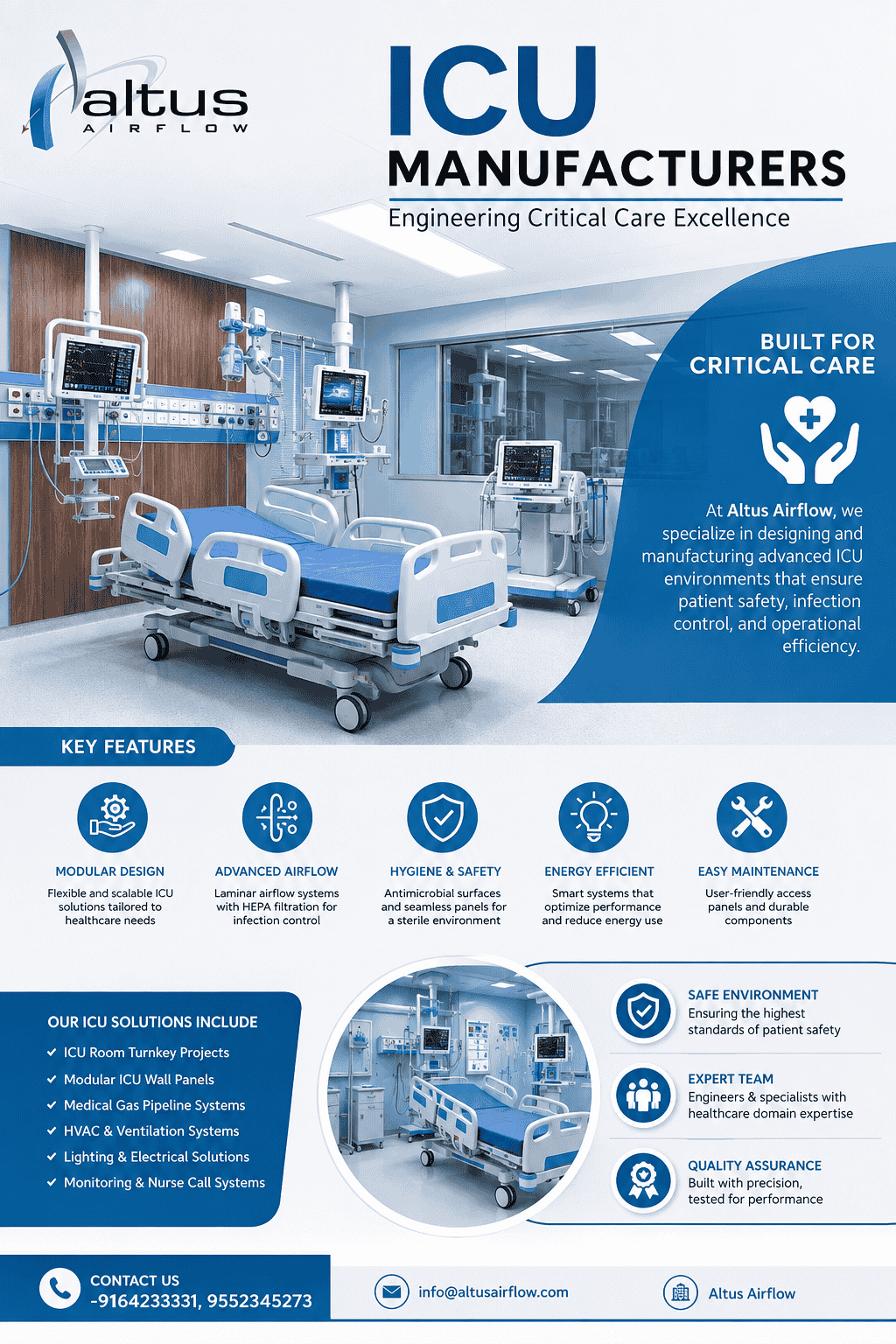
Selecting the right ICU Manufacturers involves much more than comparing individual equipment or installation features. Hospitals need an ICU environment that supports critical-care workflows, patient safety, infection-control practices, emergency access, and reliable operation of essential systems. The Indian Society of Critical Care Medicine (ISCCM) consensus statement provides recommendations covering ICU structure, layout, equipment, environmental requirements, services, and maintenance, making these areas important considerations during hospital planning.
Start With Hospital-Specific Requirements
Every hospital has different clinical services, patient volumes, available departments, and infrastructure limitations. Before selecting an ICU solution, the hospital should identify the expected number of beds, level of critical care, patient categories, equipment requirements, staffing model, and possible future expansion.
This initial assessment helps ensure that the proposed infrastructure is appropriate for the hospital rather than based on a generic layout.
Evaluate the Overall ICU Layout
The layout should provide sufficient working space around every patient bed while supporting efficient movement of doctors, nurses, equipment, and emergency teams. ISCCM recommendations address patient-care space as well as additional areas for nursing stations, storage, staff movement, equipment, doctors, nurses, teaching, relatives, and other supporting functions.
Hospitals should therefore review circulation routes, patient visibility, bed positioning, storage areas, utility access, and connections with other critical hospital departments.
Review Equipment Integration
ICU infrastructure needs to accommodate several types of medical equipment, including ventilators, multiparameter monitors, infusion pumps, emergency equipment, and other critical-care devices.
The selection process should consider equipment compatibility, available space, ease of movement, cleaning requirements, maintenance needs, upgrade potential, and feedback from clinical users and biomedical engineers. ISCCM specifically recommends involving end users and biomedical engineering personnel when evaluating ICU equipment.
Assess Medical Gas Planning
Medical gas infrastructure should be planned around the requirements of each patient-care position. Oxygen, vacuum, and compressed-air connections need to be accessible without interfering with clinical activities or creating unnecessary obstruction.
The hospital should review outlet placement, pipeline coordination, accessibility, safety provisions, and future capacity before finalizing the infrastructure.
Examine Electrical Infrastructure
Critical-care areas rely on multiple electrically powered devices, so electrical planning should be addressed during the initial design stage. The infrastructure should provide sufficient outlets and suitable arrangements for essential equipment.
ISCCM recommendations also address ICU power backup and UPS provisions, highlighting the importance of maintaining essential equipment and environmental systems during power interruptions.
Check HVAC and Environmental Control
Temperature, humidity, ventilation, and air quality are important parts of ICU infrastructure. Hospitals should examine how the proposed HVAC system will provide appropriate environmental control and how air movement is managed between different areas.
The ISCCM consensus statement recommends controlled ICU ventilation and describes air movement from cleaner toward less-clean areas, along with specific ventilation considerations for isolation spaces.
Prioritize Infection-Control Features
The physical environment should support effective cleaning and infection-prevention practices. Hospitals should assess flooring, wall finishes, furniture, equipment accessibility, hand hygiene facilities, waste movement, and separation of clean and potentially contaminated workflows.
Design decisions should also be coordinated with the hospital's infection-control team so that infrastructure supports established cleaning and operational procedures.
Consider Emergency Accessibility
Emergency access must remain clear around every patient position. Equipment, partitions, utility connections, and furniture should not interfere with urgent procedures or movement of beds.
The ICU should also have suitable access to emergency routes and adjoining clinical departments. Planning should consider how critically ill patients will be transported within the hospital without creating unnecessary delays.
Review Fire and Safety Provisions
Fire safety should be incorporated into ICU design rather than added after installation. Hospitals should evaluate emergency exits, fire-protection equipment, evacuation routes, electrical safety, and access for emergency teams.
ISCCM's ICU planning recommendations include fire-protection measures, emergency exits, escape-route signage, and regular safety exercises as part of ICU preparedness.
Evaluate Installation and Coordination
A successful ICU project requires coordination among architects, hospital administrators, clinicians, biomedical engineers, HVAC specialists, electrical teams, and other technical professionals.
Hospitals should assess whether the proposed solution can be integrated smoothly with existing building services and whether installation activities can be managed without compromising other hospital operations.
Check Maintenance and Technical Support
Long-term performance should be considered before final selection. Hospitals should understand how preventive maintenance, calibration, servicing, troubleshooting, replacement requirements, and technical support will be handled.
ISCCM emphasizes the importance of maintenance policies, responsible equipment use, calibration, disinfection, and regular servicing for ICU equipment.
Look at Future Adaptability
Hospital technology and clinical requirements can change. An ICU designed without flexibility may become difficult to modify when additional beds, new equipment, upgraded monitoring systems, or revised workflows are introduced.
Hospitals should therefore discuss future expansion, additional utility requirements, equipment upgrades, and service accessibility before finalizing the infrastructure.
Assess Documentation and Handover
Proper documentation is another factor that should be reviewed. Hospitals may need layout drawings, equipment information, utility details, maintenance documentation, operating instructions, and commissioning records.
A structured handover can help hospital engineering and biomedical teams understand the installed systems and support future maintenance activities.
Compare the Complete Solution
The final selection should consider the complete infrastructure package rather than focusing on a single component. Layout, equipment compatibility, medical gases, electrical systems, HVAC, infection control, safety, maintenance, installation coordination, and future adaptability should all be reviewed together.
A systematic evaluation allows hospital teams to compare proposed solutions against their clinical, technical, and operational requirements.
Conclusion
Hospitals selecting an ICU infrastructure partner should evaluate the entire project from planning and layout through installation, commissioning, maintenance, and future expansion. Attention to patient-care space, equipment integration, ventilation, medical gases, electrical systems, infection control, emergency access, safety, and technical support can help create a more functional critical-care environment. ISCCM's consensus guidance provides an important Indian reference for ICU planning and design, while individual projects should be adapted to their hospital's specific clinical and engineering needs. By applying these criteria systematically, hospitals can make an informed infrastructure decision when working with ICU Manufacturers.
FAQs
1. What should hospitals evaluate before selecting an ICU infrastructure solution?
Hospitals should review the ICU layout, bed capacity, equipment integration, medical gases, electrical systems, HVAC, infection control, emergency access, safety, maintenance, and future expansion requirements.
2. Why is ICU layout important?
A suitable layout provides adequate working space around patients, supports staff movement, allows equipment access, and helps maintain efficient clinical workflows.
3. Should biomedical engineers be involved in ICU planning?
Yes. Biomedical engineers and clinical end users can provide useful input regarding equipment compatibility, maintenance, service requirements, and technical integration.
4. Why should hospitals consider future expansion?
Future requirements may include additional beds, new medical equipment, upgraded monitoring systems, or changes in clinical workflows. Flexible infrastructure can make later modifications easier.
5. Why is maintenance important in ICU infrastructure?
ICU equipment and supporting systems operate in a demanding environment. Regular servicing, calibration, cleaning, and maintenance help support reliable operation and extend equipment usability.
Read Our Previous Blog-----------> PICU Manufacturers In India: How to Choose Quality Solutions?




 English
 Arabic
 French
 Spanish
 Portuguese
 Deutsch
 Turkish
 Dutch
Dutch
 Italiano
 Romaian
 Portuguese (Brazil)
 Greek
Greek