


Common Mistakes When Transitioning from Local to National SEO
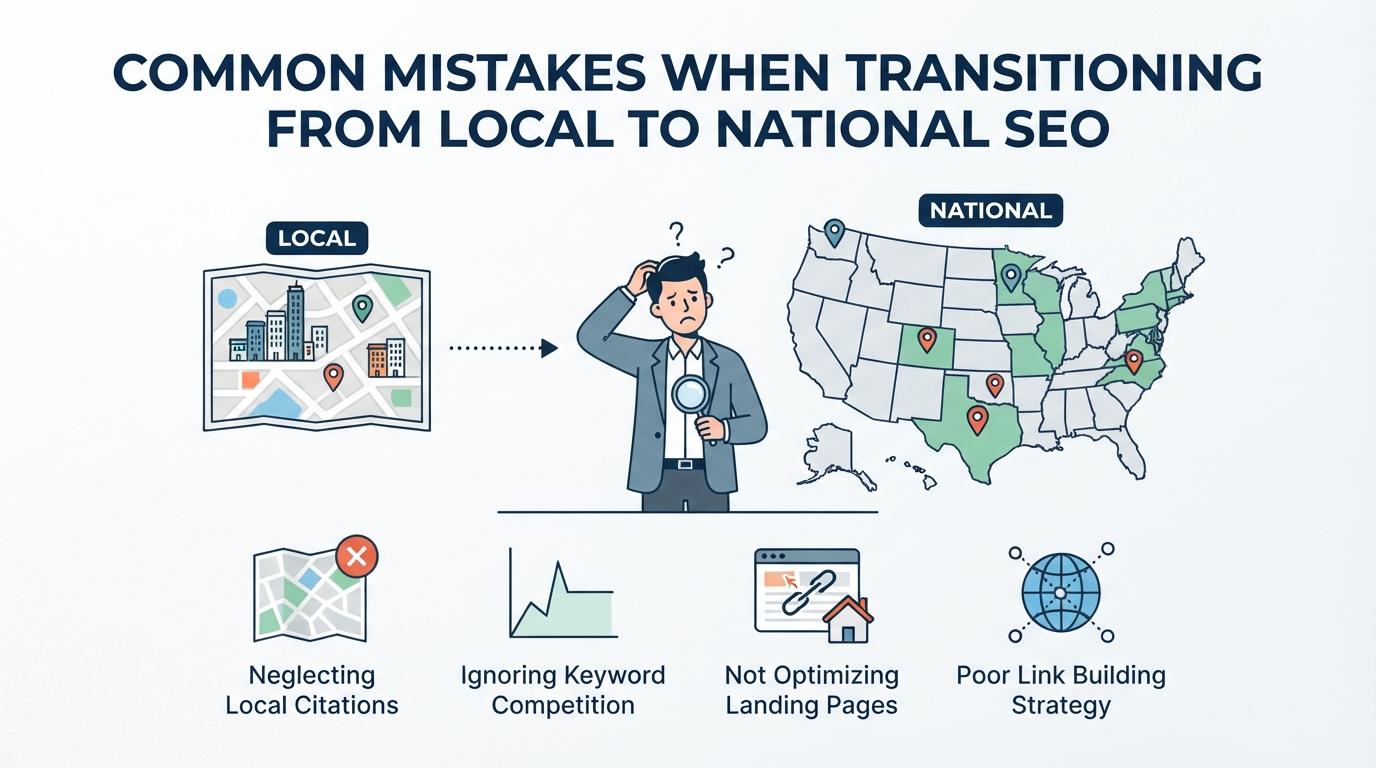
Businesses expanding from a local SEO focus into national SEO often carry over assumptions and tactics that worked well locally but don't translate to national competition — leading to some genuinely common, avoidable mistakes.
Mistake: Underestimating the Competitive Jump
Local SEO success can create a false sense of confidence about how quickly national SEO will follow the same pattern — national keywords involve considerably more competition, and businesses that don't adjust their timeline and resource expectations accordingly often become discouraged prematurely.
Mistake: Insufficient Content Investment
A content strategy that worked for local SEO — a handful of well-optimized, location-specific pages — is rarely sufficient at national scale, where competing against established national players requires considerably more comprehensive topical coverage than businesses transitioning from local SEO often anticipate.
Mistake: Neglecting Technical SEO Until It Becomes a Problem
Technical shortcomings that were tolerable in a less competitive local search environment can become genuine obstacles at national scale — businesses that don't proactively audit and address technical SEO before scaling content often find themselves diagnosing preventable issues later, after they've already limited results.
Mistake: Carrying Over Local Link-Building Tactics
Directory submissions and local partnership links, effective for local SEO, carry little weight in a national link-building context — businesses that continue relying primarily on these tactics after transitioning to national SEO often see their backlink profile fail to keep pace with national competitors.
Mistake: Diluting Focus Across Too Many Keywords Too Soon
Attempting to simultaneously target a large number of highly competitive national keywords, rather than building authority progressively through more achievable long-tail terms first, often results in spreading content and optimization efforts too thin to make meaningful progress on any of them.
Mistake: Abandoning Local SEO Entirely During the Transition
For many businesses, local SEO continues generating valuable traffic and leads even after expanding into national SEO — completely deprioritizing local efforts in favor of an unproven national strategy can create an unnecessary dip in existing performance rather than the intended growth.
Mistake: Unrealistic Timeline Expectations
Expecting national SEO to show results on a timeline comparable to local SEO's typically faster movement sets up a mismatch between actual progress and expectations, sometimes leading businesses to abandon a national strategy prematurely, before it's had a realistic chance to build momentum.
Mistake: Insufficient Budget Allocation
Underestimating the sustained content, technical, and link-building investment national SEO requires — often based on local SEO cost expectations — leads some businesses to under-resource their national campaign relative to what's actually needed to compete effectively.
Mistake: Ignoring the Buyer's Journey in Content Planning
Content built purely around bottom-of-funnel, transactional keywords, without supporting informational and comparison content addressing earlier stages of the buyer's journey, tends to underperform a more complete content strategy addressing the full range of national audience search intent.
Mistake: Failing to Adapt Measurement and Reporting
Continuing to measure success purely through local-style metrics (a handful of specific keyword rankings, for instance) without adapting to broader, more comprehensive national SEO performance indicators (overall organic visibility, content cluster performance, traffic quality) can create a misleading picture of actual progress.
Mistake: Not Accounting for Internal Resourcing Needs
National SEO's greater content and technical demands often require more internal resourcing — whether in-house team capacity or agency support — than businesses used to managing local SEO with more limited effort anticipate, leading to strategies that are under-resourced relative to their ambition.
A Transition Checklist to Avoid These Pitfalls
-
Set realistic timeline and budget expectations before beginning, based on genuine industry competitiveness
-
Build a comprehensive content plan rather than carrying over a local-scale content calendar
-
Audit and address technical SEO proactively rather than reactively
-
Shift link-building tactics toward digital PR rather than continuing local-style outreach
-
Maintain existing local SEO efforts alongside a new national push, rather than abandoning them
-
Resource the transition appropriately, whether through internal capacity or outside support
Where to Explore This Transition in More Depth
Inoma Digital's guide to national SEO strategy addresses several of these transition considerations directly, useful reading for United States businesses planning to expand beyond an established local SEO foundation.

 English
 Arabic
 French
 Spanish
 Portuguese
 Deutsch
 Turkish
 Dutch
Dutch
 Russian
 Romaian
 Portuguese (Brazil)
 Greek
Greek