


Ambient Assisted Living Market Outlook Strengthens With Connected Healthcare
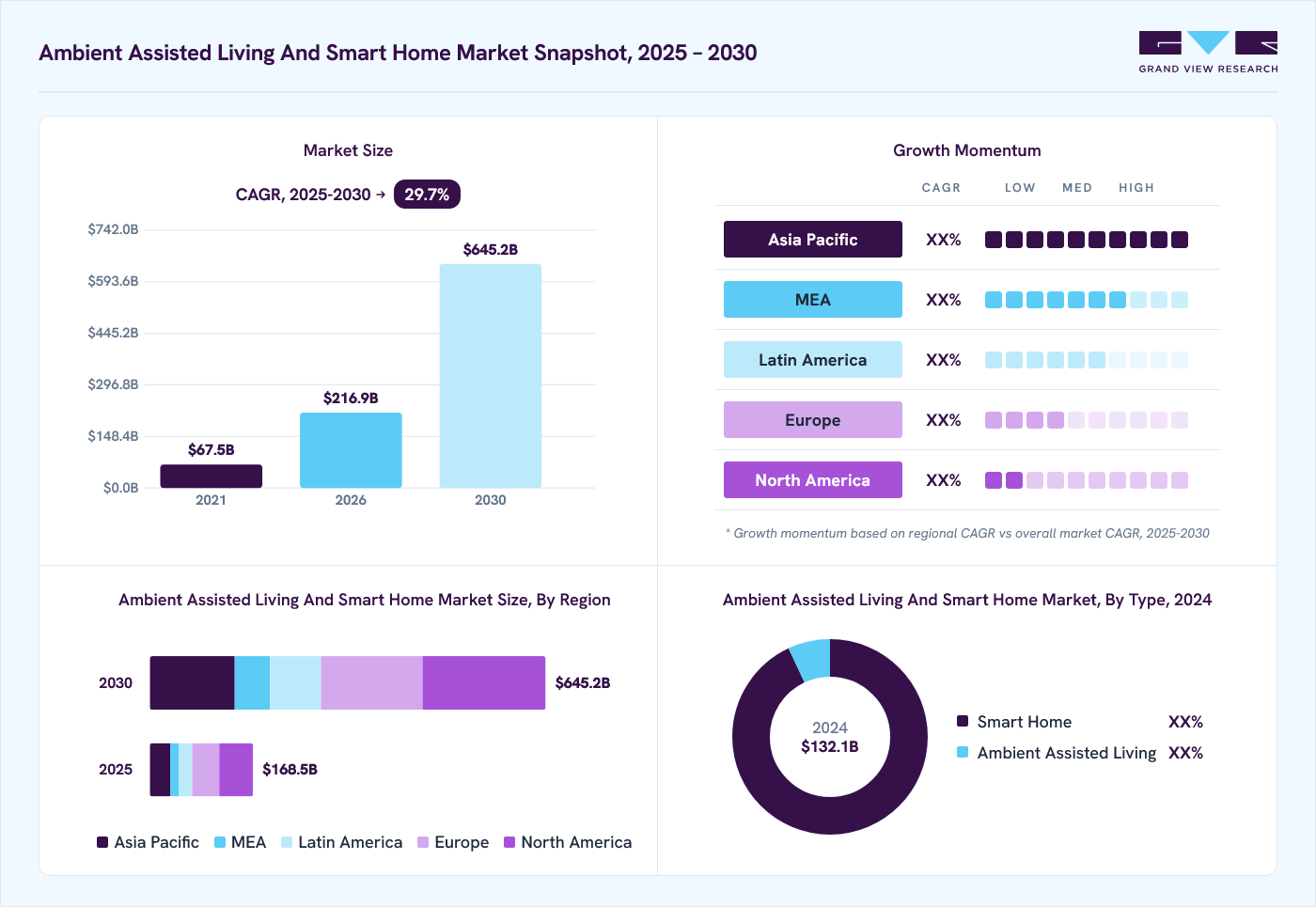
The ambient assisted living and smart home market is expanding as connected technologies become increasingly integrated into everyday living, healthcare, safety, and energy management. The market was valued at USD 132.1 billion in 2024 and is estimated to reach USD 216.9 billion in 2026, before growing to USD 645.2 billion by 2030 at a 29.7% CAGR from 2025 to 2030. Rising demand for energy-saving solutions, remote patient monitoring, telehealth, and technologies that support independent living is creating new opportunities across residential environments.
Connected Homes Are Becoming More Responsive to Everyday Needs
The development of smart homes is moving beyond convenience-focused automation. Connected devices are increasingly being used to manage lighting, security, heating, entertainment, health monitoring, and other household functions. IoT-enabled products and AI-powered automation are allowing homes to respond more effectively to user preferences and changing conditions.
Energy conservation is another important factor. Smart lighting controllers and dimming systems can automatically switch off unused lighting or adjust intensity according to requirements, helping reduce energy consumption, electricity costs, and greenhouse gas emissions. These capabilities are strengthening interest in intelligent home environments.
Smart Home Products Form the Market's Largest Foundation
Smart home products accounted for a dominant 93.3% revenue share in 2024. The segment benefits from growing consumer awareness of connected technologies and increasing adoption of products designed to improve convenience, security, and energy efficiency.
Entertainment control represented the largest smart home product category, with a 42.6% revenue share in 2024. The growing use of AI assistants such as Alexa and Siri is supporting demand for voice-compatible devices. Smart TVs, streaming services, and connected entertainment systems are also contributing to this category as consumers increasingly integrate digital content into home environments.
HVAC Control Emerges as a High-Growth Technology Area
While entertainment control maintains a leading position, HVAC control is projected to record the highest CAGR of 34.5% over the forecast period. Increasing demand for efficient temperature management, automation, and connected building systems is creating opportunities for advanced HVAC controls.
The broader expansion of IoT devices and digital technologies is also encouraging greater integration between connected home systems. As more devices generate and exchange data, smart environments can support increasingly automated energy and comfort management.
Safety Technologies Are Strengthening Independent Living
Ambient assisted living introduces a different dimension to connected-home adoption by focusing on safety, independence, accessibility, and quality of life. The safety and security segment represented the largest share within ambient assisted living, accounting for 21.1% in 2024.
Fall detection sensors, medical alert systems, and other monitoring technologies can help people remain independent while providing additional safety support. The page notes that the World Health Organization estimates around 684,000 falls globally each year, with most victims above the age of 60.
Compensatory impairment is expected to experience the highest CAGR within ambient assisted living. Assistive technologies can help people with disabilities and older adults manage daily activities more independently. This creates opportunities for smart environments that combine sensors, communication systems, mobility assistance, and automated support.
Remote Healthcare Is Bringing Smart Technology Into the Home
The convergence of smart homes and healthcare is becoming an important market development. Remote patient monitoring devices, sensors, telehealth, and connected health systems can extend healthcare services beyond conventional clinical environments.
The page cites a June 2021 MSI International survey in which 80% of Americans supported remote patient monitoring, while nearly half preferred its incorporation into medical treatment. The increasing use of in-home monitoring can support older adults and people requiring ongoing assistance while improving access to healthcare services.
Installation Is Creating a Service Opportunity Around Connected Homes
Installation and repair services accounted for the largest revenue share among services in 2024. As connected homes incorporate sensors, alarms, lighting systems, health-monitoring devices, and other interconnected technologies, professional installation and maintenance become increasingly important.
Customization and renovation, however, are expected to record the highest CAGR. Existing homes can be retrofitted with voice-controlled interfaces, automated health monitoring, emergency response systems, personalized lighting, temperature controls, and other accessibility features. This creates an opportunity to adapt existing residential environments rather than relying solely on new construction.
Regional Adoption Is Closely Linked With Aging and Digitalization
North America held the largest regional share at 33.1% in 2024. Adoption is being supported by aging demographics, demand for independent living, remote monitoring, smart devices, voice assistants, and AI-driven systems.
Europe is seeing increased investment from governments and healthcare systems in technologies designed to improve elderly care and quality of life. Asia Pacific is being shaped by aging populations, urbanization, technological adoption, and increasing demand for smart healthcare solutions, particularly across markets such as Japan, South Korea, and China.
FAQs
What is driving ambient assisted living and smart home market growth?
Demand for energy-saving solutions, remote patient monitoring, telehealth, IoT devices, AI-powered automation, aging-in-place technologies, and connected safety systems is supporting market expansion.
Which segment leads the ambient assisted living and smart home market?
Smart home products led the type segment with a 93.3% revenue share in 2024, while entertainment control held 42.6% of the smart home products segment. North America held the largest regional share at 33.1% in 2024.
Key Smart Home Companies:
· Johnson Controls
· Heila Technologies
· Medic4all
· GETEMED Medizin- und Informationstechnik AG
About us:
Grand View Research, a market research and consulting company, provides syndicated research reports, customized research reports, and consulting services. Grand View Research database is used by the world's renowned academic institutions and Fortune 500 companies to understand the global and regional business environment. Our database features thousands of statistics and in-depth analysis on 46 industries in 25 major countries worldwide.

 English
 Arabic
 Spanish
 Portuguese
 Deutsch
 Turkish
 Dutch
Dutch
 Italiano
 Russian
 Romaian
 Portuguese (Brazil)
 Greek
Greek