


Hair Loss and Scalp Treatments Become Key Areas of Hair Care Market Innovation
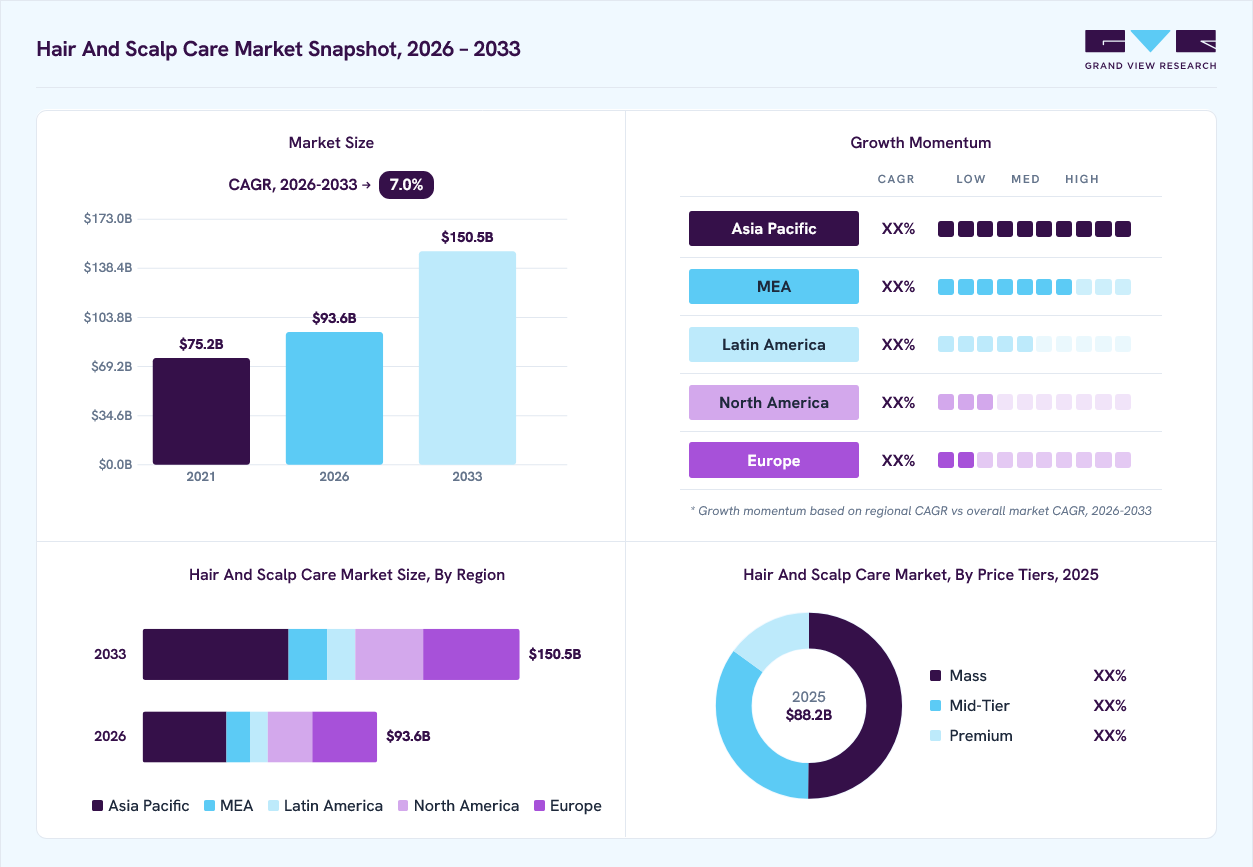
The hair and scalp care market is expanding as consumers increasingly focus on scalp health, targeted treatments, ingredient transparency, and personalized hair routines. The market was valued at USD 88.2 billion in 2025 and is estimated to reach USD 93.6 billion in 2026, before growing to USD 150.5 billion by 2033 at a 7.0% CAGR from 2026 to 2033. Rising concerns around hair loss, dandruff, scalp sensitivity, dryness, premature greying, and thinning hair are encouraging consumers to move beyond basic cleansing toward specialized care solutions.
From Hair Care to Scalp-Focused Routines
Consumer expectations are shifting from conventional cleansing toward products designed to address specific hair and scalp concerns. Pollution exposure, stress, hard water, changing dietary patterns, and lifestyle factors are contributing to increased attention toward scalp health. This is encouraging demand for anti-dandruff products, scalp serums, hair-growth solutions, masks, and treatment-oriented formulations.
Ingredient-focused products are also becoming increasingly important. Sulfate-free, pH-balanced, natural, medicated, and dermatologist-recommended formulations are expanding the range of options available to consumers. The emphasis on efficacy and targeted benefits is strengthening repeat purchases and brand engagement.
Shampoo Remains the Everyday Entry Point
Shampoo held the largest product share at 39.80% of revenue in 2025 and is expected to register the fastest CAGR over the forecast period. Its essential role in daily hygiene and scalp maintenance gives the category a broad consumer base.
The segment is also evolving from basic cleansing toward treatment-led applications. Products addressing dandruff, hair fall, scalp sensitivity, dryness, and excess oil are becoming increasingly prominent. This transition is helping specialized shampoo formulations capture demand from consumers seeking more targeted results.
Conditioners are also moving beyond basic moisturization. The segment is expected to grow at a 7.1% CAGR from 2026 to 2033, supported by demand for richer textures, longer-lasting fragrances, smoothening, strengthening, and scalp-comfort benefits.
Hair Loss Concerns Are Creating Treatment Opportunities
The growing prevalence of hair thinning and hair loss is opening a major product opportunity. Hair and scalp care products addressing hair loss and thinning are expected to grow at an 8.6% CAGR from 2026 to 2033.
Stress, hormonal changes, nutritional deficiencies, lifestyle patterns, and age-related changes are contributing to consumer interest in targeted solutions. Anti-hair-fall shampoos, scalp serums, growth tonics, and leave-in treatments are increasingly positioned around specialized care rather than cosmetic coverage alone.
At the same time, oily and greasy scalp products represented 29.43% of revenue in 2025, making this the leading concern segment. Demand is supported by concerns such as excess sebum, dandruff, irritation, itchiness, and hair thinning, encouraging adoption of oil-control shampoos, clarifying treatments, scalp exfoliators, and balancing serums.
Digital Beauty Culture Is Changing Product Discovery
Social media is playing an increasingly visible role in how consumers learn about hair and scalp care. Tutorials, product reviews, influencer routines, and before-and-after content are encouraging consumers to experiment with specialized products and multi-step routines.
Younger consumers are particularly active in this shift. A YouGov survey cited by Grand View Research found that among adults aged 18–34, nearly 9 in 10 regularly use shampoo or conditioner, while about 23% use hair oil and 25% use serums or masks.
This digital influence is also supporting niche brands and new product launches by allowing companies to communicate formulation benefits, demonstrate usage, and collect consumer feedback more directly.
E-Commerce Is Broadening Access to Specialized Products
Online and direct-to-consumer channels are becoming important for premium, professional, niche, and dermatologist-recommended products. Consumers can compare formulations, review product feedback, access detailed ingredient information, and discover products that may not be readily available through traditional stores.
Online/e-commerce sales are expected to grow at an 8.2% CAGR from 2026 to 2033. Mobile commerce, subscriptions, direct-to-consumer websites, personalized recommendations, and digital payments are supporting this expansion.
Supermarkets and hypermarkets nevertheless accounted for the largest distribution share at 33.82% in 2025, reflecting their importance for routine replenishment and mass-market hair care purchases.
Premiumization Is Adding Value Beyond Mass Products
Mass products represented 58.63% of revenue in 2025, supported by affordability, availability, familiar formulations, and frequent replenishment. However, premium products are also expanding as consumers seek higher-quality formulations, refined sensory experiences, sophisticated ingredients, and noticeable improvements in hair and scalp health.
Premium hair and scalp care products are expected to grow at a 7.9% CAGR from 2026 to 2033. This indicates an expanding opportunity for brands positioned between conventional mass products and ultra-luxury offerings.
Regional Demand Is Diversifying
Asia Pacific accounted for 35.3% of revenue in 2025, making it the largest regional market. China, India, Japan, and South Korea are seeing growing interest in specialized products addressing hair loss, dandruff, scalp sensitivity, premature greying, and pollution-related damage. Herbal, natural, botanical, oil-based, peptide, and scalp-focused formulations are also gaining attention.
North America accounted for 25.63% of revenue in 2025, supported by demand for clinically backed, clean-label, and treatment-oriented products. Europe represented 22.57% of revenue in 2025, with consumers showing strong interest in formulation quality, ingredient sourcing, dermatological testing, and premium positioning.
Key Hair and Scalp Care Companies:
· L’Oréal S.A.
· Johnson & Johnson Services, Inc.
· Beiersdorf
· Procter & Gamble
· Unilever
· AMOREPACIFIC US, INC.
· The Estée Lauder Companies Inc.
· Kanebo Cosmetics Inc.
· Himalaya Global Holdings Ltd
· Shiseido Company, Limited
About us:
Grand View Research, a market research and consulting company, provides syndicated research reports, customized research reports, and consulting services. Grand View Research database is used by the world's renowned academic institutions and Fortune 500 companies to understand the global and regional business environment. Our database features thousands of statistics and in-depth analysis on 46 industries in 25 major countries worldwide.

 English
 Arabic
 French
 Spanish
 Portuguese
 Deutsch
 Turkish
 Dutch
Dutch
 Russian
 Romaian
 Portuguese (Brazil)
 Greek
Greek