


Golf Club Basics: Understanding Your Equipment
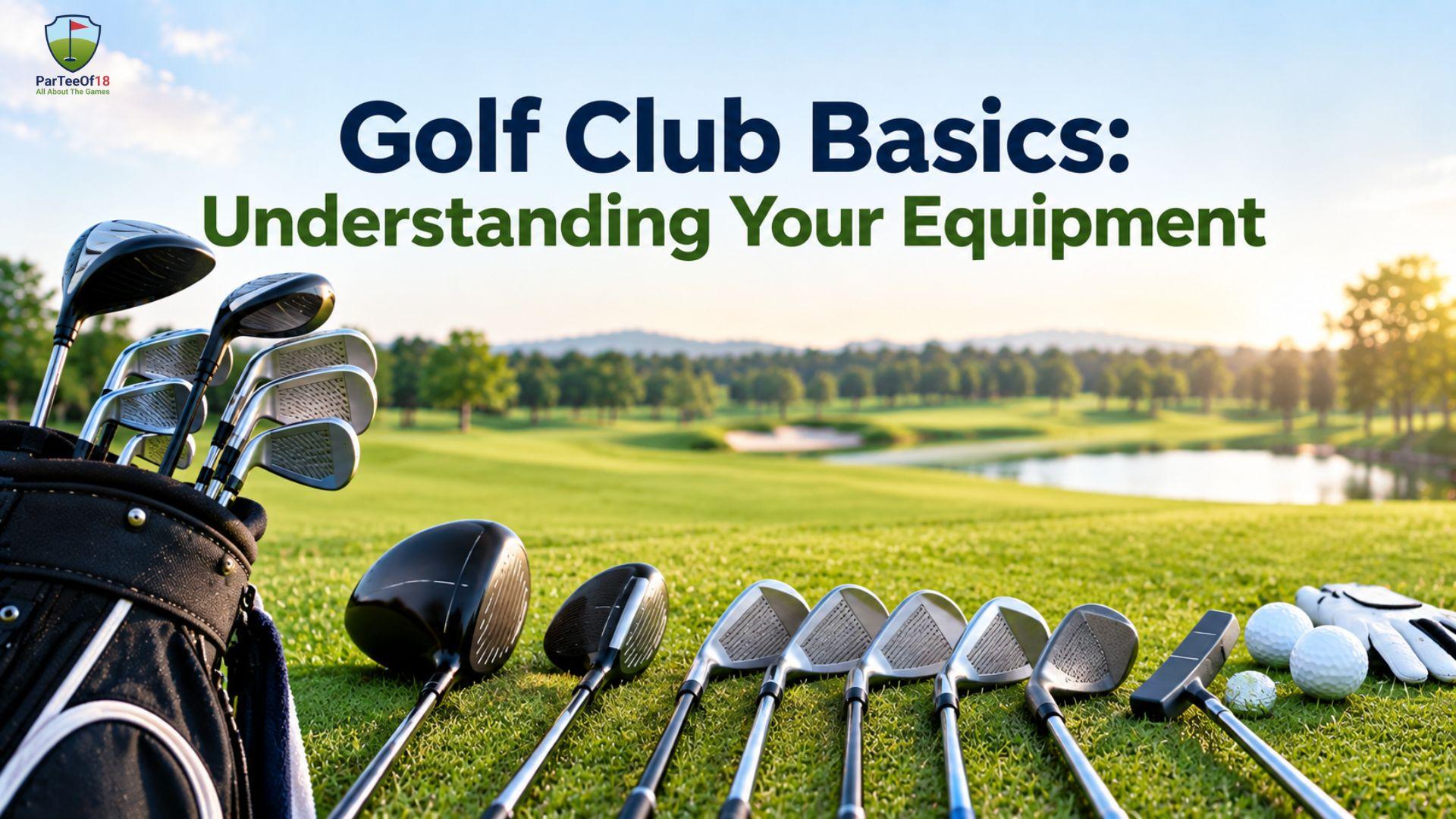
Picture a first-time golfer standing on the tee with a bag full of clubs and absolutely no idea which one to pull. Maybe a friend lent the set. Maybe it came from a garage sale. Either way, there are fourteen metal sticks in there, and they all look suspiciously alike.
Here is the good news. Golf equipment looks complicated, but it follows a simple logic. Once you understand what each club is built to do, the bag stops feeling like a puzzle and starts feeling like a toolkit. This guide walks you through the different types of golf clubs, every key part, and the terms you will hear at the pro shop, so you can play with a lot more confidence.
What Is in a Standard Golf Set?
Open any golf bag and you will find clubs that look similar but behave very differently. A standard set is built around distance and control. Longer clubs send the ball far, while shorter ones give you accuracy near the green. Think of it like a toolbox. You would not tighten a tiny screw with a sledgehammer, and golf works the same way. Each club has a job, and the sooner you learn those jobs, the sooner the game starts to make sense.
The 14 Club Rule
The rules of golf let you carry a maximum of 14 clubs in a round. Go over that number and you collect a penalty, even if you never touch the extra club. Most players use the full allowance to cover a wide range of distances.
Why a Smaller Set Works for Beginners?
Plenty of new golfers do just fine with seven or eight clubs. A driver, a hybrid, a few irons, a wedge, and a putter is plenty. Fewer choices mean fewer decisions, which lets you focus on building a repeatable swing.
The Main Types of Golf Clubs
Golf clubs fall into six broad families: drivers, fairway woods, hybrids, irons, wedges, and putters. Each family exists to solve a particular problem, whether that is launching the ball off the tee or rolling it into the cup from ten feet. Once you know what problem each club solves, picking one on the course gets much easier. Let us walk through them roughly in the order you would use them on a typical hole.
Drivers
The driver is your biggest club, built to send the ball the farthest from the tee. It has the largest head and the longest shaft in the bag. It is also the hardest to control, so do not be shy about leaving it in the bag on tight holes.
Fairway Woods
Fairway woods have smaller heads and more loft than a driver. A 3 wood can be hit from the tee or from the fairway, which makes it a handy backup when the driver is misbehaving. You give up a little distance and gain a lot of control.
Hybrids
Hybrids blend the forgiving head of a wood with the length of an iron. For most golfers they replace the dreaded long irons. If your old 4 iron has ever dug into the turf and gone nowhere, a hybrid will feel like a small miracle.
Irons
Irons are the workhorses of the bag, usually numbered 3 through 9. Lower numbers fly farther and lower, while higher numbers fly shorter and higher. They shine on approach shots into the green, and the gap between each iron is typically around 10 yards.
Wedges
Wedges handle the short game. You will usually see a pitching wedge, gap wedge, sand wedge, and lob wedge. They carry the most loft, so the ball climbs quickly and stops fast. Think of a shot that clears a bunker and lands softly by the flag.
Putters
The putter is the club you will use most. A typical round includes around 30 to 36 putts, often more than a third of your total score. Its flat face and short shaft are designed to roll the ball smoothly along the green.
The Anatomy of a Golf Club
Every club, no matter the type, has three main parts: the head, the shaft, and the grip. Small changes to any of them can change how the ball flies. That is why two clubs with the same number stamped on the sole can feel completely different in your hands. Knowing these parts also helps you make sense of product descriptions and understand why one club costs so much more than another.
The Clubhead
The clubhead is where the ball meets the club. Its shape, weight distribution, and face angle shape launch and spin. Cavity back irons, for example, push weight to the edges, so off-center hits fly straighter than they would with a thin blade.
The Shaft
Shafts come in steel or graphite, and in flexes such as regular, stiff, and senior. A shaft that is too stiff for your swing can leave shots weak and drifting right for a right handed player. Graphite is lighter, while steel tends to be more consistent.
The Grip
The grip is your only connection to the club, so it matters more than most people think. Worn, slick grips make you squeeze harder, which adds tension to your swing. If you play often, replace them about once a year and the club will feel new again.
Golf Club Specs Explained
Walk into a golf shop and you will hear terms like loft, lie angle, and bounce tossed around. They sound technical, but each one is simple. They describe angles on the clubhead, and those angles decide how the ball launches, how straight it travels, and how the club behaves when it meets turf or sand. A little knowledge here can save you from buying the wrong clubs.
Loft
Loft is the angle of the clubface relative to vertical. More loft means higher, shorter shots. A driver might sit around 10 degrees, while a sand wedge is closer to 56. That difference is why a wedge lifts the ball so quickly.
Lie Angle
Lie angle is the angle between the shaft and the ground when the sole sits flat. If it does not suit your height and posture, the face can point left or right at impact, even with a decent swing. A fitter can adjust it easily.
Bounce
Bounce is the angle on the sole of a wedge that keeps it from digging into the ground. More bounce helps in soft turf and fluffy sand. Less bounce suits firm, tight lies. Choose based on the courses you play most often.
How Far Does Each Club Hit?
Distance is the question every new golfer asks. The honest answer is that it depends on your swing speed, strike quality, and even the weather. Still, rough numbers help you plan. The list below shows ballpark carry distances for an average male amateur. Beginners and many women golfers will see shorter numbers, and that is perfectly normal. Treat the list as a starting point, because your own yardages matter far more than any chart.
-
Driver: 200 to 230 yards
-
3 wood: 180 to 210 yards
-
5 iron: 150 to 170 yards
-
7 iron: 130 to 150 yards
-
9 iron: 110 to 130 yards
-
Pitching wedge: 90 to 115 yards
-
Sand wedge: 70 to 90 yards
Build Your Own Yardage Chart
Take your clubs to the range with a rangefinder or a launch monitor app and hit ten balls with each. Toss out the best and worst, then average the rest. Write those numbers on a card and keep it in your bag.
A Real Course Example
Say you are 140 yards from the pin. The chart says a 7 iron flies 135 for you, and there is a bunker short of the green. You take the 6 iron instead. That small decision, backed by real numbers, can save a stroke.
How to Choose Clubs for Your Skill Level?
The best clubs are not the most expensive ones. They are the ones that suit the way you swing today. A beginner and a single digit handicapper want very different things from their equipment, and buying clubs built for the wrong player is one of the most common and costly errors in golf. Here is how to think about it at each stage.
For Beginners
Look for game improvement clubs with cavity backs and wide soles, because they forgive mishits. A used starter set is often a smart buy. You will learn what you like before spending serious money.
For Intermediate Players
Once you are breaking 90 with some regularity, you may want more feel and the ability to shape shots, without losing all your forgiveness. Mid handicap irons and a well-chosen set of wedges are a great upgrade.
For Advanced Players
Low handicappers often move to players cavity irons or blades. These offer better feedback and workability, though they punish bad swings. Many advanced golfers also carry several wedges with different lofts and bounces for precise short game control.
Why Club Fitting Is Worth Considering?
Off-the-rack clubs are made for an average golfer, and almost nobody is exactly average. A fitting adjusts clubs to your height, swing speed, and tendencies. You do not need to be good to benefit. In fact, beginners sometimes see the biggest jump, because a poorly matched club can quietly teach bad habits that take months to unlearn.
What a Fitter Measures
A fitting session is more straightforward than it sounds. The fitter watches you hit balls and tracks several numbers:
-
Swing speed
-
Launch angle and spin rate
-
Ball flight and dispersion
-
Shaft flex and length
-
Lie angle and grip size
Is It Worth the Cost
Many fittings cost little or nothing if you buy the clubs afterward. Even if you walk away with nothing, you will understand your swing better. For anyone planning to spend several hundred dollars, it is a smart first step.
How to Care for Your Golf Clubs?
Clubs do not need much, but a little attention goes a long way. Dirty grooves lose spin, and damp bags breed rust. Spending five minutes after each round keeps your equipment performing the way it should and helps it last for years. Here is a simple routine you can follow without thinking too hard about it.
-
Wipe the clubheads with a damp towel after every round.
-
Clean the grooves with a soft brush and warm soapy water.
-
Dry everything before returning clubs to the bag.
-
Use headcovers on woods and your putter.
-
Check grips for wear and replace them when they feel slick.
Common Equipment Mistakes to Avoid
Almost every golfer has made at least one of these. The trick is spotting them early, before they cost you money or strokes. A lot of mistakes come from chasing the latest gear instead of understanding what you actually need. Keep this short list in mind next time you are tempted by a shiny new set.
-
Buying blades too early because they look great
-
Ignoring shaft flex and just grabbing whatever is on sale
-
Carrying clubs that overlap in distance
-
Never replacing worn grips
-
Skipping a putter that suits your stroke
Conclusion
Understanding your golf equipment is one of the quickest ways to improve without changing your swing at all. When you know what each club does, how its parts work, and which specs fit your game, every shot becomes a more informed decision.
Start simple. Learn your yardages, keep your clubs clean, and consider a fitting when you are ready to upgrade. The next time you stand on the tee with that bag on your shoulder, you will know exactly what is inside it and why.
Frequently Asked Questions
1. How many golf clubs do I need to start playing?
You can start with as few as six or seven clubs. A driver or hybrid, a few irons, a wedge, and a putter will cover most situations. You can always add more once you learn your game.
2. What is the difference between a driver and a fairway wood?
A driver has a bigger head, a longer shaft, and less loft, so it goes farther but is harder to control. A fairway wood is smaller and more versatile, and you can hit it from the fairway as well as the tee.
3. What is the easiest golf club to hit for beginners?
Most beginners find hybrids and mid irons, like a 7 iron, the most forgiving. Their moderate length and loft make solid contact easier. The driver is usually the most difficult club to master.
4. What do golf club numbers mean?
Numbers show loft and distance. A lower number means less loft, a longer shot, and a lower flight. A higher number means more loft, a shorter shot, and a higher flight. A 5 iron flies farther than a 9 iron.
5. How often should I replace my golf clubs?
Clubs can last many years if you care for them. Grips usually need replacing about once a year for regular players. Most golfers upgrade clubs every five to ten years, or when their swing changes noticeably.
6. Do I really need a lob wedge?
Not necessarily. Many amateurs do fine with a pitching wedge, gap wedge, and sand wedge. A lob wedge helps with high, soft shots over hazards, but it takes practice to use well.

 English
 Arabic
 French
 Spanish
 Portuguese
 Deutsch
 Turkish
 Dutch
Dutch
 Russian
 Romaian
 Portuguese (Brazil)
 Greek
Greek