


Mobius Foundation ICSE 2026: 5 Big Takeaways From the Conference
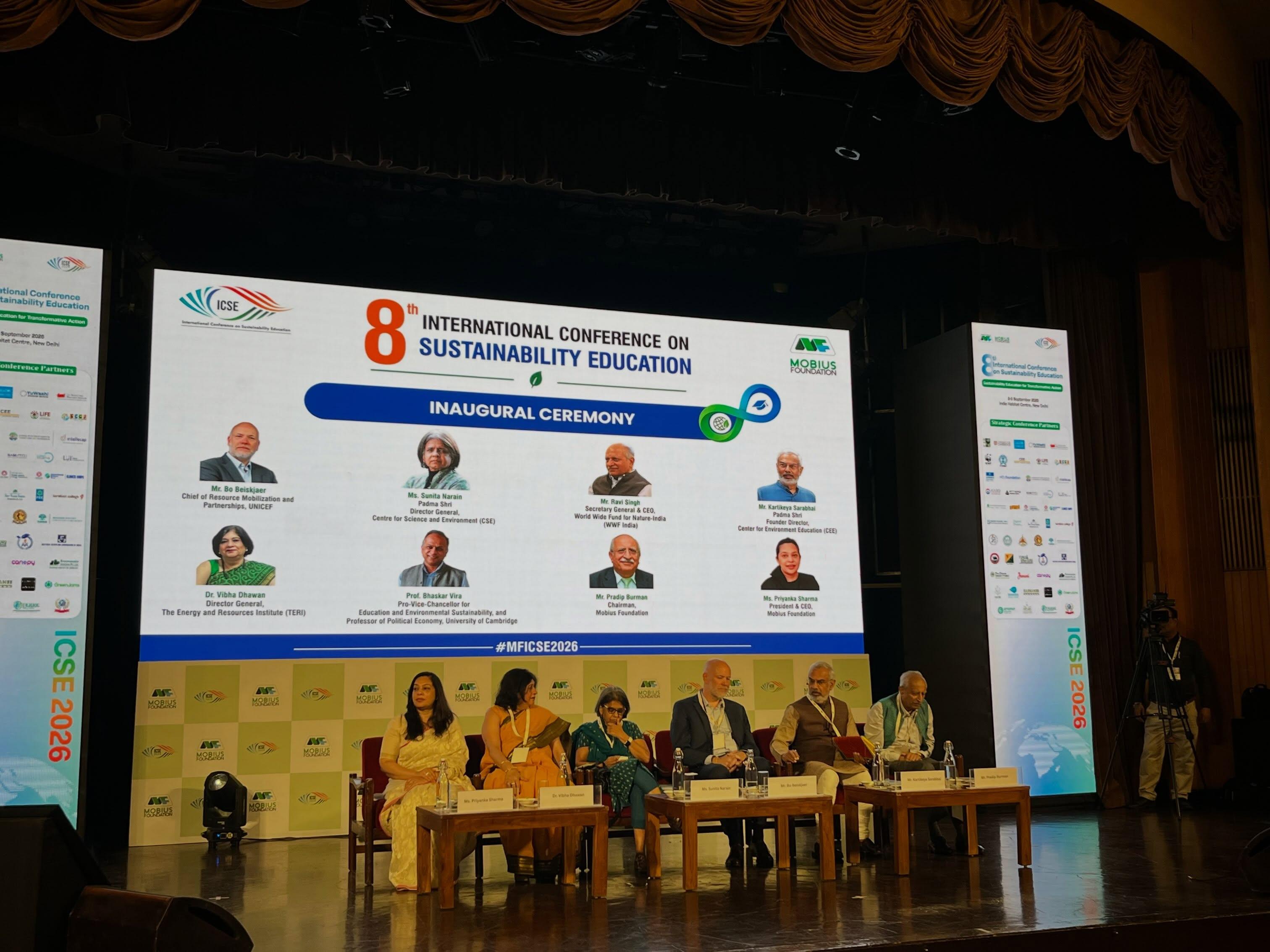
Mobius Foundation ICSE 2026 wrapped up in New Delhi this September after two packed days of debate on how education should respond to a fast moving climate crisis. The eighth International Conference on Sustainability Education, held at India Habitat Centre under the theme Sustainability Education for Transformative Action, drew educators, scientists, policymakers and students into direct conversation. Here are five takeaways that stood out.
1. Awareness Alone Is Not Enough Anymore
The clearest message from Mobius Foundation ICSE 2026 was that sustainability education has outgrown its old job of simply raising awareness. Pradip Burman, Chairman of Mobius Foundation, opened proceedings by noting India's real progress on clean energy, including crossing 290 gigawatts of renewable capacity ahead of its 2030 target. Even so, he pushed for ideas that become partnerships, and partnerships that become measurable commitments, rather than one off campaigns that fade once the headlines move on. This framing set the pace for the rest of Mobius Foundation ICSE 2026, with speaker after speaker returning to the same question: how does a good idea from a conference stage actually reach a classroom, a city budget, or a company policy?
2. Local Problems Deserve Local Solutions
Sunita Narain, Director General of the Centre for Science and Environment, delivered one of the conference's sharpest lines, describing Delhi's Yamuna river as effectively dead already. Her broader argument mattered more than the line itself. Decades of engineering around ecological limits, rather than respecting them, have produced this outcome. She argued that fixing Delhi's air requires stronger public transport, not simply swapping fuel types on private vehicles. Her comments served as a reminder that sustainability education cannot stay theoretical when the evidence sits just outside the conference hall, in the city's own rivers and streets.
3. Everyday Habits Shape Long-Term Outcomes
Vibha Dhawan, Director General of TERI, grounded the discussion in daily life. She noted how bottled water replaced refillable containers within a generation, and how costly school bus fares push families toward private cars, adding to congestion the buses were meant to reduce. Her remarks reflected a wider point echoed across Mobius Foundation ICSE 2026: sustainable choices need to be affordable and convenient by design, not left to individual willpower alone.
4. Classrooms Can Become Living Laboratories
Kartikeya Sarabhai, Founder Director of the Centre for Environment Education, offered one of the most practical ideas raised during the two days. He proposed that schools adopt a single square kilometre of land each, using it to study water use, waste and biodiversity directly, rather than relying only on textbooks. The idea drew directly from a long history of environmental education work in India, dating back to well before the 1977 Tbilisi Conference that first defined the field internationally. Several teachers in the audience said afterward that the model felt achievable precisely because it did not require new budgets, only a shift in how existing land and lessons get used.
5. Youth and Global Institutions Are Aligned on Urgency
International voices reinforced the scale of the challenge at Mobius Foundation ICSE 2026. Bo Beiskjaer of UNICEF noted that India is home to more than 470 million children, and that a majority face overlapping climate risks such as heatwaves and water scarcity. Bhaskar Vira of the University of Cambridge argued for education built around human stories rather than statistics alone, drawing on a documentary project made with Mobius Foundation. Ravi Singh of WWF-India closed this thread with a historical view, describing how sustainability has moved steadily from the margins of policy into mainstream industry strategy over the past fifteen years. He pointed out that many of today's corporate sustainability leaders first came across these ideas as schoolchildren, which he used as evidence that education invested in now can shape entire careers decades later.
What This Means Going Forward
Taken together, these five points sketch a working definition of what Mobius Foundation ICSE 2026 set out to achieve: education that changes systems, not just awareness levels. Several student delegates said afterward that they planned to pitch small, specific projects to their own schools, such as water audits or waste mapping exercises, rather than waiting for a bigger policy shift first. That willingness to start small, without waiting for perfect conditions, may end up being the most lasting takeaway from this year's conference.
The conference closed with a formal set of recommendations built from both days of discussion, intended to shape future policy and institutional action across schools, government and industry. Readers who want to track future editions of Mobius Foundation ICSE conferences can visit the Mobius Foundation homepage or explore the ICSE 2026 conference page directly for updates on speakers, sessions and registration. Taken as a whole, these five takeaways suggest the conference achieved something harder than inspiration alone: a set of ideas specific enough to actually act on.

 English
 Arabic
 French
 Spanish
 Portuguese
 Deutsch
 Turkish
 Italiano
 Russian
 Romaian
 Portuguese (Brazil)
 Greek
Greek