


ICSE 2026 Wrap-Up: What Sustainability Education for Transformative Action Really Means
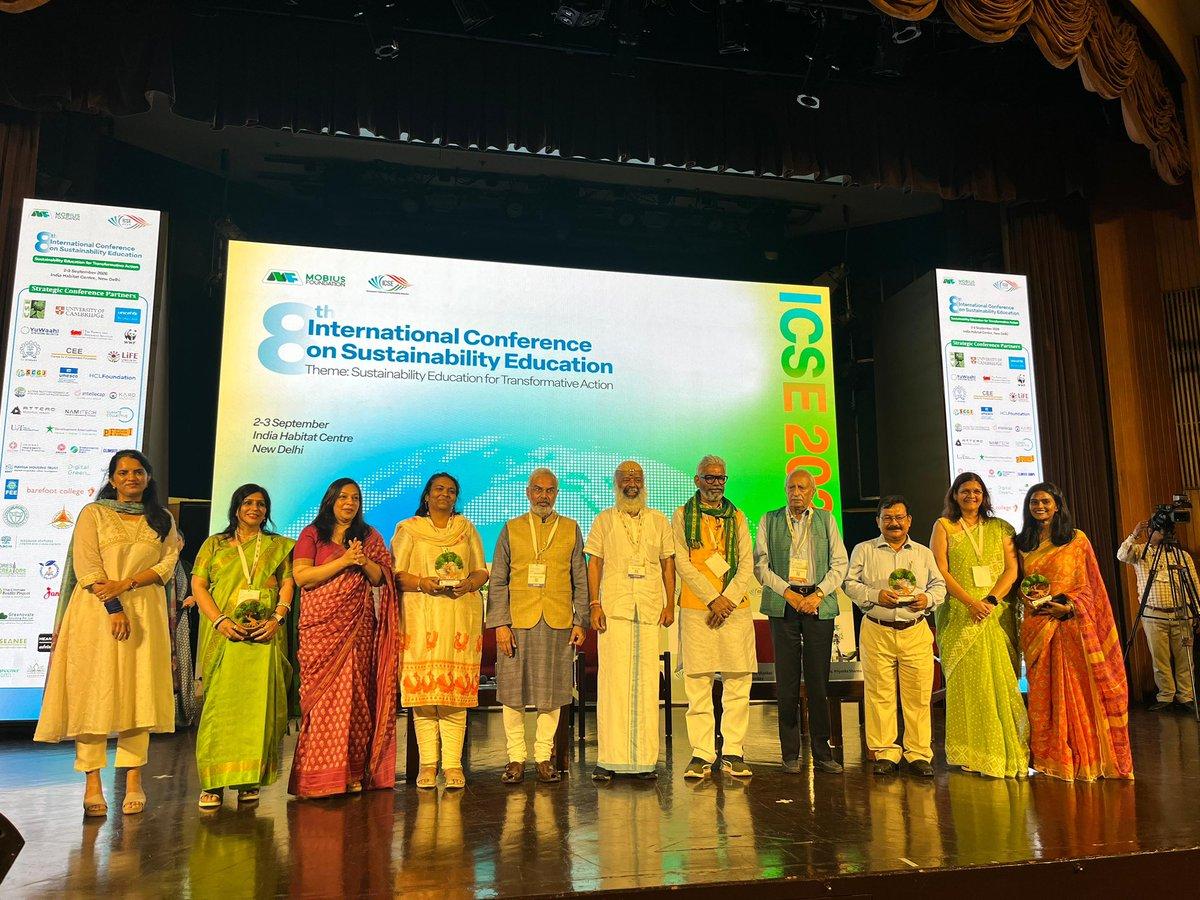
ICSE 2026 closed this September after two days of frank, sometimes uncomfortable conversation about how education should respond to a climate crisis that keeps arriving ahead of schedule. Mobius Foundation convened the eighth International Conference on Sustainability Education at India Habitat Centre, New Delhi, under the theme Sustainability Education for Transformative Action. By the end of the second day, that phrase had moved from a conference tagline to something closer to a working definition. Delegates left with fewer slogans and more specific, testable ideas to carry back into their own schools, cities and companies.
From Awareness to Action
For years, sustainability education has largely meant building awareness, teaching students what climate change is, why biodiversity matters, and how pollution affects health. ICSE 2026 pushed past that baseline. Pradip Burman, Chairman of Mobius Foundation, opened the conference by noting that India has made real progress on clean energy, crossing 290 gigawatts of renewable capacity well ahead of its 2030 target. However, he was clear that progress on paper still needs to become progress in practice, turning ideas into partnerships and partnerships into lasting commitments.
That shift from knowing to doing ran through nearly every session at ICSE 2026. Priyanka Sharma, President and CEO of Mobius Foundation, argued that sustainability can no longer live only in classrooms or conference halls. She connected it directly to green careers, entrepreneurship and the everyday decisions that shape a livable future.
Systems, Not Just Symptoms
Few speakers made the point as sharply as Sunita Narain of the Centre for Science and Environment. She described Delhi's Yamuna river as effectively dead already, arguing that the city keeps treating symptoms like poor air and dirty water instead of the systems producing them. She linked this pattern to a broader habit of engineering around ecological limits rather than respecting them, connecting it to recent flooding near the Nepal-Tibet border.
This systems-first thinking gives ICSE 2026 its sharper edge. Rather than asking students to memorise facts about climate change, speakers pushed for a model where learners question who benefits from a policy, who carries its risks, and which institutions need to change as a result. That kind of questioning is harder to teach than a fact sheet, but several speakers argued it is exactly what separates awareness campaigns from real transformative action.
A Shared Vocabulary Across Sectors
One quieter but important outcome of ICSE 2026 was how quickly educators, government officials and industry leaders found a shared vocabulary. Terms like green skills, climate resilience and circular economy moved between sessions without needing constant translation, suggesting these ideas have finally settled into everyday planning language rather than staying confined to specialist circles.
Everyday Habits Under the Microscope
Vibha Dhawan, Director General of TERI, brought the conversation down to daily choices. She pointed out how quickly bottled water replaced refillable containers within a single generation, and how costly school bus fares nudge families toward private cars, adding to the very traffic those buses exist to reduce. Her remarks reinforced a theme that recurred throughout ICSE 2026: sustainable choices need to be convenient and affordable, not treated as a personal sacrifice.
Kartikeya Sarabhai, Founder Director of the Centre for Environment Education, offered one of the most concrete classroom ideas of the conference. He suggested schools adopt one square kilometre of land each, using it as a live learning site to study water use, waste and biodiversity directly rather than through textbooks alone.
A Global Lens on a Local Crisis
International voices added scale to the discussion. Bo Beiskjaer of UNICEF noted that more than 470 million children live in India, and that a majority face overlapping climate risks including heatwaves and water shortages. Bhaskar Vira of the University of Cambridge argued that education moves people faster through human stories than through statistics, drawing on a documentary series he worked on with Mobius Foundation.
Ravi Singh of WWF-India closed the arc with a historical view, tracing environmental education in India back over five decades and describing how sustainability has steadily shifted from a niche concern into mainstream industry strategy. He noted that many professionals now leading corporate sustainability teams first encountered these ideas as students in school programs decades earlier, which he offered as proof that education investments made today can shape entire careers later.

 English
 Arabic
 Spanish
 Portuguese
 Deutsch
 Turkish
 Dutch
Dutch
 Italiano
 Russian
 Romaian
 Portuguese (Brazil)
 Greek
Greek