


Creating More Effective Nonprofit Videos: Mistakes That Can Weaken Your Message
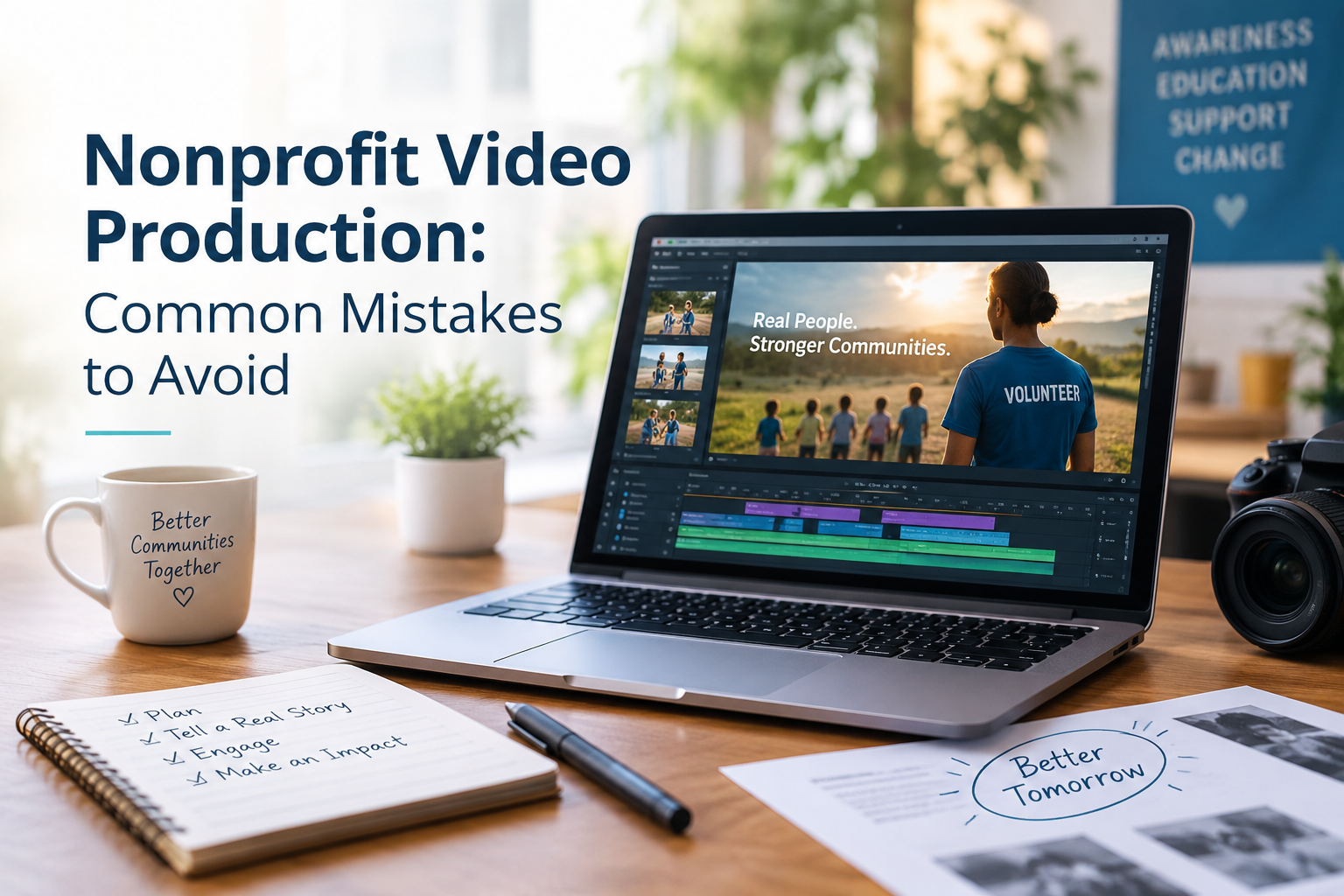
For nonprofit organizations, video can be one of the most effective ways to communicate a mission, explain an issue, connect with supporters, and encourage action. A strong video can turn a complicated subject into an understandable story while giving audiences an emotional reason to care.
However, creating a nonprofit video is not simply about putting information on screen. Organizations can have important stories to tell, but poor planning, excessive information, weak storytelling, or an unclear call to action can prevent the finished video from making the desired impact.
Understanding the most common mistakes can help nonprofit teams create content that feels authentic, communicates clearly, and connects with the people they want to reach.
1. Trying to Explain Everything in One Video
Nonprofits often have multiple programs, services, achievements, statistics, and goals they want audiences to understand. Including all of them in a single video can make the message difficult to follow.
A better approach is to establish one central objective.
Before production begins, the organization should be able to answer:
- What should viewers understand?
- Who is the video intended for?
- What should viewers feel?
- What action should they take afterward?
A fundraising video may focus on encouraging donations, while an awareness campaign might concentrate on explaining a social issue. An educational animation may have the goal of helping viewers understand a complex topic.
Keeping one primary message gives the video a stronger narrative structure.
2. Focusing on the Organization Instead of the Audience
Another common mistake is creating a video that talks extensively about the nonprofit rather than addressing what matters to its audience.
A nonprofit may want to explain its history, leadership, programs, and accomplishments. While this information can be useful, viewers are generally more interested in understanding the issue, the people affected, and how they can make a difference.
Instead of beginning with a long organizational introduction, consider starting with the problem or human story.
For example, an environmental organization could introduce the impact of a particular environmental challenge before explaining how its programs address it. This creates context and gives the audience a reason to continue watching.
3. Relying Too Heavily on Statistics
Statistics can establish credibility, but a video filled with numbers can quickly become difficult to absorb.
A better strategy is to use data as supporting evidence rather than the entire story.
A powerful nonprofit video can combine:
- Personal stories
- Visual examples
- Short statistics
- Interviews
- Animation
- Real-world footage
- Narration
- Clear explanations
Visual storytelling can be particularly useful when the subject involves information that is difficult to demonstrate through conventional footage. Hatch Studios, for example, develops nonprofit and NGO animation content for areas including public awareness, education, and outreach.
4. Using an Unclear Story Structure
Even a beautifully produced video can lose viewers if the story does not have a logical progression.
A simple structure can help:
Problem → Human impact → Solution → Result → Action
This structure gives the audience a reason to care before introducing the organization's solution.
For example, an organization working to improve access to education might first introduce the challenge students face, show how it affects individuals and communities, explain the organization's approach, and then demonstrate what support makes possible.
The structure does not have to be complicated. It simply needs to guide the viewer from one idea to the next.
5. Making the Video Too Long
Nonprofit organizations sometimes try to include every important detail because the subject is meaningful. Unfortunately, length does not necessarily create a stronger message.
A focused video can often communicate more effectively than a longer production containing unnecessary information.
The ideal length depends on the purpose and platform. A short social media video may need a different structure from an educational presentation or campaign film.
Animation projects, for example, are influenced by several production factors, including length, complexity, and visual technique. Hatch Studios notes that a typical one- to two-minute explainer or marketing video can take around four to six weeks to produce, depending on those factors.
This makes it useful to establish the required duration before developing the full script.
6. Choosing the Wrong Visual Style
Visual style should support the subject rather than simply follow a trend.
Different nonprofit messages can benefit from different approaches. A serious public-awareness campaign may require a more restrained visual treatment, while a youth-focused educational project could benefit from colorful 2D animation.
Some projects may work well with:
- 2D animation
- 3D animation
- Motion graphics
- Live-action footage
- Explainer videos
- A combination of animation and live action
Hatch Studios offers 2D animation, 3D animation, motion graphics, explainer videos, and other production capabilities, allowing the visual approach to be selected around the project's communication goals.
The important point is that the style should serve the story.
7. Forgetting About Emotional Connection
Nonprofit communication often involves subjects that are deeply personal. A video that communicates facts without creating an emotional connection may be informative but forgettable.
This does not mean every nonprofit video needs to be dramatic. Authenticity is usually more important than exaggeration.
A genuine personal story, thoughtful narration, or carefully chosen visual sequence can help audiences understand why an issue matters.
The strongest emotional moments often come from showing real consequences rather than simply telling viewers that something is important.
8. Writing the Script Without Thinking About Visuals
A nonprofit video script should not be treated like a blog post that will simply be read aloud.
Video is a visual medium, so every section of the script should provide opportunities for meaningful visuals.
Instead of writing:
"Our organization helps communities access better educational opportunities."
The production team can think about what the audience should actually see while that statement is being communicated.
Possible visuals could include animated diagrams, photographs, real-world footage, illustrations, or a visual representation of the organization's work.
This approach creates stronger alignment between narration and visuals.
9. Leaving the Call to Action Until the Last Second
A nonprofit video should give viewers a clear next step.
Depending on the objective, that action could be:
- Donate
- Volunteer
- Register
- Share the campaign
- Visit a website
- Attend an event
- Sign up for updates
- Learn more
- Contact the organization
The call to action should feel like a natural continuation of the story rather than an unrelated message suddenly appearing at the end.
A video designed to raise awareness, for example, might encourage viewers to learn more before asking them to donate. A fundraising campaign may have a much more direct donation request.
10. Treating Production as a One-Time Task
A nonprofit video can have value long after its initial launch.
Instead of creating one version and using it in only one location, organizations can consider how the production can be adapted for different platforms.
A longer campaign video might produce shorter clips for social media. Key statistics could become motion graphics. Individual sections could potentially be repurposed for presentations, websites, fundraising campaigns, or educational materials.
Thinking about content reuse during the planning stage can increase the long-term value of the production.
11. Not Planning for Accessibility
A video intended for a broad audience should be designed with accessibility in mind.
Depending on the platform and audience, organizations may need:
- Captions
- Accurate transcripts
- Clear narration
- Readable on-screen text
- Appropriate contrast
- Accessible visual pacing
Accessibility should not be treated as an afterthought. It can help more people understand and engage with the organization's message.
12. Choosing Production Quality Over Story,or Story Over Quality
There is a balance between storytelling and production quality.
A visually impressive video with a weak message will not necessarily achieve its communication goals. At the same time, a compelling idea can lose impact if poor audio, confusing visuals, or inconsistent animation makes the content difficult to watch.
Professional production should strengthen the story rather than distract from it.
Experienced studios can help organizations develop the concept, script, visual direction, animation, sound, and final delivery as parts of one process. Hatch Studios, for instance, works across conceptualization, script writing, design, animation, and post-production rather than treating these stages as completely separate tasks.
Making the Most of Nonprofit Video Production
The best nonprofit videos begin with clarity. Organizations should know their audience, establish one central message, select an appropriate visual style, and decide what action viewers should take.
From there, production becomes a process of translating that message into visuals and sound.
Organizations looking for professional nonprofit video production can also benefit from working with a studio that understands how animation and visual storytelling can communicate complex social, educational, and awareness-based subjects. Hatch Studios has experience creating animated content for nonprofit organizations and has worked across areas such as outreach, public service messaging, education, and awareness campaigns.
Final Thoughts
Nonprofit video has the potential to educate, inspire, and motivate audiences, but achieving those results requires more than attractive visuals. A successful production needs a clear message, purposeful storytelling, appropriate pacing, strong visuals, and a meaningful call to action.
Avoiding common mistakes such as information overload, weak structure, excessive length, unclear messaging, and poor audience targeting can make the final video significantly more effective.
When every production decision supports the organization's core message, video becomes more than promotional content,it becomes a useful communication tool capable of helping people understand an issue and encouraging them to take meaningful action.

 English
 Arabic
 French
 Spanish
 Portuguese
 Deutsch
 Turkish
 Dutch
Dutch
 Russian
 Romaian
 Portuguese (Brazil)
 Greek
Greek