


How to Prune Madhumalti Plant for Better Growth and Flowering
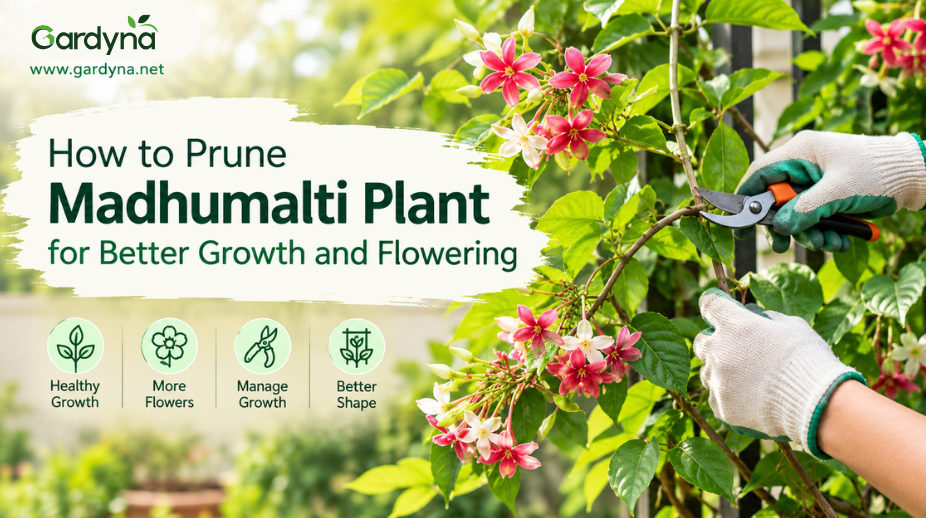
The Madhumalti plant, a popular flowering climber, boasts beautiful foliage, vigorous growth, and an abundance of sweet-smelling flowers. With the right pruning, one can ensure the healthy growth of a Madhumalti climber, promote the development of new shoots, and yield more Madhumalti flowers over time.
Meanwhile, regular trimming helps one to manage an overgrown Madhumalti bel and allows it to occupy space beautifully in garden beds, on terraces, against walls, and on trellises.
Why Is Pruning Important for Madhumalti?
Pruning encourages the removal of weak, diseased, dry, and overcrowded shoots to allow the plant to direct energy to develop strong new growth, enhancing air circulation while letting more sunlight penetrate through the leaves and stems.
For aged Madhumalti climbers that have stopped blooming, one could promote branching to encourage more Madhumalti blossoms. In addition, pruning also helps control the rampant growth of a Madhumalti creeper.
When is the best time to prune a Madhumalti plant?
Depending on the plant’s growth pattern, basic pruning can be done anytime healthy young growth emerges. In other words, one should regularly cut off dead, diseased, or damaged shoots during the growing season.
However, one should heavily prune the Madhumalti plant just after a flowering cycle when new growth emerges to control flowering. Severe pruning of stemmed shoots should be avoided in the months leading up to flowering, as it would impede the development of future Madhumalti blooms.
How does one prune a Madhumalti plant?
1.Remove diseased, dead, and damaged branches.
Using sharp, cleaned gardening shears, cutting tools, or knives, remove unsuitable stems from the Madhumalti bel. Diseased, dry, and dead growth detracts energy from healthy plant parts; hence, their removal promotes overall plant health.
2. Tidy up long, rampant stems.
To manage a rampant and overgrown madumalti creeper, one could regularly cut old, excessively long stems. It is best to prune conservatively and gradually to avoid harming a healthy and vigorously growing madumalti bel.
3. Remove crowded shoots to free space and allow better ventilation.
To allow free movement of air inside the plant, cut away some of the closely packed stems during pruning. Better airflow promotes healthy plant growth.
4. Promote branching by cutting back to healthy buds.
To encourage new branch growth, one can cut back a few stems near their healthy buds. Multiple lateral stems promote prolific flowering by providing more blossom sites for future Madhumalti blooms.
5. Train healthy stems
After pruning, one can train the healthy stems of a Madhumalti bel into a structure by tying them to a peg, post, trellis, or other suitable supports. This method guides future growth and improves the plant’s appearance by enhancing desirable plant coverage along a desired wall, fence, or piazza.
How Pruning Helps Madhumalti Flowers
While pruning itself does not directly contribute to increased blooms, a well-pruned plant produces more flowers due to enhanced growth and the provision of sufficient blossoming sites. In addition, healthier plants with good air circulation and sunlight are more likely to yield more showy Madhumalti blossoms.
Sunlight, water, fertilizer, and air circulation significantly impact the overall growth and blooming capacity of a Madhumalti plant. Therefore, in addition to regular pruning, one should provide the plant with adequate light, moisture, and nutrients while minimizing stressors like extreme temperatures.
Healthy plants with sufficient nourishment and sunlight develop strong growth, ensuring prolific blossoms in subsequent seasons.
Common Pruning Mistakes to Avoid
While pruning, it is advisable to avoid heavily trimming a vigorous and healthy Madhumalti climber. Such plants have sufficient energy to recover from extensive pruning. However, severe pruning might harm a plant’s future flowering cycle, limiting blossom sites. In addition, dirty and unclean tools can damage plant tissues and spread pathogens; hence, one should always utilize clean, sharpened pruning instruments.
While pruning, one should avoid indiscriminately and blindly removing healthy growth. Some plants require selective and occasional trimming to promote fruitful flowering. In addition, plants benefit from frequent pruning to allow continuous blooming.
Final thoughts
Pruning encourages the production of healthy plant parts while removing diseased and dead growth that attracts pests and diseases. In addition, it also helps control rampant growth, allowing more sunshine and air circulation into the plant’s core.
To boost bloom production, encourage new shoots, and ensure overall plant health, one should routinely remove dead, diseased, and overcrowded plant parts while managing vigorous growth and training stems on a trellis.
Following these cultural methods for caring for a madumalti creeper will yield spectacular Madhumalti blossoms for years.
If you want to read more about such articles, consider visiting Gardyna.net

 English
 Arabic
 French
 Spanish
 Portuguese
 Deutsch
 Turkish
 Dutch
Dutch
 Russian
 Romaian
 Portuguese (Brazil)
 Greek
Greek