


Activewear Market Growth Reflects the New Connection Between Sport and Style
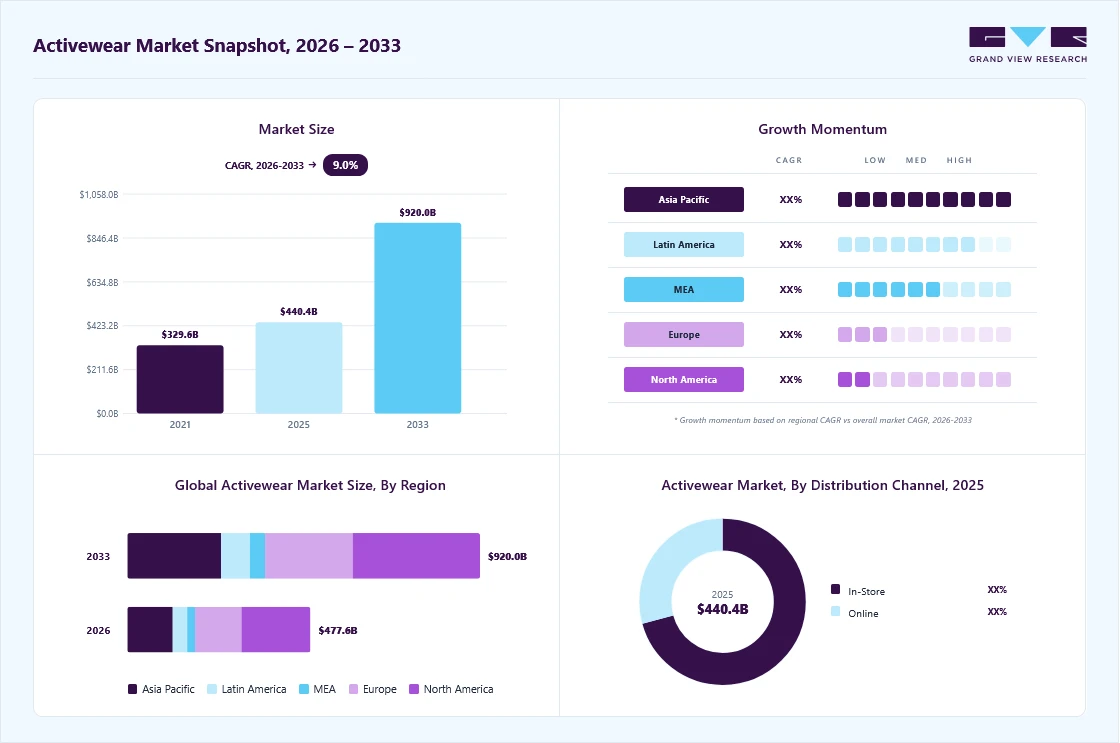
The activewear market was valued at USD 440.4 billion in 2025 and is estimated to reach USD 477.6 billion in 2026, before expanding to USD 920.0 billion by 2033, registering a 9.0% CAGR from 2026 to 2033. Rising health consciousness, increased participation in fitness activities, and the growing acceptance of activewear as everyday clothing are supporting this expansion.
When Workout Clothing Becomes Everyday Fashion
The modern activewear consumer is no longer purchasing clothing exclusively for exercise. Millennials and Gen Z increasingly associate activewear with health, wellness, convenience, and lifestyle identity. The popularity of athleisure has made products such as leggings, joggers, cropped tops, sweatshirts, and coordinated sets suitable for activities extending well beyond the gym.
This convergence of fashion and functionality is reshaping purchasing decisions. Consumers expect garments to provide comfort and durability while also fitting contemporary aesthetics. Social media, celebrity endorsements, wellness campaigns, and hybrid lifestyles are reinforcing activewear's position as a core wardrobe category rather than a niche sports purchase.
Women Remain at the Center of Demand
Women accounted for 47.9% of revenue in 2025, making the segment a particularly important contributor to market growth. Greater participation in running, cycling, gym workouts, yoga, and other fitness activities is increasing demand for apparel that combines performance with comfort.
Product development is responding to very specific consumer expectations. Research cited on the GVR page found that 92% of surveyed female respondents aged 16 to 24 reported difficulty focusing on workouts because of uncomfortable apparel. Other concerns included interruptions to adjust leggings and skin irritation from tight-fitting garments. These challenges are encouraging brands to focus on four-way stretch materials, customizable fits, improved support, airflow management, and more ergonomic construction.
The men's segment is also expanding rapidly, with a projected 9.6% CAGR from 2026 to 2033. Greater participation in outdoor activities and increasing adoption of activewear as everyday clothing are broadening men's demand.
Performance Technology Is Raising the Bar
Today's activewear is increasingly defined by what the fabric can do. Moisture-wicking textiles, temperature regulation, stretch recovery, breathability, and cooling technologies are becoming important differentiators. Brands are incorporating technologies designed to help wearers remain comfortable during exercise while maintaining flexibility and performance.
This emphasis on functionality is also influencing product innovation. For instance, Arctic Cool offers men's activewear featuring HydroFreeze X for cooling, along with UPF 50 protection, four-way stretch, antimicrobial properties, and activewick technology. Such developments demonstrate how technical functionality can become part of the product's value proposition.
Sustainability Is Becoming a Product Requirement
Environmental considerations are increasingly influencing activewear development. Consumers are looking for greater transparency and ethical sourcing, while brands are exploring recycled polyester, organic cotton, biodegradable materials, and circular approaches to apparel production. Durability, reusability, recyclability, and supply-chain efficiency are becoming important elements of competitive positioning.
Recent launches illustrate this direction. In May 2025, PANGAIA introduced a plant-based activewear collection using bio-based fibers derived from renewable sources while maintaining stretch, breathability, and comfort. The development highlights how sustainability and performance are increasingly being addressed through the same product.
Retail Still Matters Even in a Digital Shopping Era
Although online shopping is growing quickly, physical retail remains the dominant purchasing route. In-store sales represented 70.9% of revenue in 2025. Consumers continue to value the opportunity to test fit, assess material quality, compare products, and receive assistance from knowledgeable retail staff.
At the same time, online sales are expected to expand at a 10.5% CAGR from 2026 to 2033. Convenience, product variety, return policies, cash-on-delivery options, and centralized customer services are supporting this growth. The coexistence of physical and digital channels means brands increasingly need to provide a consistent experience across both environments.
Regional Growth Is Becoming More Broad-Based
North America remained the largest regional market, accounting for 38.1% of revenue in 2025. The region benefits from strong health and wellness awareness, widespread fitness participation, and the established presence of major brands such as Nike, Adidas, and Under Armour.
Asia Pacific, however, is the fastest-growing regional market, with a projected 10.9% CAGR from 2026 to 2033. Rising participation in fitness and sports, expanding athleisure adoption, and growing interest in practical yet fashionable apparel are creating new opportunities. India is expected to grow at an 11.8% CAGR over the same period, supported by its young population, expanding fitness culture, mobile-led e-commerce, and increasing adoption of activewear for casual use.
Europe accounted for 25.50% of global revenue in 2025, with consumers placing considerable emphasis on durability, comfort, sustainability, and longer product life. Germany is projected to record a 10.1% CAGR from 2026 to 2033, supported by sports participation and demand for sustainable apparel.
The Activewear Opportunity Is Becoming a Lifestyle Story
The projected rise to USD 920.0 billion by 2033 reflects more than increased spending on gym clothing. Activewear is increasingly positioned at the intersection of fitness, fashion, convenience, technology, sustainability, and personal expression. As consumers continue to prioritize active lifestyles, brands that can combine technical performance with everyday versatility are positioned to capture a broader share of this expanding market.
Key Activewear Companies:
· Adidas AG
· Nike Inc.
· PUMA SE
· The Columbia Sportswear Company
· VF Corporation
· PVH Corp.
· ASICS Corporation
· Skechers U.S.A., Inc.
· Under Armour, Inc.
· Hanesbrands Inc.
About us:
Grand View Research, a market research and consulting company, provides syndicated research reports, customized research reports, and consulting services. Grand View Research database is used by the world's renowned academic institutions and Fortune 500 companies to understand the global and regional business environment. Our database features thousands of statistics and in-depth analysis on 46 industries in 25 major countries worldwide.

 English
 Arabic
 French
 Spanish
 Portuguese
 Turkish
 Dutch
Dutch
 Italiano
 Russian
 Romaian
 Portuguese (Brazil)
 Greek
Greek