


Why Gold Continues to Matter in the Luxury Jewelry Market
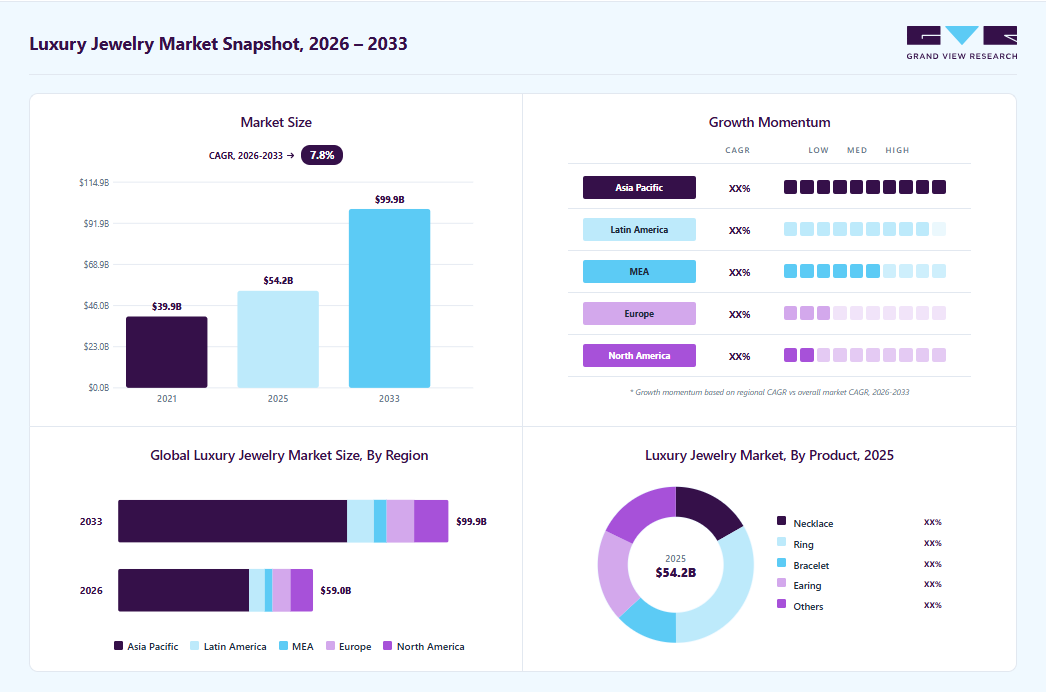
This evolving perception is supporting the expansion of the luxury jewelry market, which was valued at USD 54.2 billion in 2025 and is projected to reach USD 99.9 billion by 2033, registering a 7.8% CAGR from 2026 to 2033.
Changing Consumer Preferences Strengthen Market Opportunities
Luxury jewelry purchasing is increasingly influenced by changing lifestyles, rising disposable incomes, and growing interest in premium products. Consumers are looking beyond conventional designs and showing stronger interest in pieces that reflect individuality, personality, and personal milestones. Self-purchase is also becoming an important part of luxury consumption as buyers increasingly acquire jewelry as a reward for personal achievements or as an expression of their identity.
The emphasis on quality and exclusivity is encouraging jewelry brands to focus on craftsmanship, premium materials, customized designs, and distinctive collections. Consumers are also paying greater attention to authenticity, provenance, certified diamonds, traceable gemstones, and responsibly sourced precious metals. These preferences are encouraging brands to combine traditional craftsmanship with contemporary design concepts.
Rings Continue to Hold a Major Position
Rings remained the largest product segment, accounting for 33.2% of revenue in 2025. Their importance is closely associated with engagements, weddings, anniversaries, celebrations, and other significant personal occasions. At the same time, demand is extending beyond traditional gifting as consumers increasingly purchase rings for personal styling and self-expression.
Customization is further strengthening opportunities within the segment. Bespoke creations, rare stones, distinctive settings, and made-to-order designs allow consumers to seek pieces that offer greater individuality. These factors are helping rings maintain their strong position within the luxury jewelry landscape.
Necklaces are also expected to experience notable expansion, with the segment projected to grow at a 7.9% CAGR from 2026 to 2033. Statement necklaces, delicate chains, customized pendants, and layered jewelry are contributing to changing consumer preferences. Adjustable and modular designs are also creating opportunities for consumers to personalize their appearance across different occasions.
Gold Retains Its Importance While Platinum Gains Attention
Gold accounted for 33.1% of revenue in 2025, maintaining its importance as a preferred material in luxury jewelry. Its established cultural relevance, timeless appeal, versatility, and perceived value continue to support demand across different types of jewelry.
Platinum is also gaining momentum and is projected to register an 8.5% CAGR from 2026 to 2033. Its application in high-value diamond jewelry, rare colored gemstones, bridal pieces, and bespoke creations supports its growing role within the premium jewelry category.
Technology Is Reshaping the Luxury Buying Journey
Technology is becoming increasingly connected with luxury jewelry retail. Digital design tools, customization technologies, virtual consultations, online product visualization, and omnichannel services are helping brands create more interactive purchasing experiences.
The online channel is projected to register the fastest growth, expanding at a 8.3% CAGR from 2026 to 2033. High-resolution product imagery, virtual try-ons, digital customization, certification information, and online consultations are helping customers evaluate luxury pieces remotely. These capabilities are particularly important as consumers become more comfortable researching and purchasing premium products through digital platforms.
However, physical stores continue to play an important role. Offline channels accounted for approximately 74.4% of global revenue in 2025. Luxury boutiques allow consumers to physically evaluate craftsmanship, gemstone quality, finishing, weight, and overall design. Personalized consultations, private appointments, premium services, and brand storytelling further reinforce the importance of physical retail.
Women's Demand Remains Strong as Men's Jewelry Expands
Female consumers accounted for approximately 67.1% of revenue in 2025, making women the largest application segment. Demand includes bridal jewelry, diamond rings, gold and platinum pieces, designer earrings, and everyday luxury accessories.
The market is also witnessing growing interest in men's jewelry. The male application segment is projected to record the fastest CAGR of 8.2% from 2026 to 2033. Rings, chains, bracelets, signet jewelry, and diamond-accented pieces are gaining attention as men increasingly use jewelry for personal styling, status, individuality, and self-expression.
Regional Consumption Patterns Create New Opportunities
Asia Pacific held the largest regional revenue share at 66.87% in 2025. Economic development, rising disposable incomes, urbanization, and growing interest in premium lifestyle products are contributing to market expansion. Cultural traditions associated with weddings, festivals, family celebrations, gold ownership, and gifting also support demand for luxury jewelry.
Europe is projected to grow at a 6.4% CAGR from 2026 to 2033, supported by craftsmanship, design heritage, fashion influence, artisanal production, and premium brand positioning. Central & South America is projected to expand at 8.0%, while the Middle East & Africa market is expected to register a 7.3% CAGR during the same period.
FAQ
How big is the luxury jewelry market?
The luxury jewelry market was valued at USD 54.2 billion in 2025 and is estimated to reach USD 59.0 billion in 2026, before reaching USD 99.9 billion by 2033.
What trends are shaping the luxury jewelry market?
The market is being shaped by personalization, bespoke jewelry, digital shopping experiences, virtual consultations, ethical sourcing, premium craftsmanship, growing men's jewelry demand, and increasing self-purchase among consumers.
Key Luxury Jewelry Companies:
· Guccio Gucci S.p.A.
· The Swatch Group Ltd
· Compagnie Financière Richemont SA
· T&CO.
· GRAFF
· LOUIS VUITTON
· Signet Jewelers.
· Chopard
· MIKIMOTO
· Pandora
About us:
Grand View Research, a market research and consulting company, provides syndicated research reports, customized research reports, and consulting services. Grand View Research database is used by the world's renowned academic institutions and Fortune 500 companies to understand the global and regional business environment. Our database features thousands of statistics and in-depth analysis on 46 industries in 25 major countries worldwide.

 English
 Arabic
 French
 Spanish
 Portuguese
 Deutsch
 Turkish
 Dutch
Dutch
 Italiano
 Russian
 Romaian
 Greek
Greek