


Musical Instrument Demand Expands With Rising Participation in Music Education
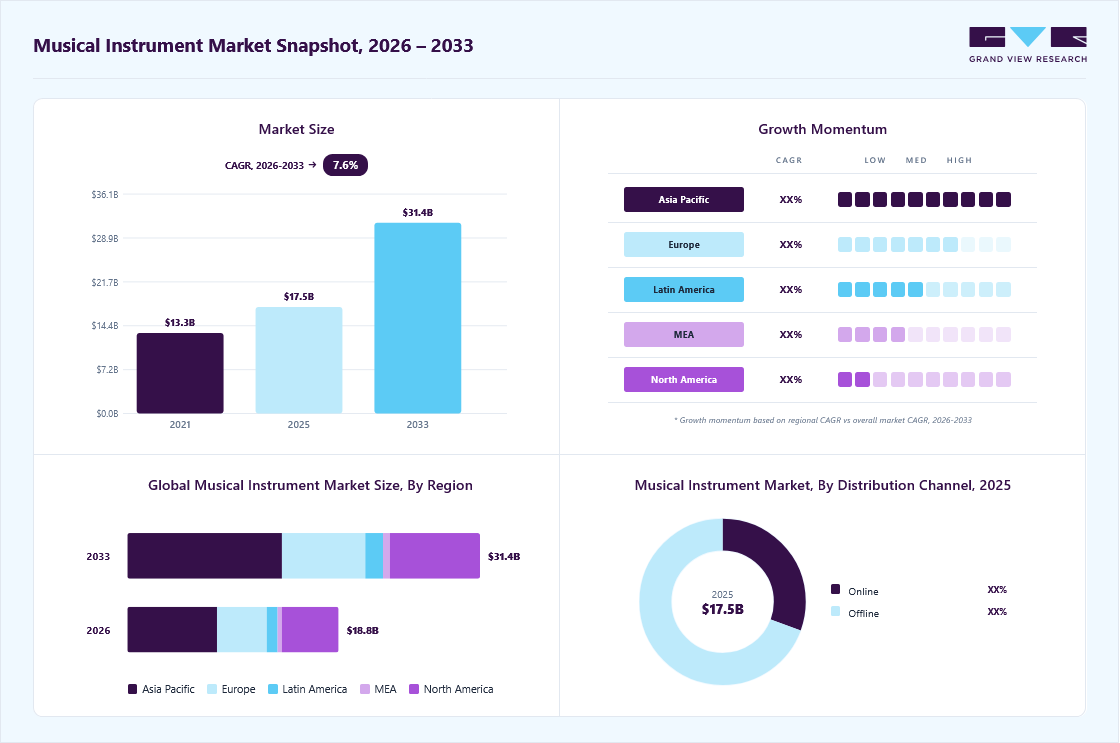
The musical instrument market was valued at USD 17.5 billion in 2025 and is projected to grow from USD 18.8 billion in 2026 to USD 31.4 billion by 2033, registering a 7.6% CAGR from 2026 to 2033.
Purpose-Driven Music Participation Supports Market Expansion
Consumers across age groups are increasingly investing in musical instruments for structured learning, performance, creative expression, and emotional well-being. Formal music education, private tutoring, self-guided practice, and online learning platforms are helping transform instruments from occasional purchases into long-term learning assets.
Entry-level instruments continue to attract first-time buyers, while consumers who progress through different levels of musical ability increasingly seek products that offer better sound quality, durability, craftsmanship, and long-term playability. Parents and adult learners are particularly influenced by the availability of instructional support and the ability of an instrument to accommodate different stages of skill development.
The popularity of traditional and culturally significant instruments also contributes to demand. Instruments associated with classical and regional music benefit from established training systems, certification programs, cultural institutions, and performance-based learning.
Stringed Instruments Maintain a Strong Market Position
Stringed instruments accounted for the largest type segment, representing 64.9% of revenue in 2025. Guitars, violins, basses, and other stringed instruments continue to attract beginners and experienced musicians because they can be used across multiple genres and levels of expertise.
Their broad availability of learning resources further supports adoption. Formal classes, private instruction, online tutorials, and hybrid learning platforms provide musicians with multiple ways to develop their skills. The expressive range and immediate tonal feedback offered by stringed instruments also encourage continued practice and experimentation.
Percussion instruments are gaining additional momentum and are projected to record a 7.6% CAGR from 2026 to 2033. Acoustic drum kits, hand percussion, electronic drums, and hybrid systems are increasingly used across live performances, studio recording, contemporary music, and independent music creation.
Digital Content Is Changing How Instruments Are Discovered
Technology and online content ecosystems are influencing the way consumers discover, evaluate, and learn musical instruments. Online tutorials, virtual classes, performance videos, social media content, and influencer-led instruction are making musical education more accessible.
Digital discovery is particularly important for younger consumers, who can compare instruments through recorded demonstrations, tutorials, reviews, and side-by-side performance content before making purchasing decisions. Smart and hybrid instruments are also bringing digital functionality into traditional music-making experiences through app-based learning, connectivity, real-time feedback, and adaptive practice modes.
Manufacturers are therefore combining technological innovation with traditional craftsmanship. The focus remains on sound quality, build standards, durability, ergonomic design, and long-term usability while adding digital capabilities that support modern learning habits.
Offline Retail Remains Important Despite Online Growth
Offline distribution continued to lead the market, accounting for 69.5% of revenue in 2025. Physical music stores provide an important advantage because consumers can directly evaluate sound quality, weight, finish, balance, tuning, and playability.
Live demonstrations, expert guidance, instrument trials, tuning support, maintenance services, and immediate availability continue to make physical stores valuable, particularly for acoustic and higher-value instruments. Buyers can also compare different models and brands in real time before completing a purchase.
At the same time, online sales are becoming an increasingly important growth channel. The online segment is projected to expand at a 8.9% CAGR from 2026 to 2033. Digital platforms provide access to detailed specifications, sound demonstrations, professional reviews, user feedback, and a broader range of instruments.
Online channels are also supporting faster discovery of electronic keyboards, digital instruments, electronic drum kits, and hybrid products that may have limited availability through physical stores.
Regional Demand Reflects Expanding Musical Participation
Asia Pacific represented the largest regional market, accounting for 42.2% of revenue in 2025, and is projected to grow at the fastest CAGR of 8.1% from 2026 to 2033. Increasing smartphone penetration, online learning, e-commerce development, and exposure to different music genres are encouraging consumers to explore instruments.
China accounted for 43.1% of Asia Pacific revenue in 2025, with guitars, keyboards, electronic drums, and hybrid instruments supporting demand. Short-video platforms, livestream demonstrations, and musician-led social commerce are also influencing instrument discovery.
India is projected to grow at the fastest CAGR of 9.2% from 2026 to 2033. Live gigs, studio sessions, event performances, social-media-driven music creation, and online learning are contributing to rising instrument purchases.
North America accounted for 27.1% of revenue in 2025, supported by live venues, recording studios, schools, churches, independent artists, and home-studio activity. Europe accounted for 23.6% of revenue in 2025, with demand influenced by craftsmanship, tonal quality, material authenticity, orchestral participation, and live performance.
Central & South America is projected to grow at a 7.3% CAGR from 2026 to 2033, while the Middle East & Africa market is expected to expand at a 7.1% CAGR during the same period.
Key Musical Instrument Companies:
· Casio Computer Co., Ltd.
· C.F. Martin & Co., Inc.
· D'addario & Company, Inc.
· Eastman Music Company
About us:
Grand View Research, a market research and consulting company, provides syndicated research reports, customized research reports, and consulting services. Grand View Research database is used by the world's renowned academic institutions and Fortune 500 companies to understand the global and regional business environment. Our database features thousands of statistics and in-depth analysis on 46 industries in 25 major countries worldwide.

 English
 Arabic
 French
 Spanish
 Portuguese
 Deutsch
 Turkish
 Dutch
Dutch
 Russian
 Romaian
 Portuguese (Brazil)
 Greek
Greek