


How to Perform a Local Rank Check for Your Business
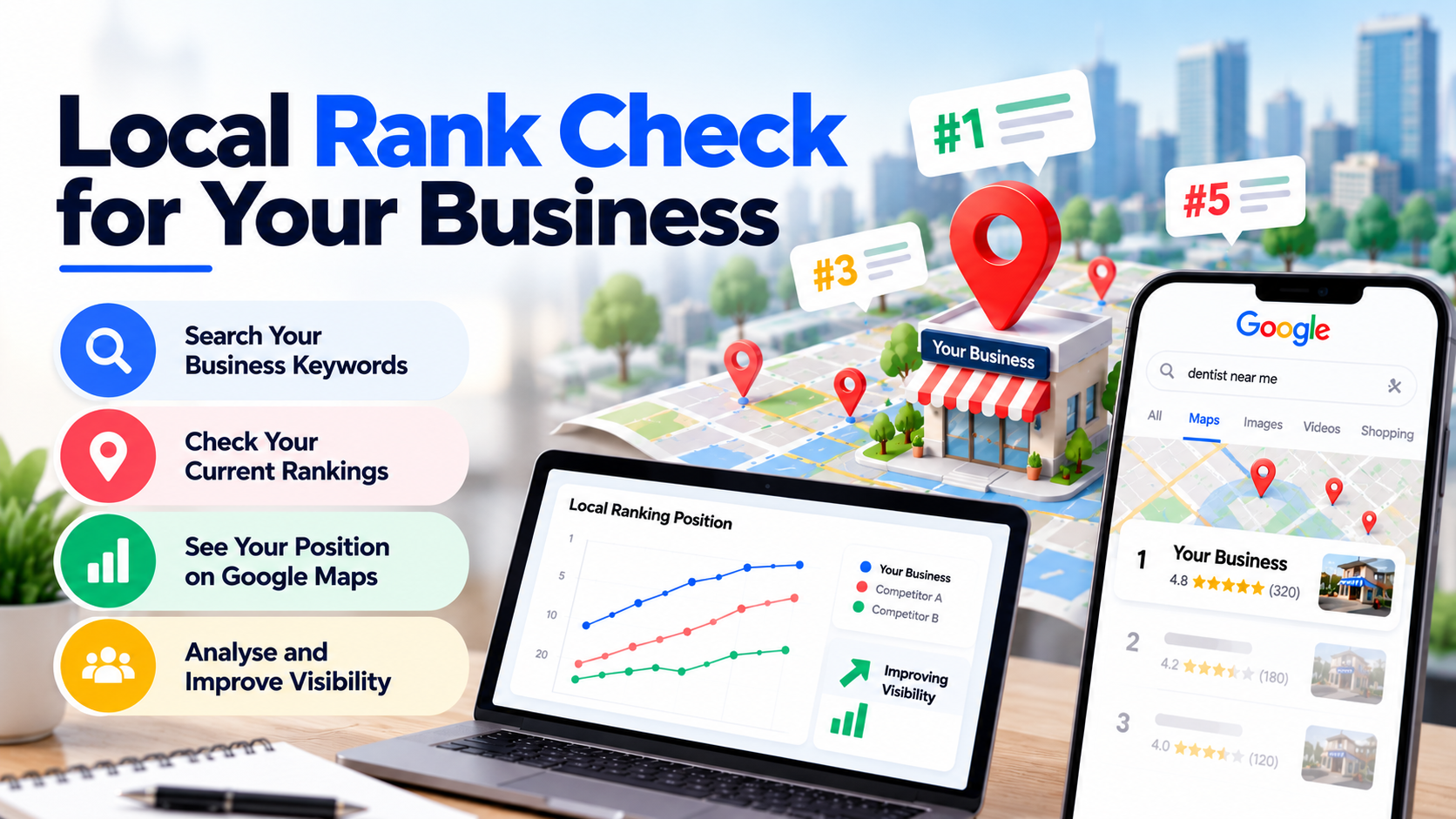
Knowing whether your business appears in local Google results is useful, but simply searching for your own business is not enough. A proper local rank check should be done with a clear keyword, the right business information, and an understanding of what the results mean. With a Local Rank Checker, businesses can check their Google Maps presence and use the results to understand how easily potential customers may discover them in local searches.
The important part is not just running the check. Businesses need to choose meaningful searches, read the results correctly, and decide what deserves attention afterwards.
Start With the Service You Want Customers to Find
Before checking rankings, decide what you actually want to measure.
Avoid starting with your business name.
Someone searching for your company name probably already knows the business. Local SEO is also about reaching people who need a service but have not decided which business to choose.
Start with an important service or category connected to what you offer.
For example, think about the type of search a new customer might make before discovering your business.
This gives the local rank check a clear purpose.
Instead of asking, "Does Google know my business?" you are asking, "Can someone looking for this service discover my business?"
Choose Keywords Based on Customer Intent
The next step is selecting the right keywords.
It can be tempting to enter every possible variation of a service, but that often creates unnecessary data.
Start with a small group of meaningful searches.
Consider your main service, an important secondary service, and searches that could realistically lead to an enquiry or visit.
Avoid choosing keywords only because they have attractive search volumes. A keyword is useful when it represents something the business actually offers and a customer could realistically search for.
The objective is to monitor searches connected to real business opportunities.
Find Your Business in the Local Rank Checker
Once you know what you want to measure, open Fly's Local Rank Checker and enter the required business information.
Select the correct business carefully, particularly if businesses with similar names appear.
Then enter the keyword you want to check.
Keeping the business and keyword accurate is important because the usefulness of the report depends on what you are asking the tool to measure.
A simple mistake at this stage can make the results less relevant to your actual local SEO goals.
Set Up the Area You Want to Understand
A local rank check becomes more useful when it reflects the market the business actually serves.
Think about where your customers realistically come from.
The objective should not automatically be to cover the largest possible area. A wider report is not necessarily a better report.
A local business should concentrate on the area that matters commercially.
This keeps the results relevant and prevents the business from worrying about weak rankings in places that are unlikely to generate customers.
Your target area should reflect your business strategy, not simply how far you would like to rank.
Run the Local Rank Check.
After setting up the business, keyword, and relevant area, run the check.
The results give you a visual understanding of local search performance rather than relying on a single manual Google search.
At this point, avoid immediately focusing on one strong or weak position.
Look at the complete result first.
The purpose is to understand the overall pattern.
Where does the business appear to perform well?
Where does visibility become weaker?
Does the pattern make sense based on where the business operates?
Are there parts of the target market that deserve closer attention?
These questions are more valuable than simply looking for the best ranking number.
Record Your First Check
Your first local rank check should become a reference point.
Save the important information from the check, including the keyword, date, and general visibility pattern.
Why?
Because a ranking report becomes more useful when you have something to compare it with later.
If you improve your Google Business Profile, publish better service content, work on reviews, or make other local SEO changes, you can return to the same search in the future.
You will then have a clearer way to evaluate whether visibility has changed.
Without a starting point, it is easy to forget what the previous search presence actually looked like.
Investigate Weak Results Before Making Changes
Seeing a weak ranking does not mean you should immediately edit your Google Business Profile.
First, investigate.
Does your profile clearly include the service being searched?
Is the most appropriate business category selected?
Does your website have useful information about the service?
Are your business details accurate?
Do customers mention relevant experiences in reviews?
Is your website helping Google and customers understand what the business offers?
Fly provides additional SEO and Local SEO tools that can help investigate different parts of your online presence.
The important principle is simple: diagnose before changing.
A Local Rank Check shows the result. Your next job is to understand what may be contributing to it.
Compare Search Visibility With Actual Enquiries
A Local Rank Check becomes even more useful when you compare the information with what is happening inside the business.
Suppose visibility looks strong for an important service.
Are enquiries for that service also increasing?
If rankings appear healthy but customers are not contacting the business, the issue may exist somewhere else in the journey.
The profile may not provide enough information. The website may not communicate the service effectively. Reviews may not create enough confidence. The contact process may be difficult.
This prevents businesses from assuming that every marketing problem can be solved by improving rankings.
Repeat the Same Check Consistently
One Local Rank Check gives you a snapshot.
Repeated checks create context.
When checking again, try to keep the important conditions consistent. Use the same business, relevant keyword, and comparable target area.
This makes it easier to evaluate changes.
If you keep changing the keyword or area every time, comparison becomes less useful.
Consistency allows businesses to build a clearer picture of their local search performance over time.
Do Not Chase Every Ranking Movement
After businesses start checking local rankings, there can be a temptation to watch them constantly.
That is rarely productive.
Local rankings can move, and not every movement requires action.
Instead, look for meaningful patterns.
If one position changes slightly, continue monitoring.
If an important search shows a sustained decline or consistently poor visibility, investigate further.
The objective is to make informed decisions, not to react emotionally to every number.
Turn the Results Into a Simple Action Plan
A local rank check should finish with a decision.
After reviewing the results, decide what happens next.
You may discover that an important service needs better website content. Your Google Business Profile may need clearer service information. You may need to investigate a competitor. Or you may find that visibility is already healthy and simply needs to be monitored.
Sometimes the correct action is not to change anything.
That is also valuable information.
Make Local Rank Checks Part of Your SEO Process
Performing a local rank check is straightforward, but using the information properly is what makes it valuable.
Start with a meaningful customer search. Select the correct business. Focus on the market that genuinely matters. Review the overall visibility pattern, record your starting point, investigate weak areas, and repeat the check consistently.
Most importantly, do not treat the report as the end of the process.
A local rank check should help answer a practical question:
What should we do next?
When businesses use ranking information this way, local rank checks become more than a way to see Google positions. They become a practical part of understanding, managing, and improving local search performance.

 English
 French
 Spanish
 Portuguese
 Deutsch
 Turkish
 Dutch
Dutch
 Italiano
 Russian
 Romaian
 Portuguese (Brazil)
 Greek
Greek