


Cryptocurrency Market Size, Share, Trends & Forecast 2034
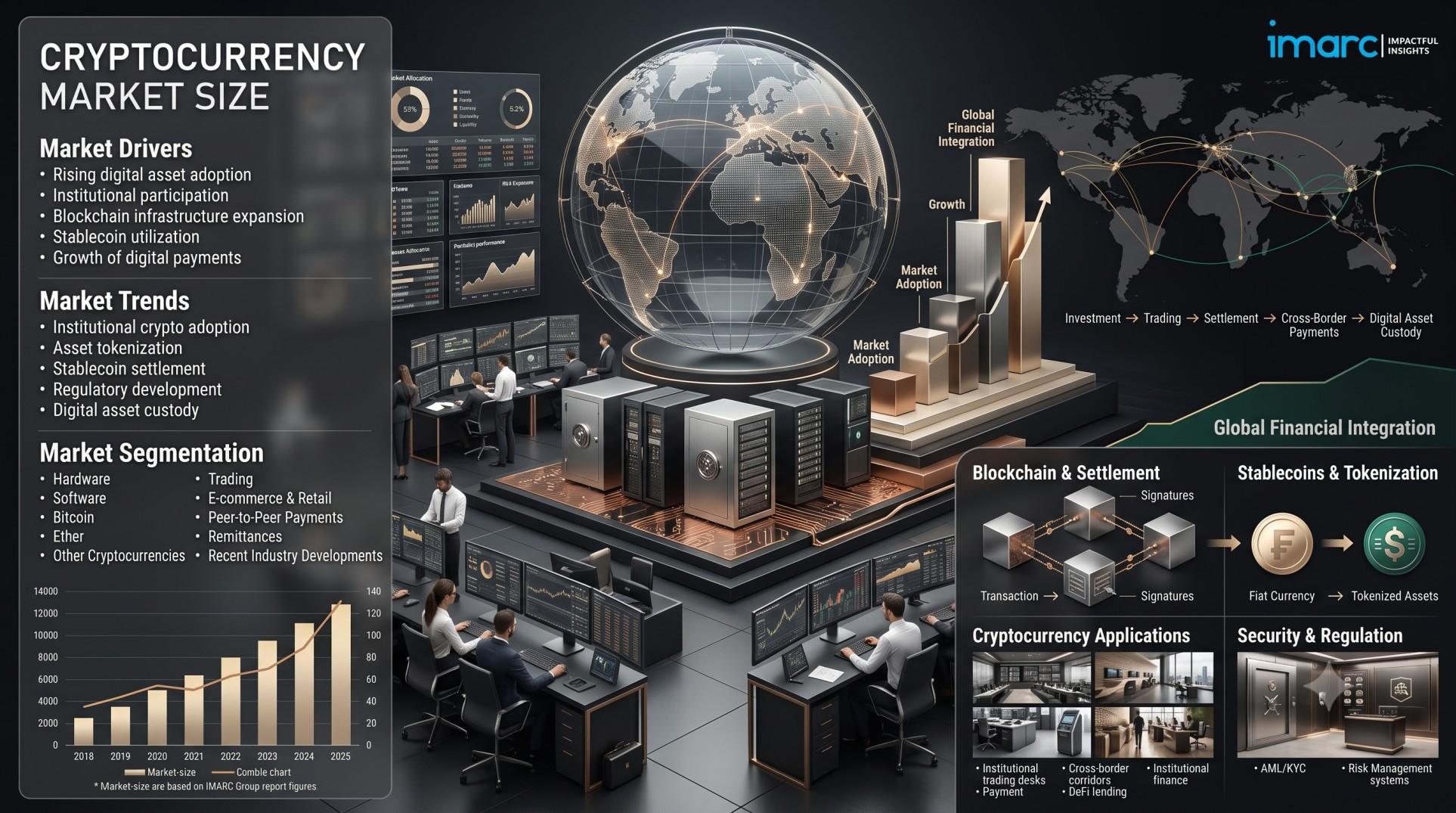
IMARC Group, a leading global market research and management consulting firm, has published its latest market intelligence report on the cryptocurrency market. The global cryptocurrency market size reached USD 2,734.6 Billion in 2025. Looking forward, IMARC Group expects the market to reach USD 6,394.1 Billion by 2034, exhibiting a growth rate (CAGR) of 9.60% during 2026-2034, driven by the widespread adoption of blockchain technology for secure and transparent transactions, rising demand for decentralized finance platforms, growing institutional investment from banks, hedge funds, and corporations, and expanding use cases across payments, remittances, smart contracts, and asset tokenization worldwide.
The cryptocurrency market trends indicate increasing adoption of decentralized finance (DeFi), blockchain-based transactions, institutional participation, digital wallets, tokenization, and regulatory frameworks for digital assets. The market is experiencing strong structural momentum driven by the steady convergence of blockchain innovation, regulatory maturity, and traditional finance participation. Large banks are building custody, trading, and tokenized deposit capabilities, while regulated derivatives exchanges are extending crypto futures and options toward round-the-clock access to meet institutional risk management needs. Simultaneously, comprehensive rulebooks such as the European Union's Markets in Crypto-Assets framework and the United States stablecoin law are replacing years of regulatory ambiguity with licensing, reserve, and disclosure standards that institutional allocators require. Digital assets are also moving well beyond speculation, with stablecoins, cross-border remittances, and tokenized real-world assets creating practical use cases in underbanked and high-inflation economies. Together, these forces are positioning cryptocurrency as an increasingly integrated layer of the global financial system.
How AI is Reshaping the Future of the Cryptocurrency Market
- Agentic Stablecoin Payments and Machine-to-Machine Commerce: Autonomous AI agents cannot open bank accounts or swipe cards, which is driving the adoption of stablecoin rails that settle in seconds with minimal fees. Coinbase launched Agentic Wallets on top of its open x402 protocol, which embeds payments directly into web requests, and Stripe followed with a preview of machine payments that lets developers charge agents in USDC on the Base network. The x402 protocol has reportedly processed over 119 million transactions on Base alone, signaling that programmable dollar payments for software agents are moving from concept to early deployment.
- AI-Powered Blockchain Intelligence for Fraud Detection and Compliance: As criminals use AI to scale fraud, theft, and laundering, analytics providers are deploying AI agents to compress investigation timelines from days to minutes. Chainalysis introduced blockchain intelligence agents built on more than ten million prior investigations and billions of screened transactions, while TRM Labs launched AI investigative assistants for fund tracing and audits just days earlier. With crypto thefts reaching USD 3.4 Billion in the preceding year and anti-money laundering obligations tightening under new regulatory frameworks, exchanges, banks, and custodians are adopting these tools to keep pace with compliance workloads.
Grab a sample PDF of this report: https://www.imarcgroup.com/cryptocurrency-market/requestsample
Cryptocurrency Market Trends and Drivers:
The global cryptocurrency market is witnessing sustained expansion, fueled by the convergence of mainstream investor awareness, institutional product development, and technology upgrades that are repositioning digital assets from a niche speculative category into a recognized component of diversified portfolios. Public awareness and ownership have reached record levels, with 40% of American adults now owning cryptocurrency, up from 30% previously, while merchants and payment companies are integrating digital currencies to benefit from lower transaction costs, faster transfers, and access to a global customer base. Institutional participation is reinforcing this shift, as hedge funds, banks, and corporations offer custody, trading, and treasury services that lend credibility to the asset class. CME Group alone reported record notional volume of USD 3 Trillion across its crypto futures and options in a single year, a statistic that illustrates how regulated derivatives have become central to institutional demand for risk management and price exposure.
Stablecoins and cross-border payments are emerging as the most practical structural driver of adoption, particularly across underbanked and high-inflation economies where digital dollars offer protection against currency devaluation. Total stablecoin supply has grown to approximately USD 300 Billion, with the bulk issued by two companies, while Chainalysis data shows that stablecoin-related transactions in Argentina exceeded USD 91.1 Billion and those in Brazil reached USD 90.3 Billion over a twelve month period. Remittance demand, mobile penetration, and fintech partnerships are extending access further, with over 30% of African adults reportedly using or owning cryptocurrency and Indian crypto investment rising from USD 923 Million to over USD 6.6 Billion across a three year span. Decentralized finance has added another layer of demand, with value locked in DeFi platforms surpassing USD 50 Billion, while NFTs, tokenization of real-world assets, and smart contract applications continue to widen the range of use cases beyond trading.
Regulatory clarity is the third pillar supporting institutional confidence, and governments across major regions are now converting policy intent into enforceable frameworks. In the United States, the GENIUS Act established the first federal framework for payment stablecoins with one-to-one reserve backing, while the CLARITY Act advanced through the House by a vote of 294 to 134 to define SEC and CFTC jurisdiction over digital asset markets. In the European Union, the MiCA transitional window closed on 1 July, requiring every crypto-asset service provider serving EU clients to hold authorization, with roughly 216 firms authorized by June. Hong Kong granted its first stablecoin issuer licences to two institutions out of 36 applicants, the United Arab Emirates hosts more than 400 crypto focused businesses in Dubai, and India maintains a 30% tax on gains with 1% tax deducted at source while coordinating on global reporting standards. These developments collectively reduce uncertainty for banks, asset managers, and exchanges evaluating long term participation.
Ask an analyst for customized report: https://www.imarcgroup.com/request?type=report&id=2546&flag=E
Cryptocurrency Industry Segmentation:
The report has segmented the market into the following categories:
Breakup By Type:
- Bitcoin
- Ethereum
- Bitcoin Cash
- Ripple
- Litecoin
- Dashcoin
- Others
Bitcoin accounts for the largest type segment, driven by its status as the pioneer and dominant cryptocurrency, its deep liquidity, and its appeal to every category of participant, from institutional allocators using it as a digital store of value to retail traders pursuing long term holdings. Often described as digital gold, Bitcoin serves as the primary entry point for new investors and the preferred hedge against economic uncertainty and inflation, supported by the steady expansion of regulated exchange traded products, custody solutions, and derivatives that make exposure accessible through traditional financial channels.
Breakup By Component:
- Hardware
- Software
Software commands the largest component share, representing the foundational layer of the cryptocurrency ecosystem through wallets, trading platforms, decentralized applications, smart contracts, and blockchain protocols. Software solutions provide the interface through which users transact and manage assets, and continuous innovation in usability, security, and scalability is driving the development of decentralized finance, non-fungible tokens, and tokenized asset applications that make software the most dynamic and fastest evolving part of the market.
Breakup By Process:
- Mining
- Transaction
The transaction segment holds the largest process share, reflecting cryptocurrency's core function as a medium of exchange across peer-to-peer transfers, online purchases, remittances, and exchange trading. Characterized by high liquidity, fast settlement, and utility in cross-border payments, smart contract execution, and token swaps, the segment continues to expand as mainstream adoption grows and merchants, payment processors, and financial institutions integrate digital asset transactions into everyday commerce.
Breakup By Application:
- Trading
- Remittance
- Payment
- Others
Trading leads the application segment as the largest and most dynamic part of the market, encompassing exchange activity, over-the-counter transactions, and speculative strategies pursued by both retail and institutional participants. High volatility and liquidity, combined with a steady stream of new trading pairs, derivatives products, and strategies, sustain exceptionally high trading volumes, while the extension of futures and options toward continuous trading hours is further deepening participation from professional investors.
Breakup By Region:
- North America (United States, Canada)
- Asia Pacific (China, Japan, India, South Korea, Australia, Indonesia, Others)
- Europe (Germany, France, United Kingdom, Italy, Spain, Russia, Others)
- Latin America (Brazil, Mexico, Others)
- Middle East and Africa
Europe dominates the global cryptocurrency market with the largest regional share, supported by the European Union's Markets in Crypto-Assets regulation, which provides a single regulatory framework that promotes innovation while protecting investors. Banks offering crypto-related services are leading institutional adoption in countries such as Germany and Switzerland, while the growth of blockchain-based companies in the United Kingdom, France, and the Nordics is accelerating decentralized technology adoption. According to Chainalysis, on-chain value in Eastern Europe rose by USD 499.14 Billion over a twelve month period as digital wallet adoption surged, and integration with e-commerce platforms such as Shopify, rising NFT use in gaming and art, and a regional focus on environmentally friendly cryptocurrencies are broadening the market further.
Competitive Landscape:
The report provides a comprehensive analysis of the competitive landscape in the cryptocurrency market with detailed profiles of all major companies, including:
- Advanced Micro Devices Inc.
- Alphapoint Corporation
- Bitfury Holding B.V.
- Coinbase Inc.
- Cryptomove Inc.
- Intel Corporation
- Microsoft Corporation
- Quantstamp Inc.
- Ripple Services Inc.
Recent News and Developments in Cryptocurrency Market
- August: Citigroup announced plans to launch institutional bitcoin custody later this year through its new Custody+ platform, allowing clients to hold crypto and traditional assets within a single framework. Citi's custody business serves clients across more than 100 markets, with its own network in 62 of them, giving the offering substantial reach from day one.
- July: The European Union's MiCA transitional period ended on 1 July, requiring all crypto-asset service providers serving EU clients to hold full authorization. Approximately 216 firms had secured authorization by June according to the ESMA interim register, signaling consolidation around licensed operators.
- April: The Hong Kong Monetary Authority granted its first stablecoin issuer licences to HSBC and Anchorpoint Financial, a joint venture of Standard Chartered Hong Kong, Animoca Brands, and HKT, following 36 applications. HSBC plans to launch a Hong Kong dollar stablecoin in the second half of the year.
Note: If you require specific details, data, or insights that are not currently included in the scope of this report, we are happy to accommodate your request. As part of our customization service, we will gather and provide the additional information you need, tailored to your specific requirements. Please let us know your exact needs, and we will ensure the report is updated accordingly to meet your expectations.
About Us:
IMARC Group is a global management consulting firm that helps the world's most ambitious changemakers to create a lasting impact. The company provides a comprehensive suite of market entry and expansion services. IMARC offerings include thorough market assessment, feasibility studies, company incorporation assistance, factory setup support, regulatory approvals and licensing navigation, branding, marketing and sales strategies, competitive landscape and benchmarking analyses, pricing and cost research, and procurement research.
Media and Sales Contact
IMARC Group
Email: sales@imarcgroup.com
United States: +1-201-971-6302
India: +91-120-433-0800
United Kingdom: +44-753-714-6104

 English
 Arabic
 French
 Spanish
 Portuguese
 Deutsch
 Turkish
 Dutch
Dutch
 Italiano
 Romaian
 Portuguese (Brazil)
 Greek
Greek