


SOC Managed Service Providers: Proven Guide for Indian Banks
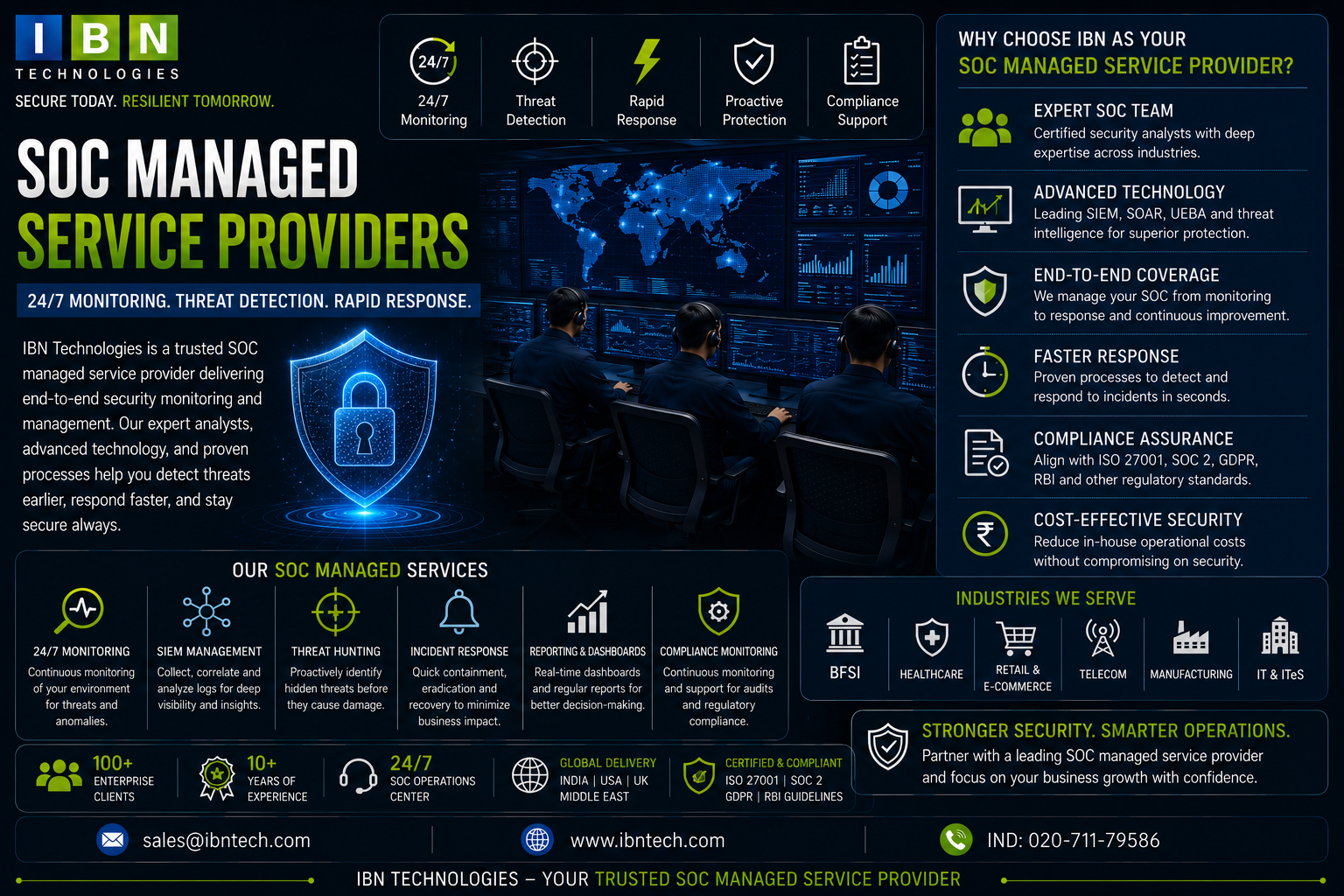
Building BFSI Resilience With SOC Managed Service Providers
Banks, insurers and financial institutions use soc managed service providers to strengthen continuous threat monitoring, investigate suspicious activity and maintain evidence for security governance. A managed SOC combines SIEM visibility, analyst-led triage and defined incident workflows so BFSI teams can respond to cyber risks while protecting critical financial services and sensitive customer information.
Why compliance needs operational visibility
BFSI organisations process high-value transactions, manage confidential records and operate digital channels that customers expect to be available at all times. Cybersecurity therefore cannot remain a periodic review activity. It needs continuous operational oversight across identities, endpoints, applications, cloud services, payment environments and network infrastructure.
Regulatory readiness: Compliance reviews often require more than written policies. Security leaders need to demonstrate that relevant events are logged, exceptions are investigated, access is governed and incidents follow a documented escalation process.
Transaction confidence: Internet banking, mobile applications, insurer portals, payment systems and partner integrations create many paths for legitimate activity. Monitoring must help teams distinguish normal customer behaviour from suspicious access, privilege misuse or attempts to disrupt services.
Evidence continuity: When log sources are fragmented across multiple teams, reconstructing an incident becomes slow and difficult. Centralised SIEM monitoring supports a clearer timeline of what happened, which systems were involved and how the organisation responded.
Where SOC and SIEM consulting fit
Why is soc siem consulting for Indian BFSI compliance important?
SOC and SIEM consulting helps BFSI teams translate security and compliance obligations into practical log sources, detection use cases, escalation paths and reporting routines. It is most effective when the consulting scope connects technical monitoring with the institution’s actual business processes, critical applications and risk priorities.
For organisations evaluating soc siem consulting for Indian BFSI compliance, the first priority is identifying the systems that must provide dependable evidence. These commonly include identity platforms, privileged-access tools, payment-related systems, customer-facing applications, databases, cloud audit trails, endpoint controls and network security devices.
Risk-led design: Detection rules should focus on material events rather than collecting every possible alert. Examples include repeated failed access attempts, abnormal privileged activity, unauthorised configuration changes, unusual data movement and suspicious administrative access.
Control mapping: Every monitoring use case should have a clear purpose. Teams should know which risk it addresses, what data it requires, who investigates it and what record is retained after the case is closed.
Reporting discipline: Security reporting should give leadership a view of open incidents, recurring risks, unresolved control gaps and remediation ownership. It should support decisions rather than simply present large volumes of technical events.
Why traditional security reviews are not enough
Can periodic audits protect Indian BFSI digital operations?
Periodic audits remain important, but they cannot replace continuous monitoring of active threats and suspicious behaviour. An audit may confirm that a control exists at one point in time, while a SOC helps determine whether that control is working when real events occur.
Time sensitivity: Credential misuse, unauthorised access and malware activity can develop quickly. Waiting for the next scheduled review can allow a manageable event to become a wider operational issue.
Complex ownership: A BFSI environment may involve IT operations, digital banking, information security, fraud teams, compliance, legal, application owners and third-party service providers. Without a defined incident workflow, critical decisions can be delayed.
Alert interpretation: Tools may generate warnings that require context from several systems. A skilled analyst must connect identity, endpoint, network and application activity before deciding whether an event represents a real incident.
SOC managed service providers can support this investigation layer, but financial institutions should ensure that their internal teams maintain clear authority over risk acceptance, customer communication and business-continuity decisions.
What a compliant operating model looks like
How do SOC Managed Service Providers support BFSI incident governance?
A managed SOC receives agreed security data, identifies suspicious patterns and escalates validated incidents through a documented process. BFSI teams then make business decisions, approve containment where needed and ensure actions align with regulatory, customer and operational responsibilities.
Log governance: Define which systems send logs, what events must be retained, how time is synchronised and who verifies data completeness. Missing or unreliable logs can weaken both investigations and compliance evidence.
Severity framework: Establish clear categories for routine alerts, suspicious events, confirmed incidents and business-critical emergencies. Each level should have named contacts, escalation timing and expected decision makers.
Investigation records: A case record should show the affected system, observed activity, analyst findings, actions taken, internal approvals and closure rationale. This creates an audit trail and makes lessons from prior incidents easier to apply.
Response coordination: A suspected compromise of a privileged account may require identity teams to disable access, application teams to review exposure, fraud teams to assess suspicious transactions and compliance teams to document notification obligations. The workflow should be agreed before an incident occurs.
|
Governance area |
Practical question |
BFSI outcome |
|
Critical systems |
Which platforms support customer access, transactions and sensitive data? |
Monitoring focuses on business-impacting assets |
|
Log coverage |
Are identity, application, endpoint, cloud and network events available? |
Investigations have stronger technical context |
|
Incident escalation |
Who must be contacted for each severity level? |
Decisions move faster during high-pressure events |
|
Case documentation |
Does each investigation show evidence and closure actions? |
Audit and governance teams have usable records |
|
Remediation tracking |
Who owns unresolved security actions after an incident? |
Repeat weaknesses are less likely to remain open |
Practical priorities for BFSI leaders
Business context first: Give SOC analysts an up-to-date inventory of critical services, sensitive data locations, privileged accounts and third-party dependencies. Technical alerts become more useful when they are linked to potential business impact.
Access monitoring: Prioritise administrator activity, unusual sign-in patterns, dormant-account use, remote access and changes to privileged permissions. Identity misuse can provide attackers with a path into critical systems.
Detection testing: Validate important use cases with controlled exercises. This confirms whether required data is arriving, alerts are generated, analysts receive context and escalation contacts respond as expected.
Remediation ownership: Keep a formal register of actions arising from incidents, investigations and monitoring reviews. Assign each action to a business or technical owner and track it to closure.
Leadership oversight: Review trends such as recurring incidents, high-risk assets, detection gaps and overdue remediation actions. This allows security investment to be directed toward areas of greatest operational importance.
Frequently asked questions
What should a BFSI organisation monitor first through a SOC?
Start with privileged identities, customer-facing applications, payment-related systems, endpoint security alerts, cloud audit activity, database access and network security events. The final scope should reflect the organisation’s specific risk assessment and service architecture.
Does SIEM monitoring replace compliance teams?
No. SIEM monitoring provides security visibility and evidence, while compliance teams interpret obligations, maintain policies and coordinate governance activities. Both functions must work together during audits and incidents.
How should banks handle SOC incident escalation?
Document severity levels, internal contacts, approval requirements, response steps and communication responsibilities before an event occurs. Test the process regularly so teams can make timely, coordinated decisions under pressure.
IBN Technologies supports organisations with managed SOC, SIEM, threat detection and cybersecurity capabilities that help strengthen security operations and governance readiness.
Contact Us
IBN Technologies
Phone: +91 20 6768 0404
Email: sales@ibntech.com

 English
 Arabic
 French
 Spanish
 Portuguese
 Deutsch
 Turkish
 Dutch
Dutch
 Italiano
 Russian
 Romaian
 Greek
Greek