


Why Enterprises Choose Custom Software Development Solutions
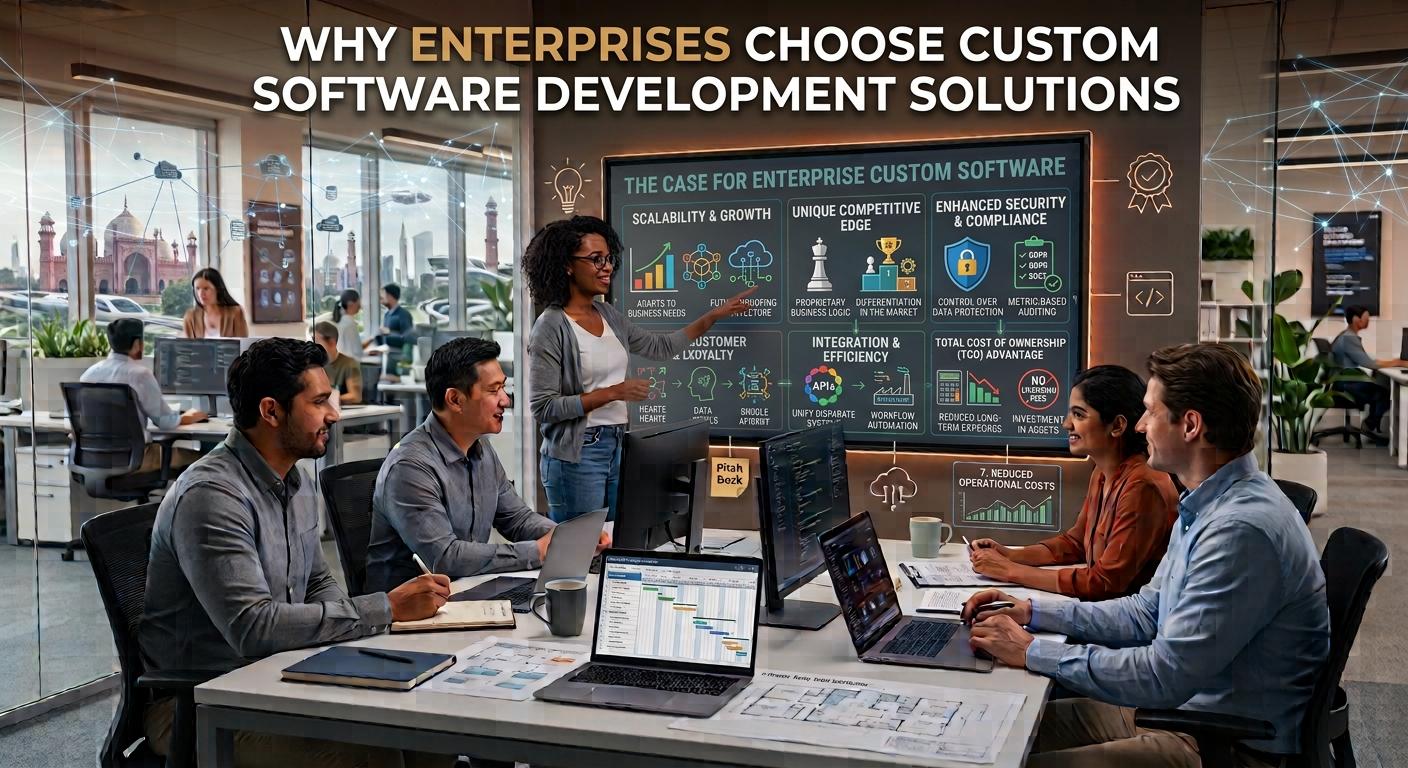
Enterprise organizations operate on a different scale from small businesses. They often manage thousands of employees, large customer bases, multiple departments, complex workflows, large amounts of data, and numerous technology platforms.
As businesses grow, their software requirements also become more complicated.
Standard software can be useful for common business processes, but enterprises often need more flexibility, deeper integrations, stronger security, advanced automation, and technology that can adapt to their unique operations. This is one of the main reasons enterprises increasingly invest in custom software development solutions.
Custom software allows organizations to build applications around their specific requirements rather than forcing their operations to fit the limitations of generic platforms.
From enterprise resource management and workflow automation to customer portals, analytics platforms, mobile applications, and industry-specific systems, custom technology can become a strategic foundation for enterprise growth.
In this article, we explore why enterprises choose custom software development services, the benefits they can provide, and what businesses should consider before investing in a custom solution.
What Are Custom Software Development Solutions?
Custom software development solutions are software applications specifically designed and developed to address the unique requirements of an organization.
Unlike off-the-shelf software, which is built for a broad market, custom applications can be designed around an enterprise's:
- Business processes
- Organizational structure
- Industry requirements
- Security policies
- Existing technology infrastructure
- Customer requirements
- Data requirements
- Automation needs
- Growth strategy
Enterprise software may include:
- Enterprise management platforms
- CRM systems
- ERP solutions
- Supply chain applications
- Customer portals
- Business intelligence platforms
- Workflow automation systems
- HR management software
- Financial applications
- Inventory management systems
- E-commerce platforms
- Mobile applications
A professional custom software development company can help enterprises analyze their requirements and develop a solution that fits their operational environment.
1. Enterprises Have Unique Business Requirements
Large organizations rarely operate exactly like one another.
Even companies within the same industry may have completely different processes, organizational structures, approval systems, reporting requirements, and technology environments.
Generic software typically provides standardized features designed for a broad customer base.
That can create limitations.
An enterprise may need:
- Customized approval workflows
- Industry-specific calculations
- Specialized dashboards
- Complex reporting
- Custom user roles
- Advanced automation
- Unique integrations
- Specialized compliance features
Trying to modify business operations around generic software can create unnecessary complexity.
With customized software development services, the software can instead be designed around the organization's actual requirements.
Technology should support the business
The goal of enterprise software should not be to force employees into a predefined process.
The software should support the way the organization operates while also identifying opportunities to improve inefficient workflows.
This is one of the strongest reasons enterprises choose custom development.
2. Better Integration With Existing Systems
Large enterprises rarely depend on a single software platform.
They may use different systems for:
- CRM
- ERP
- Accounting
- HR
- Marketing
- Customer support
- Inventory
- E-commerce
- Analytics
- Communication
- Supply chain management
If these systems operate independently, employees may need to manually transfer information between platforms.
This can result in:
- Duplicate data
- Manual work
- Data inconsistencies
- Delays
- Reporting problems
- Increased operational costs
Custom software can be designed to integrate with existing enterprise systems through APIs and other technologies.
For example:
Customer Platform → CRM → Order Management → Inventory → Accounting → Reporting
Instead of employees moving information manually, systems can communicate automatically.
For complex organizations, custom enterprise software development services can provide a structured approach to connecting different parts of the technology ecosystem.
3. Improved Business Process Automation
Enterprise organizations often manage thousands of repetitive processes.
These can include:
- Approvals
- Employee onboarding
- Invoice processing
- Customer requests
- Order management
- Data entry
- Reporting
- Document processing
- Notifications
- Compliance workflows
Even small inefficiencies can become expensive when repeated across thousands of transactions.
Custom software can automate business processes based on predefined rules.
For example, a custom application could:
- Receive a request.
- Validate the information.
- Identify the responsible department.
- Send the request for approval.
- Notify the relevant employee.
- Update the enterprise database.
- Generate a report.
- Notify the customer.
This can significantly reduce manual intervention.
Automation can improve enterprise productivity
By automating repetitive tasks, enterprises can allow employees to focus more on:
- Customer service
- Strategy
- Problem-solving
- Innovation
- Business development
- Decision-making
This makes automation an important component of modern custom software development services.
4. Greater Scalability
Enterprise software needs to support growth.
As organizations expand, they may add:
- Employees
- Customers
- Products
- Locations
- Transactions
- Departments
- Business units
- Markets
Software that cannot scale can eventually become a bottleneck.
Custom applications can be designed with future growth in mind.
Developers can consider:
- Cloud infrastructure
- Database architecture
- Application performance
- Load management
- Security
- API architecture
- Modular development
A scalable system can evolve as business requirements change.
This is particularly important when choosing a custom software development firm because architectural decisions made during the early stages can influence the system's long-term performance.
5. Stronger Data Control
Enterprise organizations manage large volumes of sensitive data.
This can include:
- Customer information
- Employee records
- Financial data
- Business documents
- Product information
- Operational data
- Internal communications
Generic applications may not always provide the level of control required by large organizations.
Custom applications can be designed around specific data governance and access requirements.
For example, organizations can implement:
- Role-based access
- Multi-factor authentication
- Data encryption
- Audit logs
- Permission management
- Secure APIs
- Data validation
- Activity monitoring
Security requirements can be incorporated throughout the development lifecycle.
For enterprises operating in highly regulated industries, this level of control can be particularly valuable.
6. Better User Experience for Employees and Customers
Enterprise software is often used by different groups of people.
Employees may have different responsibilities, customers may need different features, and administrators may require advanced controls.
A one-size-fits-all interface may not provide the best experience for everyone.
Custom applications can provide role-specific experiences.
For example:
Employees: Tasks, dashboards, workflows, and internal tools
Managers: Reports, approvals, analytics, and performance metrics
Customers: Accounts, orders, support, payments, and personalized information
Administrators: System settings, permissions, security, and reporting
This can make software easier to use and improve adoption.
Good custom software application development should therefore consider usability alongside technical functionality.
7. Advanced Reporting and Business Intelligence
Enterprise organizations generate enormous amounts of data.
However, collecting data is only useful if decision-makers can understand it.
Custom software can provide dashboards and reporting systems designed around the organization's specific KPIs.
Management may want to monitor:
- Revenue
- Sales performance
- Customer retention
- Operational efficiency
- Inventory
- Employee productivity
- Project performance
- Customer satisfaction
A custom reporting platform can bring information from multiple systems into one interface.
This allows decision-makers to identify trends and make more informed decisions.
Real-time information can improve responsiveness
Instead of waiting for manually prepared reports, managers can access current information through dashboards.
This can help organizations respond faster to:
- Market changes
- Operational problems
- Customer issues
- Supply chain disruptions
- Financial changes
- Performance gaps
8. Reduced Long-Term Operational Costs
Custom software usually requires a greater initial investment than many off-the-shelf applications.
However, enterprises should evaluate the total cost of ownership rather than focusing only on initial development costs.
Generic software may involve:
- Recurring licensing fees
- Per-user charges
- Additional module costs
- Integration expenses
- Customization fees
- Vendor restrictions
- Manual workarounds
Custom software can reduce some of these costs by creating a system specifically designed for the organization's needs.
Automation can also reduce the amount of manual work required.
The potential long-term benefits may include:
- Lower administrative costs
- Reduced manual effort
- Fewer errors
- Better resource utilization
- Improved employee productivity
- More efficient workflows
A detailed ROI analysis should be completed before starting a major project.
9. Greater Flexibility and Customization
Business requirements change over time.
An enterprise may enter a new market, launch new products, acquire another organization, or change its operating model.
Software needs to adapt accordingly.
Custom applications can be developed using modular architectures that make future changes easier.
Organizations can add:
- New features
- New integrations
- New user roles
- New workflows
- New reports
- New business modules
This flexibility is particularly valuable for enterprises undergoing digital transformation.
10. Competitive Advantage
Technology can become a major competitive differentiator.
Two companies may offer similar products, but the company with better digital processes may be able to:
- Respond faster
- Serve customers better
- Reduce costs
- Launch products more quickly
- Analyze data faster
- Automate more processes
Custom software can help enterprises develop capabilities that competitors may not easily replicate.
Instead of using exactly the same software as every competitor, organizations can build technology around their unique strengths.
This is why many businesses view custom software development solutions as a strategic investment rather than simply an IT expense.
11. Support Digital Transformation
Digital transformation involves more than replacing old software.
It often requires businesses to rethink how they operate, interact with customers, manage data, and deliver services.
Custom software can become an important part of this transformation.
For example, an enterprise might combine:
- Cloud computing
- AI
- Data analytics
- Automation
- Web applications
- Mobile applications
- API integrations
- Enterprise software
A custom technology ecosystem can connect these capabilities and create a more efficient digital infrastructure.
Custom software can support modernization
Legacy systems can sometimes make digital transformation difficult.
Rather than replacing every system at once, enterprises can use custom applications and integrations to modernize specific areas gradually.
This can reduce disruption while allowing the organization to improve its technology environment over time.
Custom Software vs. Off-the-Shelf Software for Enterprises
Both approaches have advantages.
| Factor | Custom Software | Off-the-Shelf Software |
|---|---|---|
| Customization | Very high | Limited to available options |
| Enterprise workflows | Can be tailored | Standardized |
| Integrations | Highly flexible | Depends on vendor |
| Scalability | Designed around requirements | Depends on platform |
| Security controls | Can be customized | Provider-defined |
| User experience | Fully customizable | Standardized |
| Initial investment | Usually higher | Usually lower |
| Development time | Longer | Faster deployment |
| Long-term flexibility | High | Vendor-dependent |
Enterprises should choose based on their actual requirements.
If an existing platform meets most business needs and can scale effectively, off-the-shelf software may be appropriate.
If the organization has complex processes, specialized requirements, or significant integration needs, custom development may provide greater long-term value.
What Should Enterprises Consider Before Investing?
Custom software is a significant investment, so organizations should conduct careful planning before development begins.
Important questions include:
What business problem are we solving?
Technology should solve a clearly defined business problem.
Who will use the system?
Understanding users helps determine functionality and interface requirements.
Which existing systems need integration?
Create a complete picture of the organization's technology ecosystem.
What security requirements exist?
Identify data protection, access control, compliance, and monitoring requirements.
How will the system scale?
Consider future users, transactions, locations, and functionality.
What is the expected ROI?
Estimate potential savings, productivity improvements, revenue opportunities, and other measurable benefits.
What happens after launch?
Plan for maintenance, monitoring, security updates, technical support, and future development.
This planning stage is where custom software development consulting can provide significant value.
How to Choose a Custom Software Development Company
Selecting the right technology partner can have a major impact on project success.
Enterprises should evaluate potential providers based on:
Technical capabilities
Review experience with enterprise architecture, cloud platforms, databases, APIs, security, integrations, and modern development frameworks.
Enterprise experience
Large-scale applications often involve requirements that smaller projects do not. Experience with complex systems can be valuable.
Security practices
Ask how security is addressed throughout design, development, testing, and deployment.
Development methodology
Understand how requirements, project milestones, testing, communication, and changes will be managed.
Scalability expertise
The development team should be able to explain how the architecture will support future growth.
Post-launch support
Enterprise software requires continuous maintenance and improvement.
A dependable custom software development agency should be capable of supporting the application beyond the initial launch.
Why Enterprises Can Work With UnTitleTech
At UnTitleTech, the development process can be centered around understanding the business before building the technology.
Enterprise software should solve real operational problems, integrate with existing systems, support users effectively, and provide a foundation for future growth.
Whether an organization requires a custom enterprise application, business automation platform, customer portal, web application, mobile solution, or software product, the development strategy should be based on its specific goals and requirements.
UnTitleTech can help businesses explore custom software development solutions that are designed around their workflows rather than forcing their operations into a generic software model.
The objective is to create technology that can support productivity, scalability, security, integration, and long-term digital growth.
Final Thoughts
Enterprises choose custom software for one fundamental reason: their business requirements are rarely standard.
As organizations become larger and more complex, they need technology that can integrate different systems, automate workflows, manage large volumes of data, support users, maintain security, and adapt to future changes.
Custom software development services can provide this flexibility.
From enterprise applications and workflow automation to analytics platforms, customer portals, web applications, and mobile solutions, custom development can help organizations build technology around their specific needs.
However, successful enterprise software requires more than development skills. It requires strategic planning, business analysis, strong architecture, security, scalability, testing, and ongoing support.
For enterprises considering their next technology investment, choosing the right custom software development company can be just as important as choosing the technology itself.
With the right strategy and development partner, custom software can become a long-term business asset that supports efficiency, innovation, customer experience, and sustainable growth.
UnTitleTech can help businesses explore tailored software solutions designed to meet today's operational requirements while creating a foundation for tomorrow's opportunities.
Frequently Asked Questions
1. Why do enterprises choose custom software development?
Enterprises choose custom software when they have unique workflows, complex integrations, specialized requirements, scalability needs, or security requirements that standard software cannot adequately address.
2. What are the main benefits of custom enterprise software?
Key benefits include greater flexibility, improved integration, workflow automation, scalability, stronger control over data, customized user experiences, and better support for unique business processes.
3. Is custom software more expensive than off-the-shelf software?
The initial investment is usually higher, but the total cost should be evaluated based on long-term productivity, automation, integration, scalability, licensing, maintenance, and business value.
4. Can custom software integrate with existing enterprise systems?
Yes. Custom applications can integrate with CRM, ERP, accounting, HR, payment, analytics, e-commerce, cloud, and other enterprise platforms through APIs and integration technologies.
5. Is custom software secure?
Custom software can be designed with security requirements specific to the organization. Common measures include authentication, authorization, encryption, secure APIs, audit logging, monitoring, and security testing.
6. Can custom enterprise software scale?
Yes. When scalability is considered during architecture and development, custom enterprise applications can be designed to support increasing users, data, transactions, locations, and business requirements.
7. How long does enterprise software development take?
The timeline depends on the project's scope, complexity, integrations, number of users, features, security requirements, and development methodology. Large enterprise applications may require several development phases.
8. Why is custom software development consulting important?
Custom software development consulting helps enterprises evaluate their business challenges, technology environment, workflows, integration requirements, and long-term objectives before committing to development.
9. How do I choose the right custom software development company?
Evaluate technical expertise, enterprise experience, security practices, scalability capabilities, communication, development methodology, previous projects, and post-launch support.
10. Can UnTitleTech develop enterprise software solutions?
UnTitleTech can help businesses explore and develop tailored software solutions based on their specific operational, technical, and growth requirements, including custom applications and broader digital solutions.

 English
 Arabic
 French
 Spanish
 Portuguese
 Turkish
 Dutch
Dutch
 Italiano
 Russian
 Romaian
 Portuguese (Brazil)
 Greek
Greek