


SOC Audit: Proven Compliance Guide for Indian Banks
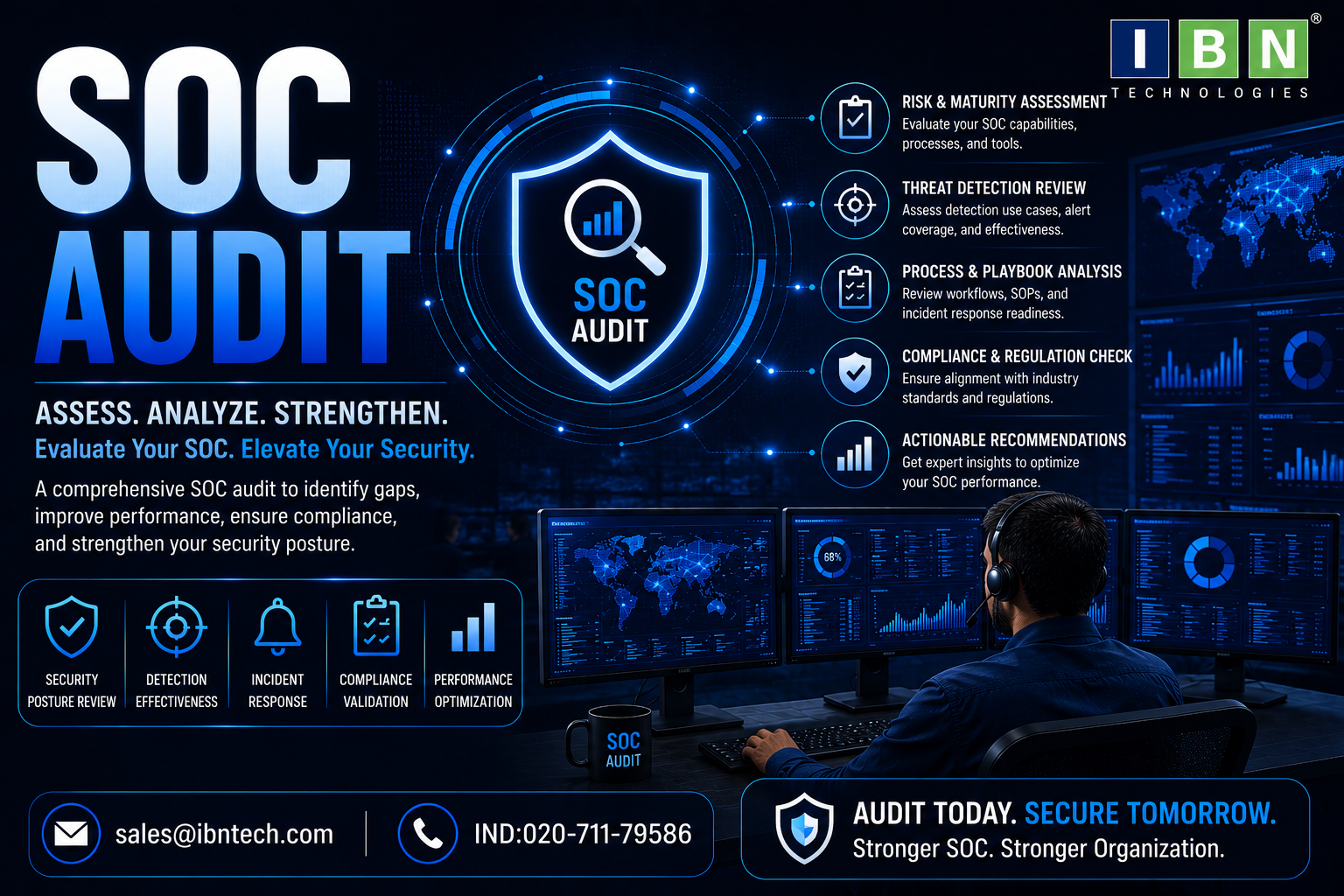
SOC Audit Controls for Indian BFSI Governance
For banks, insurers and financial-services firms, a soc audit evaluates whether security monitoring, access governance and incident-response processes operate reliably around critical digital services. It reviews evidence from SIEM alerts, investigations, escalation records and corrective actions, helping BFSI leaders demonstrate that security controls work in practice rather than only on paper.
Why BFSI audit preparation begins with operations
BFSI organisations manage high-value transactions, confidential customer records, digital channels and interconnected technology platforms. An audit must therefore examine how security teams identify, assess and respond to threats that could affect customer access, transaction integrity or service availability.
Control reliability: A written policy is only the starting point. The audit needs proof that relevant logs are collected, alerts are assessed, access is reviewed and security incidents follow a defined path from detection through closure.
Business impact: Suspicious activity involving a privileged account, customer portal or payment-connected application can require quick decisions. Audit-ready workflows make it easier to show who made those decisions, what evidence informed them and how the organisation managed the outcome.
Shared responsibilities: Security, IT operations, fraud teams, application owners, compliance staff and senior leadership may all be involved in a high-severity event. The audit should confirm that the escalation model identifies each role before an incident occurs.
Selecting support for compliance evidence
External monitoring support can strengthen security operations when it fits the institution’s governance model. The provider needs enough technical visibility to investigate events, while internal BFSI teams retain authority over business-risk decisions, customer communication and actions that may affect regulated services.
For a financial institution considering a managed soc service provider in mumbai for BFSI compliance, the selection process should examine evidence quality as closely as alert coverage. The provider should be able to document investigations, escalation timing, analyst findings and follow-up actions in a format that supports internal review.
Scope definition: Start with the systems that support customer identity, transactions, privileged administration, digital channels, sensitive data and remote access. Each system should have a named owner, expected log sources and a defined role in incident response.
Workflow alignment: The SOC must work within agreed severity levels, notification procedures and approval boundaries. This is especially important when recommended actions could affect customer services, payment workflows or regulatory obligations.
Record retention: Decide how investigation records, escalation notices, security logs and remediation evidence will be retained and accessed. Clear retention responsibilities reduce the risk of incomplete evidence during an audit or post-incident review.
Which audit controls matter most in BFSI?
What should a managed soc service provider in mumbai for BFSI compliance document?
The provider should document the lifecycle of meaningful security events, from initial alert through investigation, escalation, response and closure. These records should explain what was observed, why it was important and which internal owners approved or completed relevant actions.
Monitoring evidence: Show which critical log sources are connected to the SIEM, how collection health is checked and how missing telemetry is identified. Monitoring records should reflect current systems rather than an outdated technology inventory.
Investigation evidence: A strong case file identifies affected users, assets and applications; relevant activity; analyst assessment; severity; and the recommended next step. It should make sense to an internal risk or compliance reviewer as well as a technical specialist.
Response evidence: Record who received the escalation, when the notification occurred, what containment or recovery action was approved and whether the event led to a formal remediation task. This demonstrates accountability across the complete incident process.
Why periodic control reviews cannot stand alone
Can Indian BFSI firms rely only on policy reviews for a SOC audit?
No. Policy reviews help confirm that intended controls are documented, but they do not show whether those controls are working during live security events. A SOC audit needs operational evidence from real alerts, investigations, access reviews and remediation tracking.
Rapid events: Credential misuse, privilege changes, malicious activity and unexpected data access can occur between scheduled reviews. Continuous monitoring creates evidence that potential threats are recognised and assessed in a timely manner.
Complex dependencies: An incident can move across cloud services, endpoints, identity systems, customer applications and third-party integrations. Central log analysis helps teams reconstruct what happened and identify which business functions may be affected.
Open findings: A security issue may be contained quickly but still need configuration changes, access reviews, patching or process improvements. Audit readiness depends on tracking these corrective actions until an accountable owner verifies closure.
A soc audit should test the complete operating cycle, including whether lessons from incidents are used to improve controls and monitoring content.
Building a defensible incident process
How does a SOC Audit strengthen Indian BFSI incident governance?
A SOC audit strengthens governance by exposing gaps between planned procedures and actual response practices. It helps leaders confirm whether alerts are prioritised appropriately, approvals are documented and remediation actions reach closure.
Severity framework: Define clear categories for low-risk events, suspicious activity, confirmed incidents and business-critical security events. Each category should identify notification timing, responsible decision makers and the evidence required before closure.
Access discipline: Review who can access SIEM platforms, production consoles, privileged accounts and investigation records. Access should follow least-privilege principles and be revalidated when roles, teams or service relationships change.
Remediation ownership: Maintain a central register for actions arising from incidents, audit findings and control reviews. Assign owners, target dates and closure evidence so repeated weaknesses do not disappear into informal operational tasks.
|
Audit control |
Evidence to examine |
Governance benefit |
|
Critical asset coverage |
System inventory and log-source mapping |
Confirms monitoring follows business risk |
|
SIEM health |
Data-collection checks and gap notifications |
Reduces blind spots in investigations |
|
Incident workflow |
Case notes, severity decisions and escalation records |
Demonstrates consistent response |
|
Privileged access |
Approval records and periodic access reviews |
Limits unauthorised system control |
|
Corrective actions |
Remediation register and closure evidence |
Supports long-term risk reduction |
|
Management oversight |
Governance meeting notes and decisions |
Creates visible accountability |
Practical actions for BFSI leaders
Map decision rights: Document who can approve account suspension, access blocking, endpoint isolation, customer notifications and service-recovery actions. Clear decision rights reduce delay during incidents that affect business-critical systems.
Test realistic scenarios: Conduct exercises involving compromised privileged credentials, suspicious remote access, unusual customer-data queries or unauthorised application changes. Capture the evidence created during the exercise and use it to improve the audit trail.
Review log quality: Confirm that timestamps are synchronised, key data fields are available and high-risk systems continue sending logs after upgrades or configuration changes. Poor log quality can limit both detection and auditability.
Track third parties: Identify technology suppliers, payment partners, cloud providers and other external connections that influence security operations. Record contractual responsibilities and escalation contacts for incidents that cross organisational boundaries.
Maintain leadership visibility: Present significant incidents, unresolved remediation items, coverage gaps and control exceptions in regular governance forums. Leaders should be able to make informed choices about risk acceptance, investment and accountability.
Frequently asked questions
What should a BFSI organisation include in a SOC audit scope?
Include critical customer-facing applications, identity systems, privileged access, transaction-supporting platforms, endpoints, cloud services, network controls and relevant third-party integrations. The final scope should follow the institution’s risk assessment and business dependencies.
How does an audit assess incident-response quality?
It samples cases to review alert timelines, analyst investigation, severity classification, escalation evidence, approval records, containment actions and closure rationale. It also checks whether corrective actions were assigned and completed.
Can a managed SOC make compliance decisions for a financial institution?
No. A managed SOC can provide monitoring, analysis and documented escalation, but the institution retains responsibility for compliance interpretation, business-risk decisions, regulatory communication and final remediation approvals.
IBN Technologies supports cybersecurity operations through managed monitoring, SIEM visibility, threat detection and incident-response readiness for organisations with complex security governance needs.
Contact Us
IBN Technologies
Phone: +91 20 6768 0404
Email: sales@ibntech.com

 English
 Arabic
 French
 Spanish
 Portuguese
 Deutsch
 Turkish
 Dutch
Dutch
 Italiano
 Russian
 Romaian
 Greek
Greek