


Global Ready-to-Eat Food Market Growth Outlook: USD 792.6 Billion by 2036
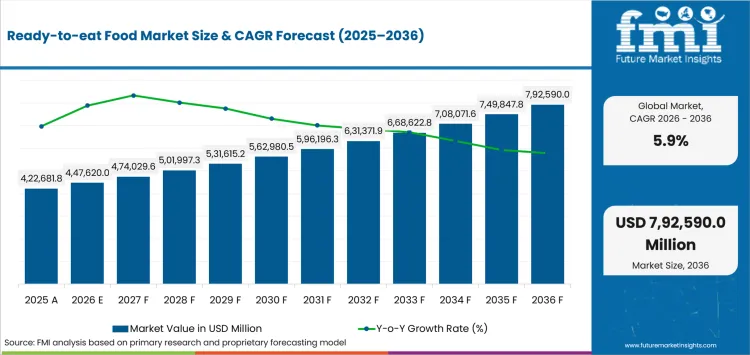
Ready-to-eat Food Market Size to Reach USD 792.6 Billion by 2036 Driven by Rising Demand for Convenient Meals and Snackable Food Products
Europe, France., Oct 6, 2026 — The global Ready-to-eat Food Market is expected to witness steady growth as consumers increasingly seek convenient meals, packaged foods, frozen products, and snackable portions that fit busy lifestyles and changing household routines. According to Future Market Insights (FMI), the market is projected to grow from USD 447.62 billion in 2026 to USD 792.59 billion by 2036, registering a CAGR of 5.9% during the forecast period.
Growing demand for convenient meal solutions, expanding retail and online distribution networks, increasing consumption of frozen and shelf-stable foods, and changing consumer preferences toward time-saving food options continue to support market expansion worldwide.
👉 Get Detailed Market Forecasts, Competitive Benchmarking, and Pricing Trends: https://www.futuremarketinsights.com/reports/sample/rep-gb-491
The market is expected to create significant growth opportunities between 2026 and 2036, supported by busy work routines, increasing household demand for convenient food, expanding modern retail, quick-commerce development, and rising adoption of frozen and shelf-stable meal solutions.
Key Ready-to-eat Food Market Highlights
· Market Size (2026): USD 447.62 Billion
· Forecast Market Size (2036): USD 792.59 Billion
· Forecast Period: 2026–2036
· CAGR (2026–2036): 5.9%
· Leading Distribution Channel (2026): Retail
· Retail Share (2026): 64.0%
· Leading Frequent Snack Buying Segment (2026): Snacks and Baked Goods and Confectioneries
· Segment Share (2026): 55.0%
· Leading Packaging Format (2026): Frozen Packaging
· Frozen Packaging Share (2026): 41.0%
· Fastest-Growing Country: India
· India CAGR:11.8%
· Second Fastest-Growing Country: China
· China CAGR: 10.2%
· Key Segments Covered: Distribution Channel, Frequent Snack Buying, Packaging, Region
· Regions Covered: North America, Latin America, Europe, East Asia, South Asia & Pacific, Middle East & Africa
· Countries Covered: United States, Canada, Germany, France, United Kingdom, China, Japan, India, Brazil, Australia, and 30+ Countries
Analyst Viewpoint
Nandini Roy Choudhury, Principal Consultant for Food and Beverages at Future Market Insights, stated:
"Ready-to-eat food is becoming a weekly planning product instead of an occasional convenience item. Buyers compare flavor trust and heating reliability before repeat purchase. Suppliers with retail freezer access and price-pack discipline should gain stronger shelf positions. Demand is expected to follow households that trade cooking time for predictable meal outcomes by 2036."
Why Is the Ready-to-eat Food Market Growing?
The growing pace of modern lifestyles and increasingly busy work routines is encouraging consumers to prioritize convenient meal solutions that reduce preparation time while providing predictable taste and quality.
Packaged meals, frozen foods, ready-to-heat products, and snackable portions are increasingly becoming part of regular household shopping baskets. Consumers are looking for products that offer convenience without requiring extensive cooking or preparation.
Retailers are also emphasizing products with clear shelf-life information, reliable storage characteristics, convenient packaging, and simple heating instructions. These attributes help ready-to-eat products compete effectively within increasingly crowded food categories.
Foodservice operators are additionally using frozen and shelf-stable meal inputs to control labor requirements, minimize kitchen waste, and improve operational efficiency.
The expansion of online grocery platforms, modern retail networks, and quick-commerce services is further improving consumer access to ready-to-eat products across developed and emerging markets.
Key Growth Drivers
- Rising demand for convenient meal solutions
- Increasingly busy work and household routines
- Growing consumer preference for time-saving food products
- Expansion of modern retail and supermarket networks
- Rapid growth of online grocery and quick-commerce channels
- Increasing consumption of frozen and shelf-stable meals
- Rising demand for snackable food portions
- Growing adoption of convenient packaged foods
- Increasing foodservice use of frozen and shelf-stable inputs
- Focus on predictable taste, quality, and heating performance
Key Segment Insights
Which Distribution Channel Leads the Ready-to-eat Food Market?
Retail is projected to remain the leading distribution channel in 2026, supported by extensive store networks, supermarkets, convenience outlets, and rapidly expanding online grocery channels.
Distribution Channel Highlights
- Retail is projected to account for 64.0% of distribution channel demand in 2026.
- Supermarket and retail networks provide broad product availability.
- Online channels are expanding access to ready-to-eat food products.
- Consumers increasingly purchase convenient meals as part of routine grocery shopping.
- Retailers continue expanding their ready-to-eat and frozen food portfolios.
Which Frequent Snack Buying Segment Drives Market Demand?
Snacks and Baked Goods and Confectioneries are expected to represent the leading frequent snack buying segment in 2026 as consumers increasingly seek convenient, portioned, and easily accessible food products.
Frequent Snack Buying Highlights
- Snacks and Baked Goods and Confectioneries are projected to account for 55.0% of frequent snack buying sales in 2026.
- High purchase frequency supports segment demand.
- Convenient portions appeal to busy consumers.
- Packaged snacks are increasingly integrated into weekly shopping routines.
- Product variety continues to support consumer engagement.
Which Packaging Format Supports Market Growth?
Frozen Packaging is estimated to account for a significant share of the market as frozen meals require packaging capable of supporting longer storage, safer distribution, and convenient household preparation.
Packaging Highlights
- Frozen Packaging is estimated to account for 41.0% of packaging demand in 2026.
- Frozen formats support longer product storage.
- Packaging plays an important role in maintaining product quality during distribution.
- Convenient heating and preparation instructions improve consumer usability.
- Frozen ready-to-eat products continue gaining traction across retail and foodservice.
Market Dynamics
Market Drivers
Increasing demand for convenience foods, changing household routines, expanding retail networks, growth of online grocery and quick-commerce channels, rising frozen food consumption, and increasing demand for snackable portions continue to drive the Ready-to-eat Food Market.
Market Restraints
Price sensitivity, cold-chain requirements for frozen products, packaging costs, competition from freshly prepared foods, food safety requirements, and the need to maintain taste and texture during storage and reheating may restrain market expansion.
👉 Access the Complete Report in PDF Format: https://www.futuremarketinsights.com/reports/brochure/rep-gb-491
Market Trends
Innovation continues reshaping the Ready-to-eat Food Market.
Major trends include:
- Expansion of frozen ready-to-eat meals
- Growth of shelf-stable meal solutions
- Increasing popularity of snackable portions
- Rising adoption of convenient baked goods and confectioneries
- Expansion of quick-commerce food delivery
- Growth of online grocery purchasing
- Increasing focus on simple heating instructions
- Development of premium ready-to-eat meal options
- Greater emphasis on packaging convenience
- Increasing use of ready-to-eat products by foodservice operators
Regional Outlook
North America remains a significant market for ready-to-eat foods due to established frozen food consumption, extensive retail networks, strong demand for convenience products, and the presence of major prepared food manufacturers.
Europe continues to experience steady demand as consumers increasingly prioritize convenient meals, frozen products, packaged foods, and efficient meal preparation.
Asia Pacific is expected to provide some of the strongest growth opportunities during the forecast period, supported by urbanization, changing household structures, rising disposable incomes, modern retail expansion, and growing consumer adoption of convenient food products.
India is projected to record an 11.8% CAGR, supported by the expansion of quick-commerce platforms and modern retail, which are improving consumer access to ready meals and packaged food products.
China is expected to expand at a 10.2% CAGR, with demand supported by small-pack meals and convenient food formats suited to densely populated urban households.
Meanwhile, Latin America and the Middle East & Africa are expected to generate additional opportunities as modern retail infrastructure expands and consumers increasingly seek convenient food solutions.
Competitive Landscape
Competition in the Ready-to-eat Food Market remains strong as manufacturers focus on product innovation, frozen and shelf-stable technologies, convenient packaging, retail expansion, pricing strategies, and development of products suited to changing consumer lifestyles.
Companies are increasingly strengthening their portfolios across frozen meals, prepared foods, baked goods, snacks, shelf-stable products, and regional ready-meal categories.
Major Ready-to-eat Food Market Global Key Companies
Global Meal and Prepared Food Brands
- Nestlé
- Campbell Soup Company
- Dr. Oetker
- Nomad Foods
- McCain Foods
North American Frozen and Shelf-stable Players
- Conagra Brands
- General Mills Inc.
- California Pizza Kitchen
- Atkins Nutritionals Inc.
Asia and Regional Ready Meal Specialists
- MTR Foods Private Limited
- Vietnam Hanfimex Corporation
- Danone
👉 Read Full Report: https://www.futuremarketinsights.com/reports/ready-to-eat-food-market
Frequently Asked Questions
What is the projected size of the Ready-to-eat Food Market by 2036?
The global Ready-to-eat Food Market is projected to reach USD 792.59 billion by 2036, increasing from USD 447.62 billion in 2026.
What is the expected CAGR of the Ready-to-eat Food Market?
The market is expected to expand at a CAGR of 5.9% between 2026 and 2036.
What is driving market growth?
Increasing demand for convenient meals, busy consumer lifestyles, expanding retail and online grocery channels, rising frozen food consumption, and growing demand for snackable portions are among the major factors driving market growth.
Which distribution channel dominates the market?
Retail is projected to lead the market, accounting for 64.0% of distribution channel demand in 2026.
Which frequent snack buying segment leads the market?
Snacks and Baked Goods and Confectioneries are expected to account for 55.0% of frequent snack buying sales in 2026.
Which packaging format leads the market?
Frozen Packaging is estimated to account for 41.0% of packaging demand in 2026, supported by the need for longer storage and safe distribution of frozen meals.
Which country is expected to grow the fastest?
India is projected to be the fastest-growing country, registering an 11.8% CAGR through 2036.
What is the growth rate of the Chinese market?
China is expected to expand at a 10.2% CAGR through 2036, supported by demand for convenient small-pack meals in urban households.
About Future Market Insights (FMI)
Future Market Insights, Inc. (ESOMAR certified and a recipient of the Stevie® Award) provides actionable market intelligence and consulting services across food & beverage, pharmaceuticals, chemicals, advanced materials, industrial manufacturing, sustainability, and consumer goods industries.
FMI delivers comprehensive market research, competitive intelligence, and strategic insights that help organizations identify emerging opportunities, evaluate market dynamics, and make informed business decisions across global markets.
For Press & Corporate Inquiries
Rahul Singh
AVP – Marketing and Growth Strategy
Future Market Insights, Inc.
+91 8600020075
For Sales: sales@futuremarketinsights.com
For Media: Rahul.singh@futuremarketinsights.com
For Web: https://www.futuremarketinsights.com/
For Web: https://www.factmr.com/

 English
 Arabic
 French
 Spanish
 Portuguese
 Deutsch
 Turkish
 Dutch
Dutch
 Italiano
 Russian
 Romaian
 Portuguese (Brazil)