


Stacker Crane Market Size and Competitive Landscape Forecast
Market Overview
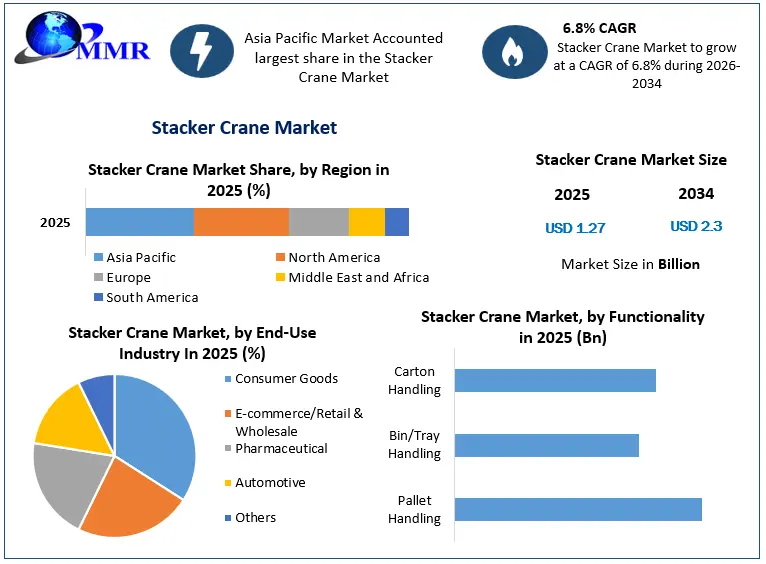
The Stacker Crane Market was valued at USD 1.27 billion in 2025 and is projected to reach nearly USD 2.3 billion by 2034, expanding at a 6.8% CAGR from 2026 to 2034, according to the latest market assessment. Stacker cranes are increasingly becoming an important component of automated storage and retrieval systems (AS/RS), enabling warehouses and manufacturing facilities to store and retrieve materials vertically with high accuracy while reducing floor-space requirements. The market is benefiting from the rapid adoption of warehouse automation, e-commerce fulfillment, labor shortages, rising operating costs, and the need for faster inventory movement. Stacker cranes can operate in narrow aisles and high-bay environments, making them particularly valuable where companies seek maximum storage density. The growing use of logistics robots, IoT-enabled material-handling equipment, warehouse management systems (WMS), and data-driven inventory control is further strengthening demand. MMR identifies industrialization in emerging economies, particularly across Asia, as another significant opportunity because expanding automotive, pharmaceutical, food and beverage, retail, and manufacturing sectors require modern distribution infrastructure. At the same time, high initial installation and integration costs remain a challenge for small and medium-sized businesses.
U.S. Market Trends and Investment
The United States is emerging as an important growth market as warehouse operators respond to labor shortages, rising labor costs and increasing e-commerce fulfillment requirements. In 2025, Daifuku strengthened its U.S. manufacturing footprint by completing a major expansion of its Hobart, Indiana facility. The company invested approximately USD 35 million to add manufacturing space and nearly double production capacity for material-handling systems, including technologies used in automated warehouses. The expansion was scheduled to begin operations in October 2025 and was designed to support growing automation demand in U.S. logistics and manufacturing. Dematic also expanded warehouse automation adoption in the U.S. through its 2025 Scentsy fulfillment-center project in Idaho, integrating AutoStore and warehouse-execution software and increasing picking capacity by nearly 50%. In addition, U.S. tax changes enacted in 2025 reinstated permanent 100% first-year expensing for qualifying machinery and equipment placed in service from January 20, 2025, potentially improving the investment case for capital-intensive automation projects. These developments indicate that automation investment is shifting from an efficiency option toward a strategic response to workforce and fulfillment pressures.
Request To Free Sample of This Strategic Report ➤ https://www.maximizemarketresearch.com/request-sample/161538/
Market Segmentation: Largest Share
By Type, the Single Column segment held the largest market share in 2025. Single-column stacker cranes are widely used because of their compact structure, efficient operation and suitability for fast-moving goods and e-commerce applications. They can support automated storage and retrieval while improving warehouse capacity and reducing unnecessary floor-space consumption. Manufacturers are also working to increase the load-handling capabilities of single-column systems, expanding their applicability beyond conventional warehouse operations into industrial applications.
By Operation Type, Automatic stacker cranes held the largest market share in 2025. Automated systems provide continuous storage and retrieval, reduce manual handling and improve warehouse throughput and inventory accuracy.
By End-Use Industry, Automotive held the largest market share in 2025. Automotive manufacturing requires efficient handling of components, dies, tires, molds and other heavy or high-value materials, making automated stacker cranes particularly suitable for high-density production and storage environments.
Competitive Analysis
The competitive landscape is led by established warehouse-automation and material-handling companies, with KION Group AG, Daifuku Co., Ltd., Murata Machinery Ltd., SSI SCHAEFER Group and Mecalux S.A. representing a leading competitive group. Industry estimates indicate that the five companies collectively account for a substantial portion of global stacker-crane revenue, with competition increasingly centered on automation software, system integration, energy efficiency, high-speed operation and global service capabilities.
KION Group AG: Through Dematic, KION maintains a strong position in warehouse automation and integrated material-flow solutions. In May 2025, KION opened a highly automated spare-parts distribution center in Germany following an investment of approximately €90 million, incorporating technology from Dematic and Linde Material Handling. KION's strategy of combining automated material handling with proprietary software supports greater warehouse visibility and optimization.
Daifuku Co., Ltd.: Daifuku is one of the leading global AS/RS suppliers. Its unit-load AS/RS portfolio includes high-speed stacker cranes, intelligent controls, energy-saving operation and power regeneration. In 2025, the company invested USD 35 million in expanding its U.S. manufacturing capacity, nearly doubling production capability and strengthening its ability to supply North American automation projects.
Murata Machinery Ltd.: Murata Machinery competes through automated material-handling, AS/RS and smart factory technologies. Its focus on integrating automated storage, production logistics and digital controls positions the company to benefit from manufacturers seeking end-to-end intralogistics solutions.
SSI SCHAEFER Group: SSI SCHAEFER is investing heavily in scalable automation and software. At LogiMAT 2025, the company highlighted AI-based predictive maintenance, scalable intralogistics solutions and WAMAS/SAP software integration. Such developments can improve equipment availability, reduce unplanned downtime and strengthen the business case for automated stacker-crane systems.
Mecalux S.A.: Mecalux continues to compete through automated warehouses, high-bay storage, stacker cranes and warehouse-management software. Its integrated approach allows customers to combine physical storage infrastructure with digital warehouse control, supporting higher throughput and more efficient space utilization.
Regional Analysis
United States: The U.S. is one of the most important national markets, supported by e-commerce, warehouse modernization, labor shortages and investments in automated fulfillment. The U.S. stacker-crane market generated approximately USD 206.2 million in 2024 and is forecast to reach USD 310.7 million by 2030, growing at 7.2% annually during 2025–2030 in one external market assessment.
Germany: Germany remains a major European market because of its advanced manufacturing base, automotive industry and mature intralogistics ecosystem. KION's €90 million automated distribution-center investment in 2025 illustrates continued investment in highly automated warehousing.
United Kingdom: The UK's large retail and e-commerce sector is encouraging investment in automated fulfillment centers, while warehouse labor availability and the need for faster order processing support adoption of AS/RS and stacker-crane technology.
France: France benefits from modernization of logistics infrastructure and increasing demand for efficient distribution and manufacturing warehouses. Automation helps operators increase storage density while reducing dependence on manual material handling.
Japan: Japan is a technologically mature market for automated storage systems, supported by labor constraints, manufacturing sophistication and strong robotics capabilities. Daifuku's global AS/RS portfolio demonstrates the country's leadership in high-density automated storage technology.
China: China represents a major growth opportunity because of rapid industrial automation, e-commerce, manufacturing expansion and investment in smart logistics. Its large manufacturing base provides significant applications for stacker cranes in automotive, electronics, consumer goods and distribution facilities.
Request To Free Sample of This Strategic Report ➤ https://www.maximizemarketresearch.com/request-sample/161538/
Key Players
Stacker Crane Market
1. Unit Load Stacker Cranes
Unit load stacker cranes are designed to handle large and heavy loads such as pallets, containers, and industrial components. They are commonly installed in high-bay warehouses and large distribution centers where high storage capacity and automated pallet handling are required.
Key Players:
1. Daifuku Co., Ltd. (Japan)
2. SSI SCHAEFER Group (Germany)
3. Swisslog AG (Switzerland)
4. Jungheinrich AG (Germany)
5. Vanderlande Industries B.V. (Netherlands)
6. TGW Logistics Group GmbH (Austria)
7. Murata Machinery, Ltd. (Japan)
8. Toyota Industries Corporation (Japan)
2. Mini Load Stacker Cranes
Mini load stacker cranes are specialized for handling smaller loads, bins, totes, trays, and cartons. These systems are widely used in e-commerce fulfillment centers, retail distribution, pharmaceutical warehouses, and spare parts storage where high-speed order picking and compact storage are essential.
Key Players:
1. KNAPP AG (Austria)
2. Swisslog AG (Switzerland)
3. SSI SCHAEFER Group (Germany)
4. Daifuku Co., Ltd. (Japan)
5. TGW Logistics Group GmbH (Austria)
6. Cassioli Group (Italy)
7. Interroll Group (Switzerland)
3. Single-Mast Stacker Cranes
Single-mast stacker cranes consist of a single vertical mast and are suitable for medium-height warehouses and lighter load applications. They offer a compact design, lower installation costs, and efficient operation for moderate storage requirements.
Key Players:
1. LTW Intralogistics GmbH (Germany)
2. MIAS Group (Germany)
3. Jungheinrich AG (Germany)
4. SSI SCHAEFER Group (Germany)
5. ATOX Sistemas de Almacenaje, S.A. (Spain)
4. Double-Mast Stacker Cranes
Double-mast stacker cranes are engineered for heavy loads, greater lifting heights, and high-speed operations. Their dual-column structure provides enhanced stability and precision, making them suitable for large automated warehouses and industrial facilities.
Key Players:
1. Daifuku Co., Ltd. (Japan)
2. Beumer Group GmbH & Co. KG (Germany)
3. Murata Machinery, Ltd. (Japan)
4. Mitsubishi Logisnext Co., Ltd. (Japan)
5. Toyota Industries Corporation (Japan)
6. Hyster-Yale Materials Handling, Inc. (United States)
5. Automated Storage & Retrieval System (AS/RS) Integrated Stacker Cranes
These advanced stacker cranes are integrated with warehouse management systems (WMS), robotics, IoT sensors, AI-based controls, and conveyor systems to enable fully automated storage, retrieval, and inventory management.
Key Players:
1. Swisslog AG (Switzerland)
2. KNAPP AG (Austria)
3. Daifuku Co., Ltd. (Japan)
4. SSI SCHAEFER Group (Germany)
5. Vanderlande Industries B.V. (Netherlands)
6. TGW Logistics Group GmbH (Austria)
7. Godrej Koerber Supply Chain Limited (India)
6. Heavy-Duty Industrial Stacker Cranes
Heavy-duty stacker cranes are designed for high-capacity industrial applications, including automotive manufacturing, metal processing, heavy machinery, and large component storage. They provide robust construction, high load-bearing capability, and reliable continuous operation.
Key Players:
1. CLARK Material Handling Company (United States)
2. Doosan Corporation (South Korea)
3. Mitsubishi Logisnext Co., Ltd. (Japan)
4. Toyota Industries Corporation (Japan)
5. Jungheinrich AG (Germany)
6. Beumer Group GmbH & Co. KG (Germany)
Conclusion
The Stacker Crane Market is positioned for sustained growth as warehouses and factories transition from conventional material handling toward automated, connected and space-efficient operations. MMR's forecast of nearly USD 2.3 billion by 2034 reflects the structural shift toward AS/RS, high-density warehousing and intelligent logistics. In our view, the strongest opportunity will come from the convergence of AI, IoT, warehouse-management software, robotics and energy-efficient stacker-crane systems. Manufacturers that can provide modular solutions with lower installation costs, predictive maintenance, regenerative energy systems and seamless WMS integration will be well positioned to capture demand. The expansion of e-commerce, automotive production, pharmaceuticals and emerging-market manufacturing will remain major growth engines, while investments in local production—such as Daifuku's U.S. expansion—are likely to shorten delivery times and accelerate market adoption.
About Maximize Market Research
Maximize Market Research Pvt. Ltd. (MMR) is a global market research and consulting company that provides reliable, data-focused, and practical business insights. The firm serves a wide range of industries, including healthcare, pharmaceuticals, technology, automotive, electronics, chemicals, personal care, and consumer goods. Through market forecasts, competitive analysis, strategic consulting, and industry impact assessments, MMR helps organizations understand changing market conditions, identify growth opportunities, and make informed business decisions for long-term success.
Contact Us
Maximize Market Research Pvt. Ltd.
2nd Floor, Navale IT Park Phase 3
Pune Banglore Highway, Narhe
Pune, Maharashtra 411041, India
Phone: +91 9607365656
Email: sales@maximizemarketresearch.com

 Arabic
 French
 Spanish
 Portuguese
 Deutsch
 Turkish
 Dutch
Dutch
 Italiano
 Russian
 Romaian
 Portuguese (Brazil)
 Greek
Greek