


Ultrasound Devices Market Forecast Driven by Smarter Diagnostic Systems
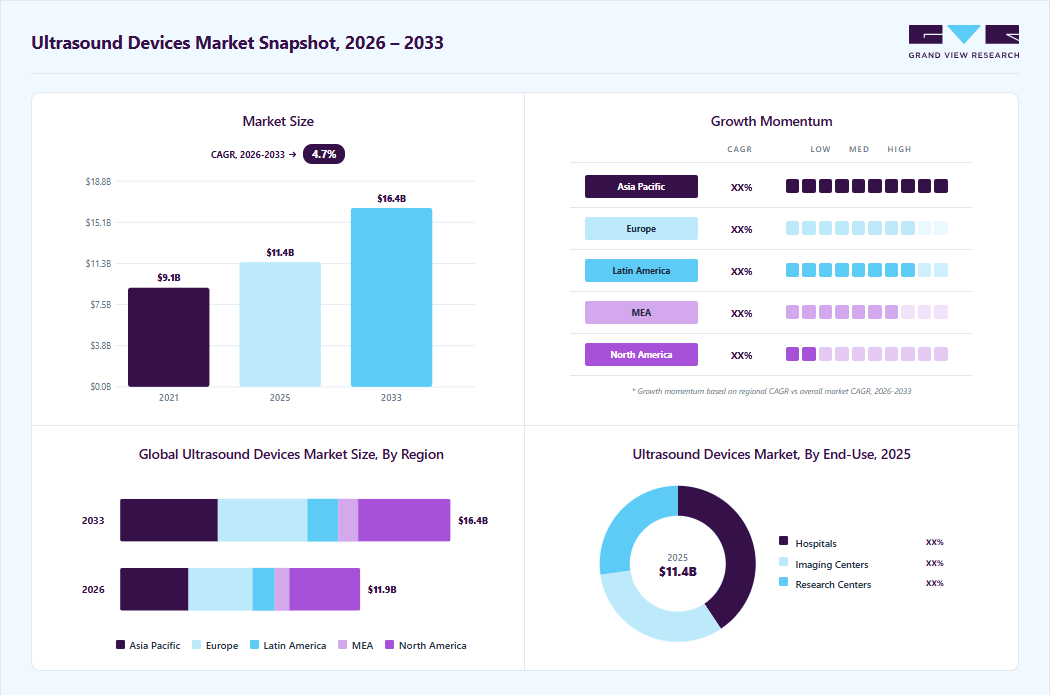
Healthcare providers are increasingly looking for imaging technologies that combine diagnostic efficiency, accessibility, and patient safety. Against this backdrop, the ultrasound devices market was valued at USD 10.9 billion in 2025 and is estimated to reach USD 11.4 billion in 2026. The market is projected to reach USD 15.7 billion by 2033, expanding at a 4.7% CAGR from 2026 to 2033. Rising use of ultrasound for diagnostic imaging and treatment, along with the growing prevalence of chronic and lifestyle-related diseases, is supporting this expansion.
Diagnostic Imaging Continues to Anchor Market Demand
Diagnostic ultrasound devices remain the core of the industry, accounting for 84.2% of revenue in 2025. Their broad use across areas such as obstetrics, cardiology, and oncology continues to sustain demand. Technological improvements and the increasing prevalence of lifestyle-related diseases are also supporting adoption.
The market is evolving beyond conventional imaging as manufacturers introduce systems that combine advanced visualization with automation. Developments in 2D, 3D/4D, and Doppler technologies are helping healthcare professionals obtain more detailed and useful clinical information. Therapeutic ultrasound devices, meanwhile, are expected to record the fastest CAGR of 5.05% from 2026 to 2033, with high-intensity focused ultrasound holding the largest revenue share within the segment in 2025.
Portability Is Changing Where Ultrasound Can Be Used
Cart/trolley-based systems accounted for 67.6% of revenue in 2025, supported by their usefulness in intensive care units, emergency departments, and other settings where moving critical patients can be difficult. These systems enable rapid imaging and contribute to faster treatment decisions.
At the same time, handheld ultrasound devices are gaining momentum. The segment is expected to grow at a 6.04% CAGR during the forecast period because of portability, cost-effectiveness, and rapid point-of-care diagnostics. AI-assisted image acquisition and interpretation are further simplifying workflows and helping clinicians perform imaging at the bedside, in emergency environments, and in resource-limited settings.
Radiology and Women's Health Expand Application Opportunities
Radiology represented the largest application segment with a 22.4% revenue share in 2025. Increasing use of artificial intelligence in radiology is contributing to segment growth, while product expansion and acquisitions are helping manufacturers strengthen their technology portfolios.
Obstetrics and gynecology is expected to record the fastest application growth, with a 5.34% CAGR from 2026 to 2033. Ultrasound plays an important role in monitoring fetal development and maternal health, while gynecological applications support the identification of conditions such as ovarian cysts, uterine fibroids, and endometriosis. Advances in 3D/4D imaging, Doppler ultrasound, and AI-assisted diagnostics are adding further capabilities.
Hospitals Remain the Largest End-Use Setting
Hospitals accounted for 40.7% of revenue in 2025 and are expected to grow at the fastest CAGR over the forecast period. The extensive use of ultrasound across radiology, cardiology, emergency medicine, and intensive care supports this position.
Hospitals are also adopting AI-enabled imaging, 3D/4D visualization, high-resolution systems, and portable equipment. Imaging centers represent another important opportunity, with the segment expected to grow at a 4.62% CAGR. Their cost-effectiveness, faster turnaround times, specialized diagnostic capabilities, and increasing use of advanced ultrasound technologies are supporting demand.
AI and Smart Imaging Define the Next Stage of Innovation
Artificial intelligence is becoming an important part of ultrasound development. AI-assisted image acquisition and interpretation can reduce operator dependency while improving workflow and diagnostic efficiency. The industry is also moving toward compact, smart, and highly precise imaging solutions.
Wireless transducers, app-based ultrasound, cloud connectivity, tele-ultrasound, fusion with CT/MR, laparoscopic ultrasound, elastography, and contrast-enhanced imaging are broadening the technology's clinical applications. These innovations are helping make ultrasound faster, more accessible, and increasingly patient-centric.
Regulation and Product Innovation Will Shape Competition
The ultrasound devices industry is moderately competitive, with major companies including GE HealthCare, Siemens Healthineers, Philips Healthcare, and Canon Medical Systems Corporation. Companies are investing in product upgrades, partnerships, AI capabilities, and new clinical applications to strengthen their positions.
Recent developments highlight this direction. In February 2026, GE HealthCare introduced next-generation LOGIQ ultrasound systems featuring AI-powered automation and digital platforms. In March 2026, Butterfly Network received FDA clearance for an AI-powered gestational-age estimation tool integrated into its handheld ultrasound platform. In December 2025, Clarius Mobile Health expanded its AI-enabled portfolio with new FDA-cleared AI models.
Regulatory requirements remain important as imaging systems increasingly incorporate AI, cloud functionality, cybersecurity, and software-based medical capabilities. Although compliance can lengthen approval timelines, it remains essential for maintaining safety, reliability, and clinical confidence.
FAQs
1. What is driving the ultrasound devices market?
The key factors include increasing use of ultrasound for diagnostic imaging and therapy, rising chronic and lifestyle-related diseases, demand for minimally invasive procedures, technological advancements, and expanding adoption of portable and AI-enabled systems.
2. Which segment leads the ultrasound devices market?
Diagnostic ultrasound devices led the product segment with an 84.2% revenue share in 2025, while cart/trolley-based devices led portability, radiology led applications, and hospitals led end use.
Key Ultrasound Devices Companies:
· Koninklijke Philips N.V.
· GE Healthcare
· Siemens Healthineers AG
· Canon Medical Systems
About us:
Grand View Research, a market research and consulting company, provides syndicated research reports, customized research reports, and consulting services. Grand View Research database is used by the world's renowned academic institutions and Fortune 500 companies to understand the global and regional business environment. Our database features thousands of statistics and in-depth analysis on 46 industries in 25 major countries worldwide.

 English
 Arabic
 French
 Spanish
 Portuguese
 Deutsch
 Turkish
 Dutch
Dutch
 Italiano
 Russian
 Romaian
 Portuguese (Brazil)