


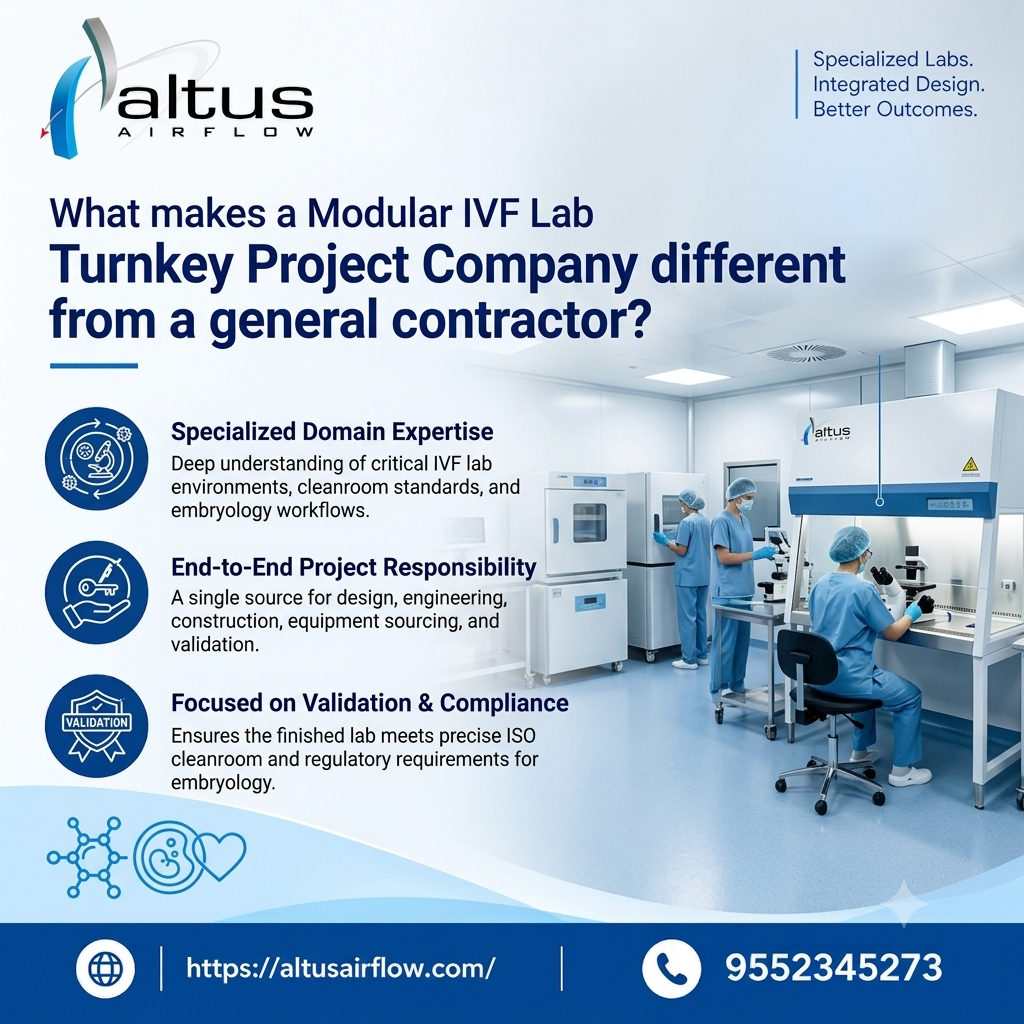
What Makes a Modular IVF Lab Turnkey Project Company Different From a General Contractor?
Introduction
Altus Airflow approaches IVF laboratory development through specialized planning where a Modular IVF Lab Turnkey Project Company combines modular construction with controlled-environment engineering and coordinated laboratory infrastructure. Unlike a general contractor, the focus extends beyond conventional construction to HVAC, filtration, environmental monitoring, utilities, electrical systems, workflow, contamination control, and laboratory-specific requirements.
A general contractor can coordinate multiple construction trades, while a specialized IVF project provider focuses on integrating systems required for reproductive healthcare environments. This distinction can influence design coordination, installation quality, testing, commissioning, documentation, and long-term laboratory performance.
1. Specialized IVF Laboratory Knowledge
The most significant difference is specialization. IVF laboratories have requirements that are different from ordinary commercial or healthcare construction.
Embryology areas, sample-handling spaces, procedure rooms, storage areas, and supporting zones may require carefully coordinated environmental conditions and workflows.
A specialized provider understands that laboratory infrastructure must be designed around sensitive procedures, equipment, personnel movement, sample handling, and contamination-control considerations.
A general contractor may manage the construction process effectively but may rely on external specialists for many of these laboratory-specific decisions.
2. Integrated Modular Construction
A Modular IVF Lab Turnkey Project Company combines modular construction with engineering services instead of treating walls and ceilings as separate construction elements.
Modular wall and ceiling systems can be designed around HVAC diffusers, electrical outlets, medical utilities, data connections, doors, windows, monitoring systems, and laboratory equipment.
This integrated approach can simplify coordination because service locations are considered before manufacturing and installation.
The result is a laboratory environment where the physical enclosure and technical infrastructure are developed as connected systems.
3. Controlled HVAC and Airflow Planning
IVF laboratories require carefully considered environmental conditions. HVAC design can influence temperature, humidity, air quality, filtration, pressure relationships, and airflow distribution.
A specialized provider evaluates these factors together with room function and equipment requirements.
General contractors may coordinate HVAC subcontractors, but a specialist laboratory provider can take a more integrated approach by coordinating air distribution with modular ceilings, filtration, equipment heat loads, room zoning, and monitoring systems.
This can be particularly important where environmental stability is a key operational requirement.
4. HEPA Filtration Integration
Filtration is another area where specialized laboratory knowledge can make a difference.
A turnkey IVF provider can consider filter selection, installation location, housing, accessibility, airflow requirements, pressure drop, maintenance, and testing as part of the overall environmental strategy.
HEPA filtration should not be viewed as an isolated component. Its effectiveness depends on proper installation, sealing, airflow, maintenance, and appropriate testing.
A general contractor may procure filtration equipment through a specialist subcontractor, whereas an IVF-focused provider can coordinate filtration with the complete laboratory design.
5. Contamination-Control Considerations
Contamination control is central to specialized laboratory environments. It involves more than installing cleanable wall panels.
Room zoning, airflow patterns, pressure relationships, personnel movement, material movement, equipment placement, cleaning access, sealed penetrations, and surface finishes all contribute to the overall environment.
A Modular IVF Lab Turnkey Project Company can consider these elements from the beginning of the design.
This integrated planning can reduce conflicts between construction requirements and laboratory operations.
6. IVF-Specific Workflow Planning
Workflow is another important distinction. IVF laboratories require carefully organized movement of staff, samples, equipment, and materials.
The layout should support efficient transitions between relevant laboratory activities while reducing unnecessary movement.
Specialized providers can coordinate room dimensions, workstations, storage, equipment locations, doors, service points, and access routes around the intended IVF workflow.
A general contractor can construct the approved layout, but the responsibility for developing a laboratory-specific workflow may rest with architects, consultants, or clinical teams.
7. Equipment Coordination
IVF equipment often has specific electrical, environmental, spatial, utility, and maintenance requirements.
A specialist provider can review equipment specifications during the infrastructure design stage.
Important considerations may include equipment dimensions, power loads, heat generation, data connectivity, utility requirements, ventilation, service clearance, and access for maintenance.
Early equipment coordination can reduce the need for modifications after construction and help ensure that the laboratory is prepared for equipment installation.
8. Electrical Infrastructure Planning
Laboratory equipment can place significant demands on electrical infrastructure. The design should consider dedicated circuits, power quality, emergency power interfaces, equipment connections, lighting, data systems, and future capacity.
A specialist provider coordinates electrical infrastructure with equipment placement and modular construction.
This can help prevent poorly located outlets, excessive cable runs, and conflicts between electrical services and laboratory work areas.
A general contractor may manage electrical installation through a subcontractor, but the specialized provider can integrate the electrical system more closely with the laboratory's operational requirements.
9. Medical Gas and Utility Coordination
Depending on the IVF laboratory design, specific utility systems may be required. These can include medical gases, vacuum, compressed air, water, drainage, or other services.
A specialized turnkey provider coordinates these utilities with walls, ceilings, HVAC, electrical infrastructure, and equipment.
Utility outlets can be positioned according to the intended laboratory workflow and equipment requirements.
This reduces the risk of having to modify completed walls or ceilings after equipment installation.
10. Modular Manufacturing and Installation
A general contractor often works with multiple construction trades on site. A modular laboratory provider can manufacture specialized wall and ceiling components according to approved drawings before installation.
This can improve dimensional consistency and allow service openings to be prepared in advance.
Factory-controlled manufacturing may also reduce some site-based fabrication activities.
Installation then focuses on assembling the planned modular environment and integrating the technical services.
11. Environmental Monitoring
Specialized IVF laboratories can benefit from monitoring systems that track relevant environmental conditions.
Depending on the project, monitoring may include temperature, humidity, differential pressure, HVAC status, alarms, and other selected parameters.
A specialist provider can integrate sensors and monitoring points into the modular infrastructure and connect them with suitable control or building management systems where required.
This provides the laboratory team with greater visibility into environmental conditions.
12. Testing and Commissioning
One of the major differences between a construction-focused contractor and a specialized turnkey provider is the emphasis on integrated commissioning.
Testing can include airflow measurements, room pressure verification, temperature and humidity checks, filtration testing where applicable, electrical testing, utility testing, alarm verification, and functional performance checks.
The systems should be reviewed individually and as an integrated laboratory environment.
A Modular IVF Lab Turnkey Project Company can coordinate these activities and compile relevant results for handover.
13. Documentation and Technical Handover
Specialized laboratories require useful technical documentation for operation and maintenance.
Handover documentation may include as-built drawings, HVAC information, equipment details, testing reports, commissioning records, maintenance instructions, warranties, electrical documentation, and utility layouts.
A specialist provider can organize these documents around the installed laboratory infrastructure.
Complete documentation makes it easier for facility teams to understand the systems and plan future maintenance or modifications.
14. Project Management Under One Scope
A turnkey provider can bring several technical activities under a coordinated project scope.
Design, modular manufacturing, HVAC, electrical systems, medical utilities, installation, testing, and commissioning can be managed as connected activities.
This can reduce the number of separate interfaces that the clinic must coordinate.
A general contractor may also provide project management, but specialized laboratory systems can require additional coordination with consultants, equipment vendors, HVAC specialists, and laboratory teams.
15. Quality Control
Quality control in an IVF laboratory should cover both construction and technical performance.
Modular panels should be inspected for alignment, joints, sealing, surface quality, and installation accuracy.
HVAC and filtration systems should undergo appropriate testing. Electrical and utility installations should be checked before handover.
A specialist provider can establish quality checks across different project stages rather than relying only on final visual inspection.
16. Maintenance Planning
Maintenance requirements should be considered during design, not after the laboratory is completed.
Filter access, HVAC servicing, sensor replacement, electrical maintenance, utility isolation, and equipment service clearances should be planned into the layout.
A specialist provider can identify these requirements while developing the infrastructure.
This can make future maintenance more practical and reduce the need to disturb controlled laboratory areas unnecessarily.
17. Future Expansion Capability
IVF clinics may expand equipment, services, or laboratory capacity over time. Infrastructure should therefore be designed with reasonable flexibility where possible.
Future electrical capacity, data points, utility routes, monitoring systems, and modular expansion options can be considered during the initial project.
Modular construction can offer advantages when future modifications are required because certain components may be easier to reconfigure than conventional permanent construction.
18. Coordination With Clinical and Technical Teams
An IVF project requires communication between clinical teams, laboratory personnel, architects, engineers, equipment suppliers, facility managers, and contractors.
A specialized turnkey provider can act as an important coordination point between these groups.
This helps translate laboratory requirements into practical infrastructure decisions and ensures that technical installations remain aligned with the intended workflow.
19. Greater Focus on Integrated Performance
A general contractor's primary responsibility is often construction delivery. A specialized IVF provider has a stronger focus on how the completed laboratory's systems work together.
The HVAC system must work with the room enclosure. Electrical systems must support equipment. Modular panels must accommodate services. Monitoring systems must reflect environmental requirements. Equipment placement must work with workflow.
This integrated perspective is one of the most important distinctions between a general construction approach and a specialized laboratory turnkey approach.
20. End-to-End Responsibility
A Modular IVF Lab Turnkey Project Company can provide an end-to-end approach covering planning, design, engineering, modular manufacturing, installation, system integration, testing, commissioning, and handover.
This does not mean that every specialist task is necessarily performed by one individual team. Instead, the provider coordinates the required disciplines under a unified project structure.
For clinics, this can simplify communication, improve accountability, and make it easier to track project progress from initial planning through operational readiness.
Conclusion
The main difference between a Modular IVF Lab Turnkey Project Company and a general contractor is the level of specialization and system integration. While general contractors can manage broad construction activities, a specialized IVF provider focuses on controlled environments, modular construction, HVAC, filtration, utilities, electrical systems, workflow, equipment coordination, monitoring, testing, commissioning, and long-term maintainability.
Altus Airflow brings together modular laboratory infrastructure and specialized engineering coordination for IVF environments. Altus Airflow can support clinics through planning, design, manufacturing, installation, integration, testing, commissioning, and technical handover while considering the specific requirements of reproductive healthcare facilities.
FAQs
1. What makes a Modular IVF Lab Turnkey Project Company different from a general contractor?
A Modular IVF Lab Turnkey Project Company specializes in integrating IVF laboratory construction with HVAC, filtration, modular systems, utilities, electrical infrastructure, workflow, equipment coordination, testing, and commissioning.
2. Does a turnkey IVF provider handle HVAC?
Yes. HVAC planning and integration can be included as part of the complete laboratory infrastructure scope.
3. Can a specialized provider coordinate IVF equipment?
Yes. Equipment dimensions, power requirements, heat loads, utilities, data connections, and service clearances can be considered during design.
4. Why is modular construction useful for IVF labs?
Modular construction provides controlled, cleanable surfaces and can allow technical services to be integrated efficiently into walls and ceilings.
5. Does a turnkey provider handle HEPA filtration?
It can. HEPA filtration can be incorporated into the overall HVAC and environmental-control strategy with appropriate testing and maintenance planning.
Read Our Previous Blog ---------------> What automation features are included in Andrology Room Setup Services?

 English
 Arabic
 Spanish
 Portuguese
 Deutsch
 Turkish
 Dutch
Dutch
 Italiano
 Russian
 Romaian
 Portuguese (Brazil)
 Greek
Greek