


Trade Credit Insurance Market Growth and Emerging Business Needs
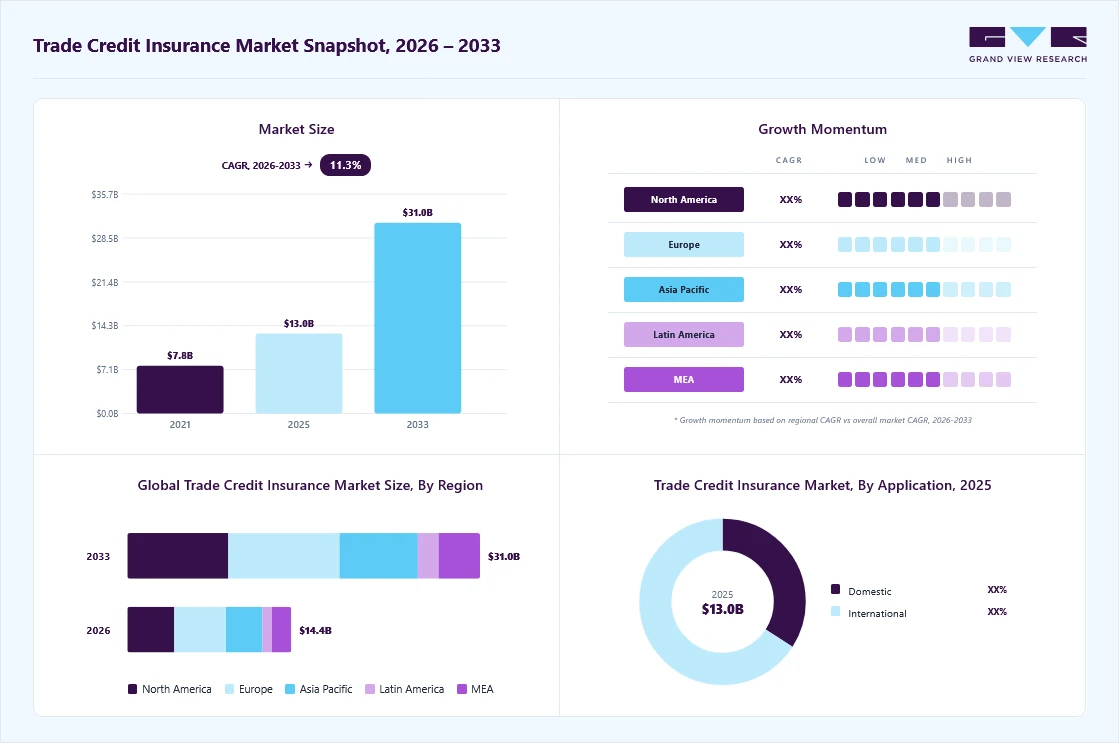
When businesses sell goods or services on credit, a delayed payment or buyer default can quickly affect working capital and operational stability. Trade credit insurance is becoming an important risk-management tool for companies seeking to protect receivables while maintaining commercial relationships. The trade credit insurance market was valued at USD 13.0 billion in 2025 and is projected to grow from USD 14.4 billion in 2026 to USD 31.0 billion by 2033, registering a CAGR of 11.3% from 2026 to 2033. Increasing trade complexity, uncertainty surrounding buyer payments, and the adoption of digital risk-management tools are shaping demand for these insurance solutions.
Large Enterprises Remain the Main Source of Demand
Large enterprises accounted for 60.0% of market revenue in 2025, reflecting their exposure to substantial receivables, high-value transactions, and extended payment terms. For companies operating across multiple markets, a single major customer default can disrupt cash flow and affect business continuity. Trade credit insurance helps protect against losses arising from buyer insolvency, bankruptcy, and prolonged payment defaults.
These policies can also support credit management by helping businesses evaluate customer risk before extending payment terms. Large organizations increasingly use this protection to maintain financial stability while pursuing commercial growth.
Small and medium enterprises (SMEs), however, are expected to record the fastest CAGR during the forecast period. Smaller businesses can be particularly vulnerable when sales revenue remains tied up in unpaid invoices. Insurance protection can help them manage receivables, support working capital, and pursue new customers with greater confidence.
Coverage Options Address Different Business Risks
Whole turnover coverage held the largest share of the market in 2025. This approach protects a company's broader portfolio of receivables rather than focusing on only one customer. It can support credit-control operations and provide businesses with more comprehensive protection against non-payment across their debtor base.
Single buyer coverage offers a more targeted alternative. It is designed to protect transactions with a particular customer and can be useful when a business begins working with a new buyer or faces concentrated exposure to one account. Demand for tailored policies is expected to support this segment as companies look for flexible ways to manage customer-specific credit risks.
International Trade Makes Payment Protection More Important
International transactions represented the largest application segment in 2025. Cross-border sales expose businesses to payment risks that may be complicated by different commercial environments, trade regulations, and economic conditions. Trade credit insurance can provide conditional protection when a foreign buyer fails to pay, helping exporters manage receivables and pursue international opportunities.
Domestic applications are expected to grow at the fastest CAGR during the forecast period. Businesses selling within their own markets are also seeking protection against bad debts, customer concentration, and cash-flow disruptions. As companies reassess credit policies, insurance can become part of a broader approach to receivables management.
Food and Beverage Businesses Lead End-Use Demand
The food and beverage segment held the largest market revenue share in 2025. Companies in this industry often operate with tight margins while navigating changing consumer expectations and fluctuating agricultural commodity prices. Offering extended payment terms can help maintain customer relationships, but it can also increase exposure to delayed payments and unpaid invoices.
Automotive is expected to record the fastest CAGR during the forecast period. High-value transactions, supply-chain complexity, changing consumer preferences, and evolving regulations create credit-management challenges for automotive businesses. Trade credit insurance can help suppliers and other participants manage the financial risks associated with selling to customers on credit.
Digital Tools Are Reshaping Credit Risk Management
Insurers are increasingly using digital platforms, APIs, data analytics, blockchain, and artificial intelligence to improve information access and streamline services. Better business information can help insured companies assess potential buyers, identify payment difficulties, and make more informed credit decisions.
Partnerships are also expanding access to trade credit solutions. In August 2025, M1xchange partnered with Tata AIG to introduce trade credit insurance on its TReDS platform, aiming to strengthen risk protection for financiers and improve MSME access to working capital. In July 2025, DUAL Europe launched its trade credit insurance business, supported by A-rated carrier Axeria.
These developments illustrate how digital distribution and strategic collaboration are extending insurance capabilities across business financing and receivables management.
Affordability and Awareness Remain Important Challenges
Despite rising demand, trade credit insurance can be costly and complex to administer. Limited awareness among businesses and differences in trade regulations across jurisdictions may also slow adoption. Insurers therefore face the challenge of making policies easier to understand, access, and manage while providing effective protection against evolving commercial risks.
As businesses continue to balance growth with financial resilience, demand for solutions that protect receivables and support informed credit decisions is expected to remain an important market driver.
FAQs
1. What is driving the trade credit insurance market?
Increasing trade complexity, non-payment risks, economic uncertainty, SME expansion, and digital tools for credit assessment are supporting demand for trade credit insurance.
2. Which segment leads the trade credit insurance market?
Large enterprises led by enterprise size, accounting for 60.0% of market revenue in 2025. Whole turnover coverage led the coverage segment, international transactions led applications, and food and beverage led end use.
Key Trade Credit Insurance Companies:
· Allianz Trade
· Atradius N.V.
· Coface
· American International Group, Inc. (AIG)
About us:
Grand View Research, a market research and consulting company, provides syndicated research reports, customized research reports, and consulting services. Grand View Research database is used by the world's renowned academic institutions and Fortune 500 companies to understand the global and regional business environment. Our database features thousands of statistics and in-depth analysis on 46 industries in 25 major countries worldwide.

 English
 Arabic
 French
 Portuguese
 Deutsch
 Turkish
 Dutch
Dutch
 Italiano
 Russian
 Romaian
 Portuguese (Brazil)
 Greek
Greek