


Polki Jewellery: Meaning, History and the Types
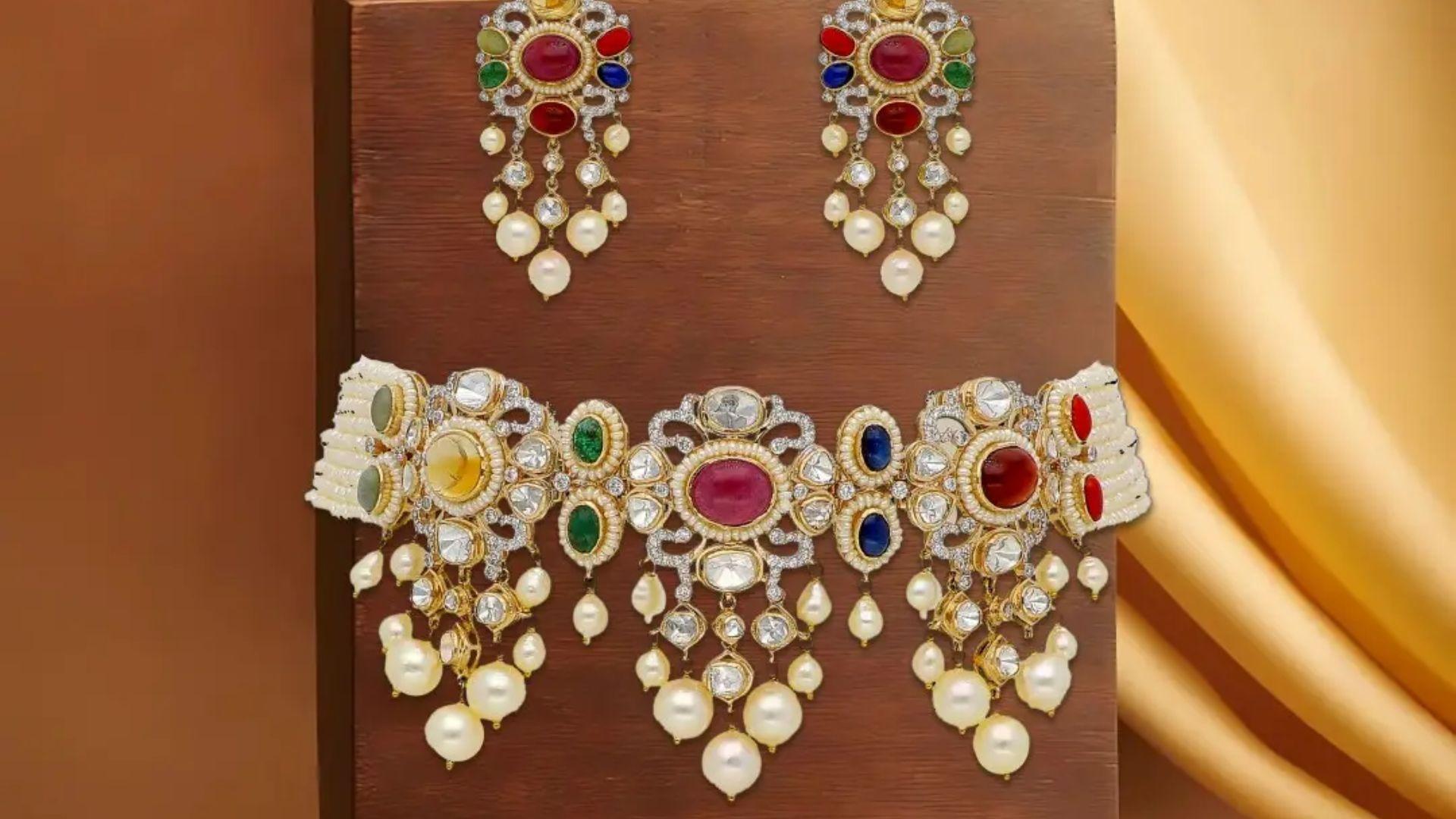
A bridal buyer's guide to India's uncut diamond heirloom
Hold a polki necklace near a window and it does not flash. It glows, soft and watery, like lamplight on a river at dusk. Polki jewellery is made from uncut, unpolished diamonds, set by hand into gold. Every stone keeps the shape it was born with, so no two pieces are ever quite alike. In this jewellery buying guide, you will learn what polki is, where it comes from, how it is made, how to judge quality and how to spot the real thing before you pay.
What is polki jewellery?
Polki is jewellery set with natural diamonds that have been left uncut, or barely shaped. Think of a rough diamond that has been cleaned, not carved into facets.
Unlike a modern brilliant-cut diamond, which throws sharp white sparks, a polki stone glows softly instead of flashing. The surface is flat, slightly uneven, raw and radiant.
The stones are usually set in gold with a thin foil backing and often finished with meenakari (enamel work) on the reverse. That is why many polki pieces look pretty from both sides.
The result is jewellery with presence. It sits heavy and warm on the skin, and the light moves across it slowly instead of snapping back. Many brides describe it as quietly opulent.
Where does polki come from? Origin and history
India has worked with diamonds for centuries, and uncut stones were prized long before the modern brilliant cut existed [VERIFY]. Royal courts, especially in Rajasthan and the Mughal era, favoured large, glowing stones set in heavy gold [VERIFY].
The craft grew from jadau, the traditional Rajasthani method of setting stones into gold by hand. Jadau goldsmiths passed their skills from one generation to the next, often within a single family.
Unlike machine-made jewellery, early polki pieces were shaped around the stone, not the other way round. The goldsmith studied each diamond and built a setting that suited its outline.
That habit still defines good polki today. The best pieces feel organic, as if the gold grew around the diamond, and you can see the maker's patience in every small curve.
How is polki jewellery made?
Making polki is slow, patient work. Most pieces follow these steps:
- Design. A sketch maps where each stone will sit, from the largest centre diamond to the smallest edge pieces.
- Gold frame. The goldsmith shapes a gold base with small wells (cups) to hold each stone.
- Foil and setting. A thin foil is placed in the well, the stone is pressed in, and gold is gently closed around its edge.
- Enamelling. Many pieces get meenakari on the back, in deep reds, greens and blues.
- Finishing. The piece is cleaned, checked stone by stone and strung or fitted with its clasp.
A single heavy necklace can take weeks, depending on size and detail [VERIFY]. That is part of its character.
How is polki quality and grading judged?
Polki is not graded in the same way as polished diamonds, because there is no cut to assess. Instead, buyers look at a few plain, practical things:
- Clarity. Uncut stones often show tiny natural marks. Fewer and fainter is better.
- Colour. Most polki diamonds look soft white, grey or slightly warm. Even tone across a piece matters.
- Size and weight. Larger, flatter stones cost more. Ask for the total diamond weight in carats.
- Matching. On a necklace, stones should feel balanced in size and shade.
- Gold quality. Check the purity and weight of the metal. Look for a hallmark.
Always ask whether the diamonds are natural and whether a grading report is available for the main stones [VERIFY]. A trustworthy jeweller will answer plainly.
What are the types of polki jewellery?
1. Polki necklaces and sets
- The bridal centrepiece, often worn with matching earrings
- Ranges from short chokers to long, layered haars
- Usually the biggest investment of the trousseau
2. Polki chokers
- Sit close to the neck, regal and structured
- Pair well with open necklines and heavy bridal blouses
- Often combined with pearls or emeralds for colour
3. Polki earrings
- Studs for a soft, everyday glow
- Jhumkas (bell-shaped drops) and chandbalis (crescent drops) for ceremony
- Easiest first purchase if you are new to polki
4. Polki bangles and kadas
- Worn in pairs or stacks on the wrist
- Heavier styles carry more gold and more stones
- Check the inner surface for smooth, comfortable finishing
5. Polki maang tikka and rings
- Maang tikka sits at the parting of the hair
- Rings and smaller pieces suit gifting
- Good for adding polki without a full set
Polki vs kundan: what is the difference?
Polki and kundan look related, but they are different. Kundan uses glass or other stones set with pure gold foil. Polki uses natural uncut diamonds.
Unlike kundan, which is often brighter and more colourful, polki has a quieter, deeper glow. It also tends to cost more, because the stones are real diamonds.
Both can look opulent at a wedding. Choose kundan for lighter weight and a lower budget. Choose polki when you want diamonds, heirloom value and a softer, old-world shine. Remember that resale or buyback value depends on the jeweller's policy and current gold and diamond rates, so ask before you buy.
Why is polki so important at Indian weddings?
For many families, polki is the jewellery of ceremony. It appears at engagements, receptions and the wedding itself, often passed from mother to daughter.
Regional styles differ. Rajasthani jadau work is known for its heavy, colourful detail. Other regions favour lighter pieces or different enamel colours [VERIFY].
Symbolically, uncut diamonds suggest purity and a stone left true to its nature. Many brides choose polki because it feels rooted, handcrafted and full of character, not showy.
It also works across generations. A polki set bought for a wedding is often worn again at a daughter's engagement, which gives each piece a story, a little extra ceremony and a place in the family.
How do I identify real polki jewellery?
Use this simple checklist before you buy:
- Look closely with a loupe (a small magnifier). Real polki stones show slight surface unevenness and tiny natural marks. Perfect, identical facets are a warning sign.
- Check the back. Quality work is neat, with clean gold edges and often fine enamel.
- Ask for paperwork. You should receive an invoice listing gold weight, diamond weight and purity, plus any grading report.
- Look for the hallmark. Gold jewellery in India carries a BIS hallmark (a government quality mark) [VERIFY].
- Compare weight and price. If a heavy set is priced very low, ask why.
- Check the return policy. A reliable jeweller has clear exchange and buyback terms.
When in doubt, get a second opinion from a certified gemmologist or valuer.
Polki jewellery at Shaadinama
Craft like this deserves a home that respects it. At Shaadinama, the bridal house of Talla Jewellers, we treat polki as ceremony, not decoration.
Our polki collection includes necklace sets, chokers and diamond polki stud earrings, set in 14KT (583) gold. Pieces such as the Marquise Petal Polki Necklace Set, the Rajvanshi Emerald Polki Choker Set and the Navara Pearl Polki Choker Set show how colour and heritage can sit together.
If you want to see a price before visiting, the JadeCascade Royal Polki Long Set is listed at ₹14,92,386.85 including GST [VERIFY: price may change]. Many other pieces are available on request for a quote.
You can explore the full range, find a store near you, or message us on WhatsApp. Our team will walk you through weights, stones and policies, with no pressure.
Frequently asked questions
Is polki real diamond? Yes, polki is made with natural uncut diamonds. Ask your jeweller to confirm this in writing on the invoice.
Is polki jewellery expensive? Usually, yes, because it uses real diamonds and a lot of handwork. Price depends on diamond weight, gold weight and design.
How is polki different from kundan? Polki uses natural uncut diamonds, while kundan uses glass or other stones. Polki has a softer glow and costs more.
Can I wear polki every day? Yes, in small pieces such as studs or a slim pendant. Heavy sets are better kept for ceremony.
How do I spot fake polki? Check three things. Look through a loupe for natural surface variation, inspect the neatness of the back, and ask for an invoice with diamond weight and hallmark details. Perfectly uniform stones are a red flag.
How should I care for polki jewellery? Keep it dry, store it in a soft pouch and wear it after perfume and makeup. Avoid harsh cleaners, and have it checked by your jeweller once a year.
Does polki gain value over time? Not guaranteed. Gold and diamond rates change, and resale depends on the stones and the jeweller's buyback terms. Treat it as an heirloom first.

 English
 Arabic
 French
 Spanish
 Portuguese
 Deutsch
 Dutch
Dutch
 Italiano
 Russian
 Romaian
 Portuguese (Brazil)
 Greek
Greek