


How Does an Andrology Room Setup Company Integrate HEPA Filtration Systems?
Introduction
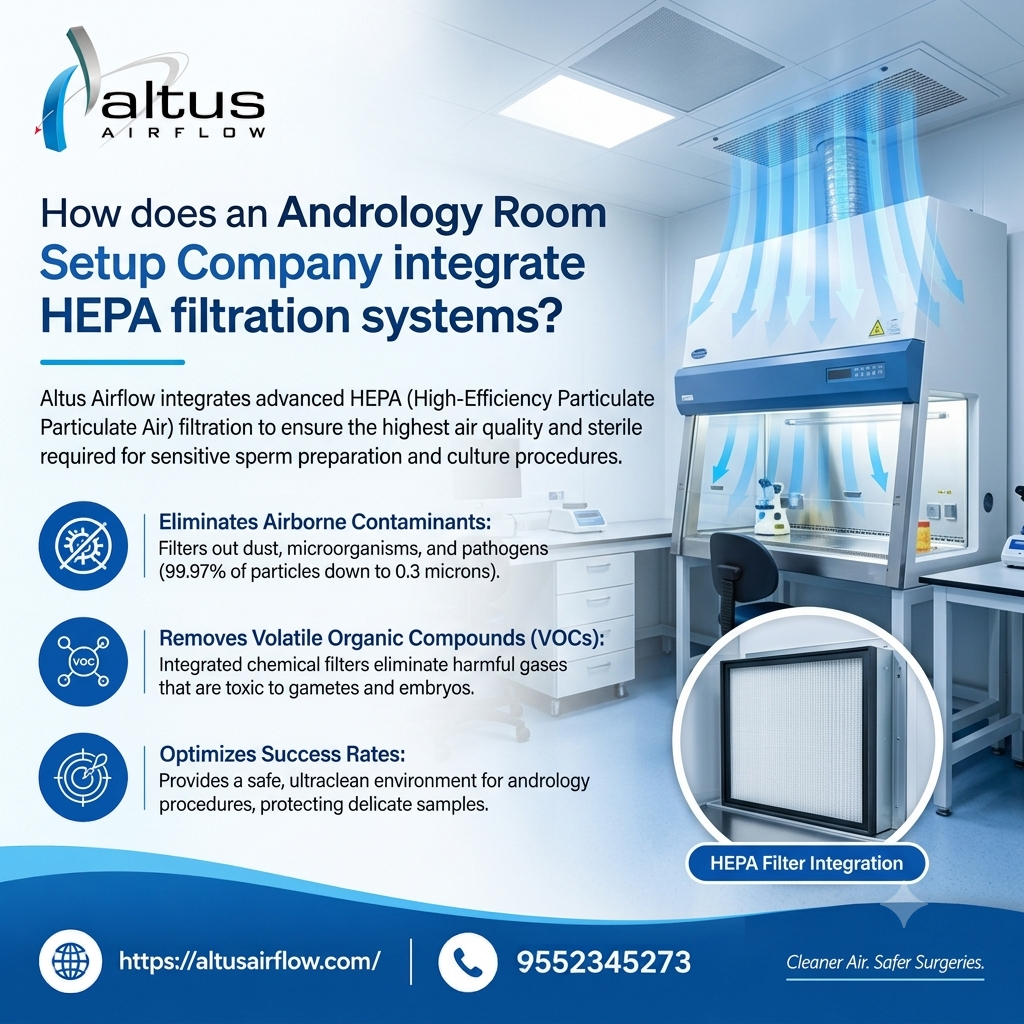
Altus Airflow supports the development of controlled laboratory environments for fertility clinics and healthcare facilities. An Andrology Room Setup Company integrates HEPA filtration systems by coordinating air handling equipment, filter housings, ductwork, airflow distribution, and environmental monitoring with the laboratory layout. Proper integration helps reduce airborne particulate levels and supports the environmental requirements of andrology procedures. The filtration system must be selected according to laboratory activities, equipment specifications, ventilation needs, and applicable standards to ensure reliable performance and practical long-term maintenance.
1. Understanding HEPA Filtration in Andrology Rooms
High-efficiency particulate air (HEPA) filters are designed to remove a high proportion of airborne particles from the air passing through them. They are used in certain controlled healthcare and laboratory environments where particulate control is important.
In an andrology laboratory, procedures may include semen analysis, sperm preparation, microscopy, and other activities related to reproductive health. The environmental requirements depend on the procedures performed and the equipment used. HEPA filtration may be incorporated when supported by the laboratory's design requirements, risk assessment, or applicable standards.
A HEPA filtration system typically includes several components:
-
HEPA filter elements with specified filtration performance.
-
Filter housings designed to prevent air bypass.
-
Air handling equipment capable of providing the required airflow.
-
Ductwork and supply outlets, where applicable.
-
Pressure measurement points or filter condition indicators.
-
Access provisions for inspection, testing, and replacement.
Selecting a filter alone is not sufficient. The complete system must be designed, installed, and tested to ensure that air passes through the intended filtration pathway without unacceptable leakage or bypass.
2. Assessing Laboratory Requirements Before Installation
Before integrating HEPA filtration, the design team should understand how the andrology room will be used. Different laboratory activities may have different requirements for ventilation, temperature, humidity, cleanliness, and equipment placement.
An initial assessment helps establish whether HEPA filtration is necessary and what type of installation is appropriate.
The assessment should consider:
Laboratory procedures: Identify the tests and sample preparation activities performed in the room.
Equipment specifications: Review environmental and ventilation requirements for microscopes, analysers, incubators, and other instruments.
Room dimensions: Determine the room volume, ceiling height, and available space for filters, ducts, and air handling components.
Occupancy: Consider the number of staff, movement patterns, and the effect of door openings on environmental conditions.
Applicable standards: Identify relevant healthcare, laboratory, and building requirements.
Maintenance needs: Ensure filters can be inspected, tested, and replaced without unnecessary disruption.
A documented assessment allows the design team to establish performance criteria before selecting equipment. It also helps prevent over-specification or installation of filtration equipment that does not match the laboratory's actual needs.
3. Selecting the Appropriate HEPA Filter
HEPA filters are available in different configurations and performance classifications. The correct selection depends on the required particulate control, airflow rate, pressure drop, installation arrangement, and applicable standards.
The design team should verify the filter's certified performance and compatibility with the air handling system. The selected filter must also be suitable for the expected operating conditions and the intended installation environment.
Important selection factors include:
-
Filtration efficiency and the applicable test standard.
-
Required airflow through the filter.
-
Initial and final pressure-drop limits.
-
Filter dimensions and housing compatibility.
-
Sealing arrangements to prevent air bypass.
-
Availability of replacement filters.
-
Manufacturer instructions for handling and installation.
A filter with higher resistance to airflow may require additional fan capacity. If this is not considered during system design, the installation may fail to deliver the required airflow.
The filtration classification should be stated clearly in the project specifications. Terms such as HEPA should not be used as a substitute for documented performance data or evidence that the installed system meets its required acceptance criteria.
4. Integrating HEPA Filters With the HVAC System
HEPA filters are commonly integrated into an air handling system or installed in suitable terminal filter housings. The arrangement depends on the room layout, the required airflow pattern, the selected equipment, and maintenance considerations.
The HVAC designer should calculate the required airflow and determine the effect of the selected filters on fan performance. Duct sizing, pressure losses, air distribution, and the location of return air outlets must all be considered.
The integration process may include:
-
Reviewing the room layout and ventilation requirements.
-
Selecting compatible air handling equipment and filter housings.
-
Planning duct routes and supply outlet locations.
-
Calculating airflow and pressure losses.
-
Coordinating electrical controls and monitoring points.
-
Providing access for filter inspection and replacement.
-
Testing the installed system against approved specifications.
The air handling unit must provide sufficient airflow under the expected operating conditions. Ducts and housings should be installed correctly, with suitable seals and access panels.
HEPA filtration does not replace ventilation design. Outdoor air requirements, temperature control, humidity management, and air distribution must still be addressed separately as part of the complete HVAC strategy.
5. Planning Airflow Distribution Inside the Room
Airflow distribution influences how filtered air moves through the laboratory. Supply outlets, return grilles, workstations, equipment, and staff movement can all affect the air pattern.
The layout should be designed to support the intended environmental conditions without creating unnecessary draughts or poorly ventilated areas. The location of filtration outlets should be coordinated with microscopes, sample preparation benches, storage units, and other laboratory equipment.
Important considerations include:
-
Positioning supply outlets according to the airflow design.
-
Avoiding unnecessary obstruction of air movement.
-
Coordinating air outlets with ceiling lights and service fittings.
-
Ensuring return air paths are appropriately located.
-
Maintaining access for inspection and cleaning.
-
Verifying airflow after the room is fully equipped.
Not every andrology room requires laminar or unidirectional airflow. Such systems should be included only when justified by the laboratory's procedures and design requirements.
If unidirectional airflow is specified for a particular work zone, its performance should be assessed with the actual equipment and room arrangement in place. Furniture, instruments, and staff activity can change the airflow pattern, so system verification should reflect the intended operating conditions.
6. Maintaining Temperature and Humidity Alongside Filtration
HEPA filtration primarily addresses airborne particles. It does not independently regulate room temperature or humidity, so these parameters must be managed through suitable HVAC controls.
An andrology laboratory may require stable environmental conditions to support equipment operation and laboratory procedures. The required limits should be established using equipment manuals, laboratory protocols, and applicable guidance rather than assuming a universal temperature or humidity setting.
An integrated environmental control system may include:
-
Temperature sensors and control devices.
-
Relative humidity sensors.
-
Cooling and dehumidification equipment.
-
Airflow balancing components.
-
Environmental displays or monitoring software.
-
Alarms for deviations where specified.
The HVAC designer should consider how cooling and dehumidification requirements interact with the selected airflow rate and filter resistance.
Sensor placement is also important. Sensors installed too close to supply air outlets or heat-producing equipment may provide readings that do not represent the room as a whole.
Commissioning should verify temperature and humidity performance under representative operating conditions. Monitoring records can then help identify recurring variations and guide maintenance decisions.
7. Understanding Room Pressure and Filtration Requirements
Some laboratories require a defined pressure relationship between the room and adjoining spaces. This relationship influences the direction of air movement when doors or other openings are present.
Positive pressure may be used in certain environments to help limit the entry of less-controlled air from adjacent areas. Other rooms may require different pressure strategies based on their function and risk assessment.
The appropriate pressure arrangement should be determined during design, taking into account the laboratory's purpose, surrounding spaces, ventilation requirements, and applicable standards.
Components used for pressure management may include:
-
Differential pressure sensors.
-
Local pressure displays.
-
Airflow balancing dampers.
-
HVAC control interfaces.
-
Door seals and suitable room construction details.
-
Alarms or monitoring functions where specified.
HEPA filtration does not automatically create the required pressure relationship. Pressure depends on the balance between supplied, returned, and exhausted air, as well as the room's construction and leakage characteristics.
Where pressure control is required, the completed system should be balanced and tested. Readings should be reviewed alongside airflow performance and the intended room operating conditions.
8. Installing Filter Housings and Preventing Air Bypass
Correct installation is essential for the performance of a HEPA filtration system. Air that passes around a filter rather than through its filtration media can undermine the intended particulate control.
Filter housings should be compatible with the selected filter and designed to provide appropriate sealing. Installation teams should follow manufacturer instructions for handling, mounting, and securing the filter element.
Key installation practices include:
-
Inspecting the filter and housing before installation.
-
Checking seals and gaskets for damage.
-
Ensuring correct seating and clamping.
-
Confirming that the housing is properly supported.
-
Avoiding damage to the filter media.
-
Providing safe access for future replacement.
Filters should be handled carefully because physical damage can affect their performance. Installation should be completed by trained personnel using appropriate procedures.
Where required by the design or applicable standards, installed HEPA filters and associated housings should undergo integrity testing. This helps identify leaks through the filter media, seals, or installation interfaces. The specific test method and acceptance criteria should follow the relevant requirements and manufacturer guidance.
9. Testing and Commissioning the HEPA Filtration System
Commissioning confirms whether the filtration system performs according to the approved design. A filter's rated efficiency alone does not prove that the complete installation is operating correctly.
Testing requirements depend on the system type, project specifications, and applicable standards. They may include:
Airflow measurement: Confirms that the system delivers the required air volume.
Filter integrity testing: Checks for leakage through the filter and relevant sealing interfaces where required.
Pressure-drop measurement: Helps establish the filter's operating condition and provides a baseline for future maintenance.
Air distribution checks: Assesses whether air is delivered as intended throughout the room or designated work area.
Environmental monitoring checks: Verifies relevant temperature, humidity, and pressure controls.
Control-system verification: Confirms that sensors, displays, and specified alarms operate correctly.
The commissioning team should document results and compare them with the agreed acceptance criteria. If a test identifies a problem, corrective work should be completed and the relevant test repeated.
The laboratory should receive commissioning records, equipment manuals, filter details, maintenance recommendations, and instructions for reporting environmental deviations. These documents support ongoing quality management and future servicing.
10. Filter Maintenance and Replacement Planning
HEPA filters require planned inspection and replacement according to system performance, manufacturer instructions, and the laboratory's maintenance procedures. A fixed replacement interval should not be assumed to suit every installation.
Over time, collected particles can increase filter resistance and affect airflow. Damage, poor sealing, or maintenance errors may also compromise performance.
A maintenance plan should cover:
-
Routine inspection of filter housings and seals.
-
Monitoring pressure drop where specified.
-
Reviewing airflow performance.
-
Replacing filters according to approved criteria.
-
Retesting after replacement when required.
-
Documenting maintenance and corrective actions.
Facilities personnel should be trained to identify signs of abnormal operation, such as unexpected pressure changes or reduced airflow. However, pressure readings alone do not prove filter integrity, so the system should be assessed using the relevant inspection and testing procedures.
Filter replacement should be performed safely and in accordance with the laboratory's operational requirements. Where work could affect room conditions, the laboratory manager should assess whether activities need to be paused until acceptable environmental performance has been restored.
How an Andrology Room Setup Company Coordinates the Process?
An Andrology Room Setup Company can coordinate HEPA filtration as part of a broader laboratory setup project. Depending on its scope, this may include design coordination, HVAC integration, filter housing installation, airflow planning, and support for commissioning.
The process typically involves collaboration among the laboratory owner, HVAC designer, equipment suppliers, installation contractors, and commissioning specialists. Each party should understand its responsibilities for design approval, installation quality, testing, and documentation.
Before appointing a supplier, laboratories should confirm:
-
Whether HEPA filtration design and installation are included.
-
Which filter classifications and test standards will be used.
-
Who is responsible for HVAC calculations and airflow balancing.
-
Whether filter integrity testing is included where required.
-
What commissioning documents will be provided.
-
How maintenance and replacement support will be arranged.
This coordination helps ensure that filtration is integrated with the room's other systems rather than treated as an isolated piece of equipment.
Conclusion
Integrating HEPA filtration into an andrology laboratory requires appropriate filter selection, compatible HVAC equipment, effective sealing, coordinated airflow distribution, and documented commissioning. Temperature, humidity, pressure relationships, and maintenance access must also be considered where relevant to the room's intended use. Proper planning helps the facility establish an environmental control system that can be monitored and maintained over time.
Altus Airflow supports the planning of controlled healthcare and laboratory environments, including coordination of ventilation and filtration infrastructure. Working with Altus Airflow and qualified HVAC specialists can help laboratories align filtration equipment, installation procedures, and performance verification with their documented requirements.
Frequently Asked Questions
1. How does an Andrology Room Setup Company integrate HEPA filtration systems?
An Andrology Room Setup Company coordinates filter selection, housings, HVAC equipment, ductwork, airflow distribution, and testing according to the laboratory's requirements. The final installation should be commissioned against documented performance criteria.
2. Why is HEPA filtration used in an andrology room?
HEPA filtration can reduce airborne particulate levels when required by the laboratory's environmental control strategy. Its suitability depends on the procedures performed and applicable requirements.
3. Does every andrology laboratory need HEPA filters?
No. HEPA filtration should be selected based on laboratory activities, equipment requirements, risk assessment, and relevant standards.
4. How is an installed HEPA filter tested?
Testing may include airflow measurements, pressure-drop checks, and filter integrity testing where specified. The exact method depends on the system and applicable requirements.
5. Does HEPA filtration control temperature and humidity?
No. HEPA filters remove airborne particles but do not independently regulate temperature or humidity. These conditions require appropriate HVAC equipment and controls.
Read Our Previous Blog -------------->Does an Andrology Room Design Company install HVAC systems?

 English
 Arabic
 French
 Spanish
 Portuguese
 Deutsch
 Turkish
 Dutch
Dutch
 Russian
 Romaian
 Portuguese (Brazil)
 Greek
Greek