


Fruit Set Enhancers Market Heads Toward USD 355.3 Million by 2036, FMI Research Finds
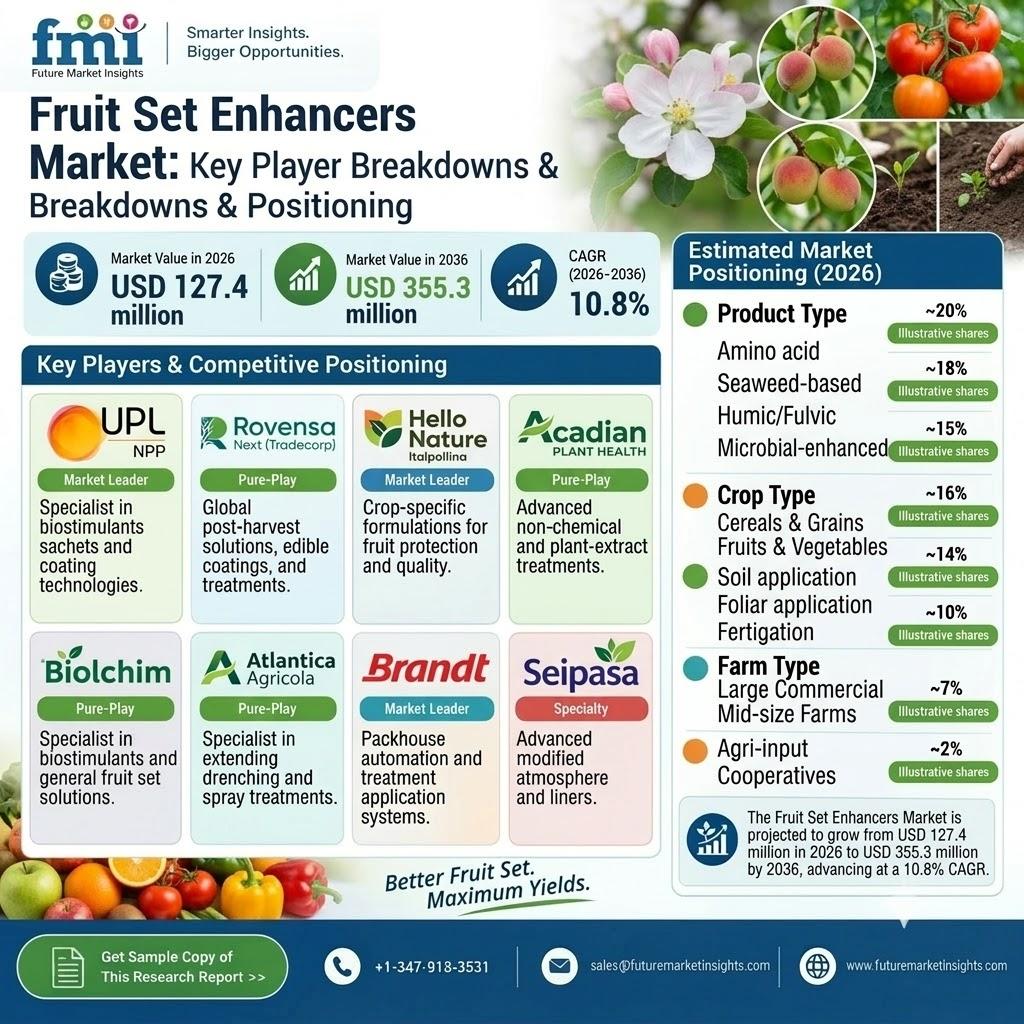
NEWARK, Del., October 12, 2026. — The global Fruit Set Enhancers Market is estimated at USD 127.4 million in 2026 and is projected to reach USD 355.3 million by 2036, expanding at a CAGR of 10.8% from 2026 to 2036, according to Future Market Insights (FMI). The market was valued at USD 115.0 million in 2025.
The growth outlook is being shaped by increasing agricultural pressure from heat stress, water scarcity and unpredictable weather conditions that can affect flowering, pollination, fertilization and early fruit development. FMI identifies the growing need to protect reproductive crop stages and maintain yield stability as a key market driver. Fruit set enhancers are gaining attention as growers seek solutions that can support crop performance under adverse environmental conditions and integrate with existing crop nutrition programs.
👉 Get Detailed Market Forecasts, Competitive Benchmarking & Industry Insights: https://www.futuremarketinsights.com/reports/sample/rep-gb-35783
Reproductive-stage stress management drives demand for specialized crop nutrition
Agricultural producers are placing greater emphasis on improving flower retention, successful fertilization and early fruit development during periods of environmental stress. FMI notes that amino acid and peptide-based formulations are gaining importance because they can be incorporated into regular crop nutrition programs. Growers are increasingly evaluating products based on application timing, dosage requirements, compatibility with existing farming practices and demonstrated performance under local field conditions.
Where growth is fastest
· USA — 10.4% CAGR: Demand is projected to benefit from increasing interest in crop-stage stress management and agricultural biostimulant solutions. Growers are expected to prioritize products that support flowering, fruit set and yield stability under heat and water stress.
· Germany — 10.1% CAGR: Market growth is expected to be supported by demand for specialized agricultural inputs and crop nutrition solutions. Product performance, application guidance and evidence of effectiveness under field conditions are likely to influence adoption.
· South Korea — 9.8% CAGR: Demand is projected to expand as growers seek solutions that support reproductive development and crop performance under changing environmental conditions.
· Japan — 8.9% CAGR: Although it has the lowest projected CAGR among the profiled countries, the market is expected to benefit from continued interest in crop quality, efficient nutrient management and reliable agricultural productivity.
What leads the market
· Amino acid and peptide-based products — 44.9% share in 2026: These formulations lead product-type demand because they can supply amino acids and peptides during flowering and early fruit development and can be incorporated into regular crop nutrition programs.
· Cereals and grains — 43.9% share in 2026: Extensive cultivated acreage and the ability to implement treatment programs across larger crop areas support the leading position of this crop category.
· Soil application — 37.6% share in 2026: Root-zone placement and compatibility with existing irrigation systems support the adoption of soil-applied fruit set enhancers.
· Large commercial farms — 39.7% share in 2026: Larger treated areas, crop mapping and irrigation records allow commercial growers to evaluate treatment performance and compare results across fields.
· Agri-input distributors — 37.7% share in 2026: Local product availability and agronomy support help distributors serve growers during time-sensitive flowering and fruit-set periods.
The hurdle
Environmental variability and the need to demonstrate field-level performance remain key challenges. Heat stress, water shortages and unpredictable weather can disrupt flowering, pollination and early fruit development. The effectiveness of fruit set enhancers can also depend on crop type, application timing, dosage and local growing conditions. FMI's analysis highlights the importance of clear application guidance and evidence of retained flowers and saleable yield under actual field stress. Suppliers that demonstrate reliable performance and provide practical agronomic support can strengthen their position with growers.
For full coverage of the Fruit Set Enhancers Market, including forecasts by product type, crop type, application method, farm type, sales channel, region and country, visit the FMI report: https://www.futuremarketinsights.com/reports/fruit-set-enhancers-market
Key market developments and demand trends
The fruit set enhancers market is benefiting from broader changes in agricultural input management, crop resilience and biostimulant development:
· Climate-related crop stress: Increasing concerns about heat and water stress are encouraging growers to consider solutions that support flowering, fertilization and early fruit development.
· Amino acid and peptide formulations: These products are gaining traction because they can be incorporated into existing crop nutrition schedules and targeted at sensitive reproductive stages.
· Precision application practices: Soil application, irrigation compatibility and crop-stage-specific treatment programs are supporting more targeted use of fruit set enhancers.
· Evidence-based product selection: Growers are increasingly interested in field trial results, practical dosage recommendations and measurable effects on flower retention and saleable yield.
· Agricultural biostimulant innovation: Product launches, regulatory developments and investments in production capacity are expanding the range of solutions available to growers.
Key developments in the Fruit Set Enhancers Market
· April 2026 — Seipasa: The company secured European registration for Kynetic4 as a PFC 6(B) non-microbial plant biostimulant associated with flower development, pollination, fertilization and fruit set.
· December 2025 — UPL: The company launched HYCOXA, a patented seaweed-based technology positioned to address abiotic stress and nitrogen uptake during heat-sensitive reproductive stages.
· December 2025 — Rovensa Next: The company launched Myndra in Europe for fruit-quality improvement in woody perennial crops, reporting trial gains in firmness, sugar content and fruit weight.
· June 2025 — Hello Nature: The company announced an expansion of its Italian biostimulant facility intended to double production capacity at the site.
Key players in the Fruit Set Enhancers Market
FMI profiles several participants across the agricultural biosolutions and specialized crop nutrition landscape, including:
· Broad biosolutions platforms: UPL (NPP), Rovensa Next (Tradecorp) and Hello Nature (Italpollina).
· Botanical and seaweed technology specialists: Acadian Plant Health and Seipasa.
· Crop-stage specialty nutrition specialists: Biolchim, Atlantica Agricola and Brandt.
These companies participate in the broader agricultural biostimulant and crop nutrition sectors, where product differentiation, application expertise and field performance are important competitive considerations.
Analyst perspective
“Growers will prefer products showing retained flowers and saleable yield under actual field stress. In my experience, suppliers having clear dose, timing and local evidence will receive repeat demand as crop-stage heat increases.” — Nandini Roy Choudhury, Principal Consultant, Future Market Insights.
What this means for growers and fruit set enhancer suppliers
· Prioritize reproductive-stage crop protection. Aligning treatments with flowering, pollination and early fruit development can help growers address periods when environmental stress threatens crop performance.
· Strengthen field-level validation. Local trials, clear dosage instructions and evidence of flower retention and saleable yield can help build confidence in product effectiveness.
· Improve application efficiency. Integrating soil-applied products with existing irrigation and crop nutrition programs can support practical implementation across different farm sizes.
· Expand stress-management solutions. Continued product development focused on heat and water stress can create opportunities for agricultural input suppliers serving climate-sensitive crops.
· Build stronger agronomic support. Distributors and manufacturers that provide timely availability, crop-stage recommendations and application guidance can improve adoption and encourage repeat purchases.
Related Reports:
Food Starch Market https://www.futuremarketinsights.com/reports/food-starch-market
Bread Crumbs Market https://www.futuremarketinsights.com/reports/bread-crumbs-market
Pulse Products Market https://www.futuremarketinsights.com/reports/pulse-products-market
Animal Feed Alternative Protein Market https://www.futuremarketinsights.com/reports/animal-feed-alternative-protein-market
Functional Food Ingredients Market https://www.futuremarketinsights.com/reports/functional-food-ingredients-market
About Future Market Insights
Future Market Insights, Inc. (FMI) is an ESOMAR-certified market research and consulting firm headquartered in Delaware, USA, with offices in the United Kingdom, the United Arab Emirates and India. FMI delivers syndicated and custom research across food and beverage, healthcare, chemicals, technology, packaging, consumer goods and industrial sectors.
For Press & Corporate Inquiries
Rahul Singh
AVP – Marketing and Growth Strategy
Future Market Insights, Inc.
+91 8600020075
For Sales: sales@futuremarketinsights.com
For Media: Rahul.singh@futuremarketinsights.com
For Web: https://www.futuremarketinsights.com/

 English
 Arabic
 French
 Spanish
 Deutsch
 Turkish
 Dutch
Dutch
 Italiano
 Russian
 Romaian
 Portuguese (Brazil)
 Greek
Greek