


What monitoring systems are integrated by a Modular Cardiac OT Turnkey Project Company?
Introduction
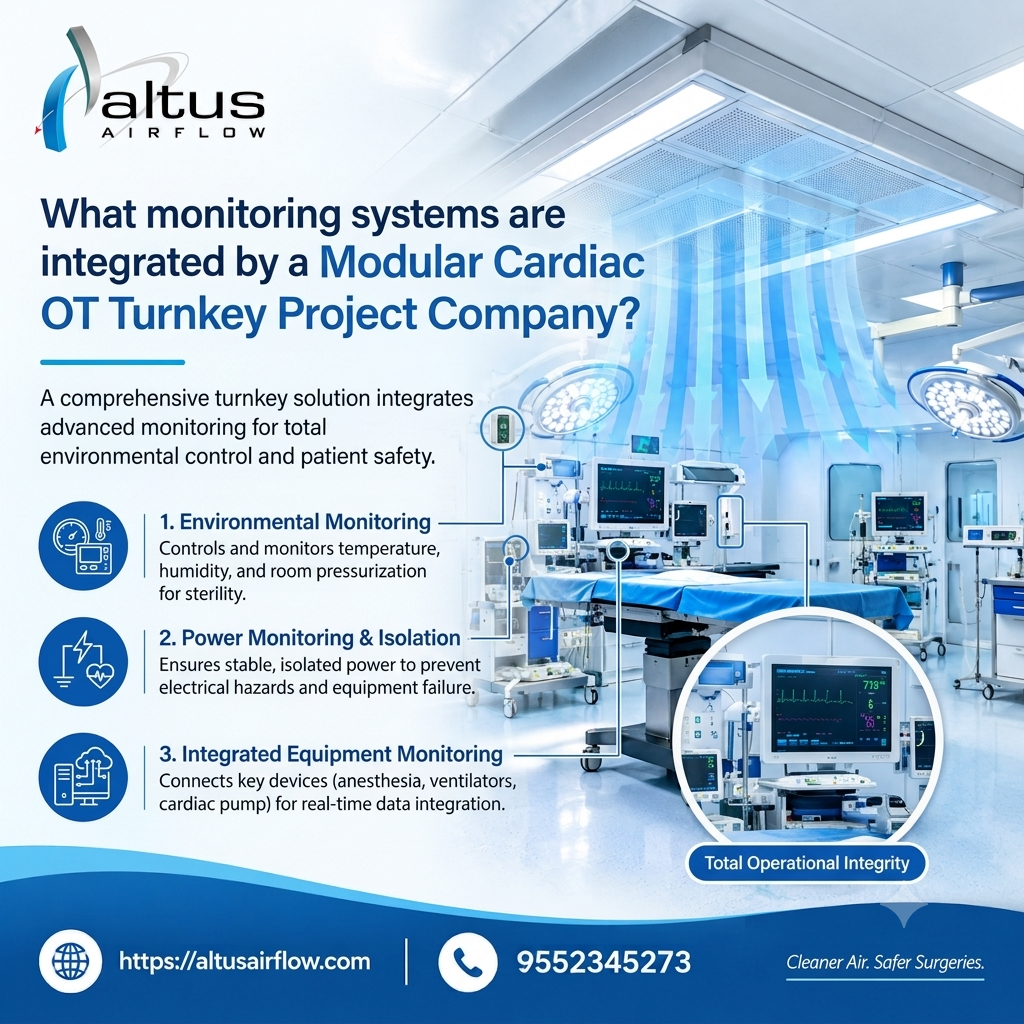
Altus Airflow, a trusted Modular Cardiac OT Turnkey Project Company, focuses on creating advanced operating theatre environments that support surgical safety, hygiene, and operational efficiency. Monitoring systems are essential components of modern cardiac operating theatres because they help healthcare teams track air pressure, temperature, humidity, air quality, and equipment performance. Integrating these systems with modular OT infrastructure enables healthcare facilities to maintain controlled environmental conditions and identify potential issues before they affect critical surgical operations.
Why Are Monitoring Systems Important in a Modular Cardiac OT?
Cardiac operating theatres require carefully controlled environmental conditions to support complex surgical procedures. Monitoring systems help healthcare facilities assess whether the operating room is functioning according to its design specifications and established clinical requirements.
These systems collect information from sensors, display readings through control panels, and generate alerts when monitored parameters move outside predefined limits. Depending on the installation, they may also record historical data for maintenance, troubleshooting, and compliance documentation.
Monitoring is particularly important in modular cardiac OTs because several interconnected systems operate simultaneously. Heating, ventilation, and air conditioning (HVAC), high-efficiency filtration, electrical infrastructure, medical gas installations, and environmental controls must work together to support reliable operating theatre performance.
An effective monitoring arrangement provides visibility into these systems and helps authorized personnel respond quickly to abnormal conditions. It does not replace clinical supervision, equipment maintenance, or the facility's infection prevention procedures. Instead, it supports informed decisions and more consistent management of the operating environment.
1. Differential Air Pressure Monitoring System
Differential air pressure monitoring is one of the most important environmental monitoring functions in a cardiac operating theatre. It measures the pressure difference between the operating room and adjacent spaces.
The pressure relationship is established through the ventilation design and depends on the facility's intended airflow strategy. Monitoring helps verify whether the room is maintaining the specified pressure conditions during normal operation.
Key Functions
-
Continuously measures pressure differences between designated spaces.
-
Displays readings on a digital indicator or integrated control panel.
-
Generates visual or audible alarms when configured limits are exceeded.
-
Helps identify potential ventilation imbalances or unexpected changes in room conditions.
-
Supports troubleshooting and routine performance checks.
For example, a sudden pressure deviation may indicate a change in airflow, a door left open, a ventilation fault, or another operational issue. The monitoring system alerts authorized staff so they can investigate the cause.
A Modular Cardiac OT Turnkey Project Company should coordinate pressure monitoring with the ventilation design, door arrangements, room layout, and commissioning requirements. Alarm limits and corrective procedures should be established by the facility's qualified engineering and infection prevention teams.
2. Temperature Monitoring System
Temperature monitoring helps maintain the thermal conditions specified for the operating theatre. Surgical teams require an environment that supports staff comfort, equipment operation, and appropriate patient care.
Temperature sensors are typically installed at suitable locations and connected to local displays or a building management system. The readings help facilities personnel determine whether the HVAC system is maintaining the intended temperature range.
Benefits of Temperature Monitoring
-
Tracks room temperature during operating hours.
-
Identifies deviations from approved environmental settings.
-
Supports HVAC troubleshooting and preventive maintenance.
-
Helps assess the performance of heating and cooling equipment.
-
Provides historical information when data logging is available.
Temperature requirements may differ according to the procedure, patient needs, clinical protocols, and facility policy. Therefore, the system should allow authorized personnel to configure appropriate limits where supported by the equipment.
Monitoring should also be coordinated with the air-handling system to ensure that temperature adjustments do not adversely affect humidity, ventilation, or other environmental parameters.
3. Relative Humidity Monitoring System
Humidity monitoring measures the amount of moisture present in the air relative to the maximum moisture the air can hold at a given temperature. It is an important consideration in operating theatres because humidity interacts with thermal comfort, condensation risk, and the performance of certain materials and equipment.
A humidity sensor can transmit readings to a room display, environmental monitoring panel, or centralized building management platform.
Key Advantages
-
Tracks relative humidity continuously or at configured intervals.
-
Alerts staff when readings exceed specified limits.
-
Helps identify HVAC control problems.
-
Supports the management of condensation-related concerns.
-
Creates records for environmental reviews when logging is enabled.
Maintaining appropriate humidity requires coordination between ventilation, cooling, and dehumidification systems. The monitoring equipment should be selected and positioned according to the room's design.
Healthcare facilities should establish acceptable humidity limits using applicable standards, equipment requirements, and clinical policies rather than relying on a universal setting for every operating theatre.
4. Air Quality and HEPA Filtration Monitoring
Air quality monitoring helps assess selected environmental parameters and the performance of systems responsible for supplying clean, filtered air.
High-efficiency particulate air (HEPA) filtration may be specified in particular operating theatre designs to help control airborne particles. However, not every OT uses the same filtration configuration, and HEPA filtration requirements depend on the facility's engineering design and applicable standards.
Monitoring and maintenance arrangements may include filter differential pressure measurements, airflow checks, and scheduled filter integrity testing.
What Can These Systems Monitor?
-
Pressure differences across filters, where appropriate.
-
Airflow conditions within designated ventilation systems.
-
Selected airborne particle measurements when particle monitoring is specified.
-
Environmental trends that may indicate a ventilation or filtration issue.
A rise in differential pressure across a filter may indicate increasing resistance as the filter loads with particles, although readings must be interpreted according to the manufacturer's specifications and the overall system condition.
It is important to distinguish filter pressure monitoring from direct measurement of airborne contamination. A pressure sensor alone cannot confirm that the operating theatre's air is microbiologically safe.
Likewise, an airborne particle counter measures particles rather than identifying specific microorganisms. Appropriate testing, maintenance, and infection prevention procedures remain necessary to evaluate overall environmental performance.
5. HVAC and Airflow Monitoring System
The HVAC system is responsible for maintaining the operating theatre's designed ventilation conditions. Monitoring its performance helps ensure that air-handling equipment, fans, dampers, and associated controls function as intended.
Depending on the project, the system may use airflow sensors, duct pressure sensors, temperature sensors, humidity sensors, and equipment status indicators.
Important Monitoring Functions
-
Tracks selected supply and return air conditions.
-
Monitors fan and air-handling unit operating status.
-
Identifies abnormal duct pressure or airflow conditions.
-
Displays equipment faults and configured alarms.
-
Supports preventive maintenance and operational troubleshooting.
Integration with a building management system can provide a centralized view of relevant HVAC parameters. Authorized personnel can review trends, identify recurring issues, and coordinate corrective action.
Airflow monitoring must reflect the approved ventilation design. Changes to airflow settings should be undertaken by qualified personnel because inappropriate adjustments may affect room pressure relationships, filtration performance, and environmental conditions.
6. Medical Gas Pressure and Alarm Monitoring
Cardiac operating theatres rely on medical gas infrastructure to support anaesthesia and other clinical requirements. Depending on the facility, relevant services may include oxygen, medical air, nitrous oxide, and vacuum.
Medical gas monitoring is generally implemented through dedicated alarm panels and suitable pressure or system-status sensors. The exact arrangement depends on the medical gas services installed and the applicable healthcare requirements.
Main Functions
-
Indicates abnormal medical gas supply pressure.
-
Provides local or designated remote alarms.
-
Helps staff identify supply interruptions or pressure deviations.
-
Supports prompt escalation to the responsible technical team.
-
Improves visibility into the status of critical gas services.
Medical gas alarms are particularly important because supply problems may require immediate clinical and technical responses. Alarm panels should be installed in appropriate locations, and staff must understand the meaning of each alarm and the required response.
These systems should be designed, installed, tested, and maintained by qualified professionals in accordance with applicable medical gas standards. Environmental monitoring software should not replace dedicated safety-critical medical gas alarm functions.
7. Electrical Power and UPS Monitoring
Reliable electrical power is essential for operating theatre lighting, monitoring equipment, surgical devices, and other critical infrastructure. Depending on the facility design, electrical monitoring may cover distribution panels, emergency power supplies, and uninterruptible power supply (UPS) equipment.
Common Monitoring Features
-
Indicates power supply and equipment operating status.
-
Monitors selected voltage, current, and load parameters.
-
Reports UPS battery status and relevant faults.
-
Provides alerts for specified electrical abnormalities.
-
Supports maintenance planning and electrical system troubleshooting.
Some facilities also monitor emergency generator status and transfer-switch operation to help confirm the availability of backup power arrangements.
Monitoring should be coordinated with the facility's electrical engineering design. Critical electrical protection, isolation, and changeover functions must remain compliant with the relevant safety requirements.
8. Operating Theatre Control Panel and Centralized Monitoring
A centralized OT control panel can bring selected environmental controls and monitoring functions together in one accessible interface. The exact features depend on the installed system and the project's requirements.
Instead of checking several independent displays, authorized personnel may be able to review room pressure, temperature, humidity, lighting controls, and selected equipment statuses from a common panel.
Advantages of Integrated Control
-
Provides a consolidated view of selected room parameters.
-
Makes configured alarms easier to identify.
-
Supports convenient operation of compatible systems.
-
Reduces the need to access separate interfaces for routine checks.
-
Helps maintenance teams investigate faults more efficiently.
Integration must be carefully engineered to ensure that information is accurate and alarms are clearly differentiated. Safety-critical functions should retain appropriate independent controls and alarm arrangements.
The control panel should also be designed for the operating theatre's hygiene requirements, with suitable materials, accessible controls, and clear labeling.
9. Data Logging, Alarm Management, and Building Management System Integration
Modern operating theatre projects may include digital monitoring platforms that record environmental readings and equipment status over time. These platforms can support trend analysis, maintenance planning, and documentation.
Data Logging
Data logging stores selected measurements with timestamps, enabling authorized personnel to review historical operating conditions and investigate recurring deviations.
Alarm Management
Alarm management systems notify designated personnel when readings move beyond configured limits or monitored equipment reports a fault. Alarm priorities and response procedures should be defined according to operational risk.
Building Management System Integration
A building management system (BMS) can consolidate compatible HVAC, electrical, and environmental monitoring points across the healthcare facility. Integration may help engineering teams identify faults and coordinate maintenance activities.
However, integration does not mean every device must be connected to a single platform. Compatibility, cybersecurity, reliability, and the independence of safety-critical systems must be considered during design.
Access permissions, backup arrangements, data retention, and alarm escalation procedures should be established before commissioning.
10. How Are Monitoring Systems Selected and Commissioned?
Selecting suitable monitoring equipment requires a clear understanding of the cardiac OT's clinical use, environmental requirements, and technical infrastructure.
The project team should first identify which parameters must be monitored and which require alarms, data logging, or centralized display. Sensor ranges, accuracy, placement, calibration requirements, and communication protocols should then be specified.
During installation, sensors and control panels must be coordinated with modular wall panels, electrical wiring, HVAC equipment, and medical gas infrastructure where applicable.
Commissioning should include functional checks, alarm verification, sensor calibration or verification as appropriate, and testing of system integration. Environmental performance should be assessed against the approved design criteria.
After handover, the healthcare facility should maintain a preventive maintenance schedule covering sensor checks, calibration, alarm testing, filter inspections, and review of system records. Staff training is also important so that readings and alarms are interpreted correctly.
Conclusion
Monitoring systems are essential for maintaining visibility into the environmental and technical conditions of a cardiac operating theatre. Differential pressure, temperature, humidity, filtration, airflow, medical gas, electrical power, and centralized control systems each serve specific purposes within the broader OT infrastructure.
Altus Airflow supports modular healthcare environment planning, with monitoring requirements coordinated according to individual project specifications. An experienced Modular Cardiac OT Turnkey Project Company can help integrate compatible monitoring systems into the overall design, installation, and commissioning process. Altus Airflow recommends evaluating each system according to clinical needs, applicable standards, technical compatibility, and long-term maintenance requirements to support reliable operating theatre performance.
Frequently Asked Questions (FAQs)
1. What monitoring systems does a Modular Cardiac OT Turnkey Project Company integrate?
A Modular Cardiac OT Turnkey Project Company may integrate differential pressure, temperature, humidity, airflow, filtration, medical gas, electrical power, and centralized OT monitoring systems, depending on project requirements.
2. Why is differential pressure monitoring important in a cardiac OT?
It helps verify that the operating theatre maintains its specified pressure relationship with adjacent spaces.
3. Can OT monitoring systems be connected to a BMS?
Yes. Compatible environmental and equipment monitoring points can be integrated with a building management system.
4. Is HEPA filter monitoring necessary in every cardiac OT?
The monitoring and testing requirements depend on the specified filtration system, ventilation design, and applicable standards.
5. Do monitoring systems provide automatic alarms?
Yes. Systems can generate visual or audible alarms when monitored parameters exceed configured limits or equipment faults are detected.
Read Our Previous Blog --------------->Does a Modular Cardiac OT Setup Company install hermetically sealed doors?

 Arabic
 French
 Spanish
 Portuguese
 Deutsch
 Turkish
 Dutch
Dutch
 Italiano
 Russian
 Romaian
 Portuguese (Brazil)
 Greek
Greek