


PK-Stat Review for Clinical Trials: From Study Design to Regulatory-Ready PK Data
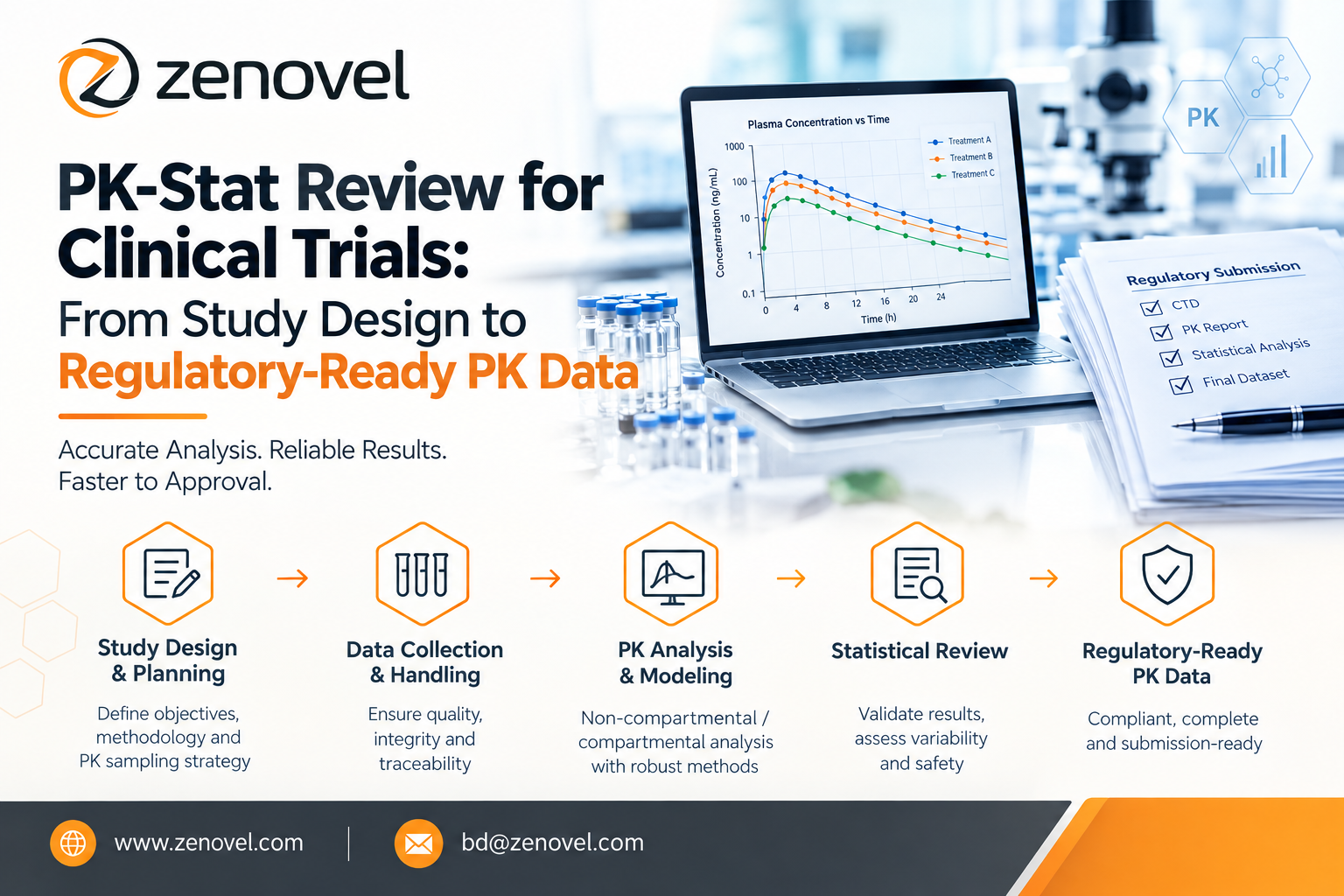
In modern drug development, generating clinical data is only half the battle. The true test of a successful trial lies in how rigorously that data is analyzed, interpreted, and presented to regulatory authorities. At the heart of pharmacokinetic and pharmacodynamic (PK/PD) evaluations are specialized PK-Stat (Pharmacokinetic-Statistical) reviews—a critical discipline that bridges clinical pharmacology with advanced biostatistics.
Whether dealing with a complex first-in-human dose-escalation trial or a high-stakes bioequivalence study for generic approval, ensuring the integrity, accuracy, and regulatory readiness of PK-Stat data can make or break a submission timeline.
The Vital Role of PK-Stat Reviews in Drug Development
Pharmacokinetic evaluations track how a drug is absorbed, distributed, metabolized, and excreted by the body over time, while statistical modeling ensures these observations are robust, reproducible, and statistically valid.
A comprehensive PK-Stat review goes beyond simple number crunching. It provides regulatory agencies—such as the US FDA, EMA, and CDSCO—with high-confidence evidence regarding a drug's safety, therapeutic window, and dosing regimens. Without meticulous oversight, minor discrepancies in blood concentration curves or statistical variance can trigger costly regulatory delays or "complete response letters" (CRLs).
Core Components of a Robust PK-Stat Process
An end-to-end PK-Stat review encompasses several vital stages across the clinical lifecycle:
-
Study Design & Protocol Development:
Informing early-stage trial designs by establishing optimal blood sampling time points, washout periods, and sample size calculations to ensure sufficient statistical power.
-
Non-Compartmental Analysis (NCA) & Compartmental Modeling:
Precise calculation of key PK parameters such as maximum concentration ($C_{max}$), area under the curve ($AUC_{0-t}$ and $AUC_{0-\infty}$), and elimination half-life ($t_{1/2}$).
-
Bioequivalence & Biosimilar Evaluations:
Conducting rigorous statistical testing (e.g., ANOVA, Schuirmann's two one-sided tests for 90% confidence intervals) to prove pharmacokinetic equivalence between test and reference formulations.
-
Root-Cause Investigations & Outlier Analysis:
Investigating unexpected trial results, high pharmacokinetic variability, or anomalous data points to identify underlying causes—whether biological, analytical, or operational.
Common Pitfalls in PK-Stat Analysis
During regulatory audits and dossier reviews, authorities frequently identify recurring vulnerabilities in PK data handling:
-
Inadequate Sampling Schedules: Poorly timed blood draws that miss absorption peaks or terminal elimination phases, leading to unreliable AUC calculations.
-
Flawed Handling of BQL (Below Quantification Limit) Data: Inconsistent treatment of values below the assay's lower limit of quantification, which can skew statistical outcomes.
-
Siloed Bioanalytical and Statistical Teams: A lack of seamless communication between the clinical lab measuring concentrations and the biostatisticians modeling the data.
-
Insufficient Audit Trails: Incomplete documentation of data manipulation or software scripts used during Non-Compartmental Analysis, raising data integrity flags during inspections.
How Zenovel Elevates Your PK-Stat Strategy
At Zenovel, our multidisciplinary experts integrate deep pharmacological knowledge with rigorous biostatistical oversight to ensure your clinical trial data stands up to the strictest global standards:
-
End-to-End PK/PD Support: From early protocol design and NCA analysis to final statistical reporting and electronic submission formatting (e.g., SEND/CDISC standards).
-
Regulatory-Ready Compliance: Aligning all data workflows with ICH guidelines and global regulatory expectations to streamline approvals with the FDA, EMA, and other health authorities.
-
Advanced Troubleshooting & For-Cause Audits: Unpacking complex variability and identifying root causes for unexpected pharmacokinetic outcomes to protect your trial investment.
-
Data Integrity & Quality Assurance: Implementing robust validation safeguards across all biostatistical software and data pipelines.
Are you preparing for an upcoming clinical trial or bioequivalence study and looking to optimize your PK-Stat framework? Connect with our global experts today at bd@zenovel.com.

 English
 Arabic
 French
 Spanish
 Portuguese
 Deutsch
 Turkish
 Dutch
Dutch
 Russian
 Romaian
 Portuguese (Brazil)
 Greek
Greek