


Top Industrial Applications of Siphon Pumps in Manufacturing
A Small Transfer Mistake Can Disrupt an Entire Production Line
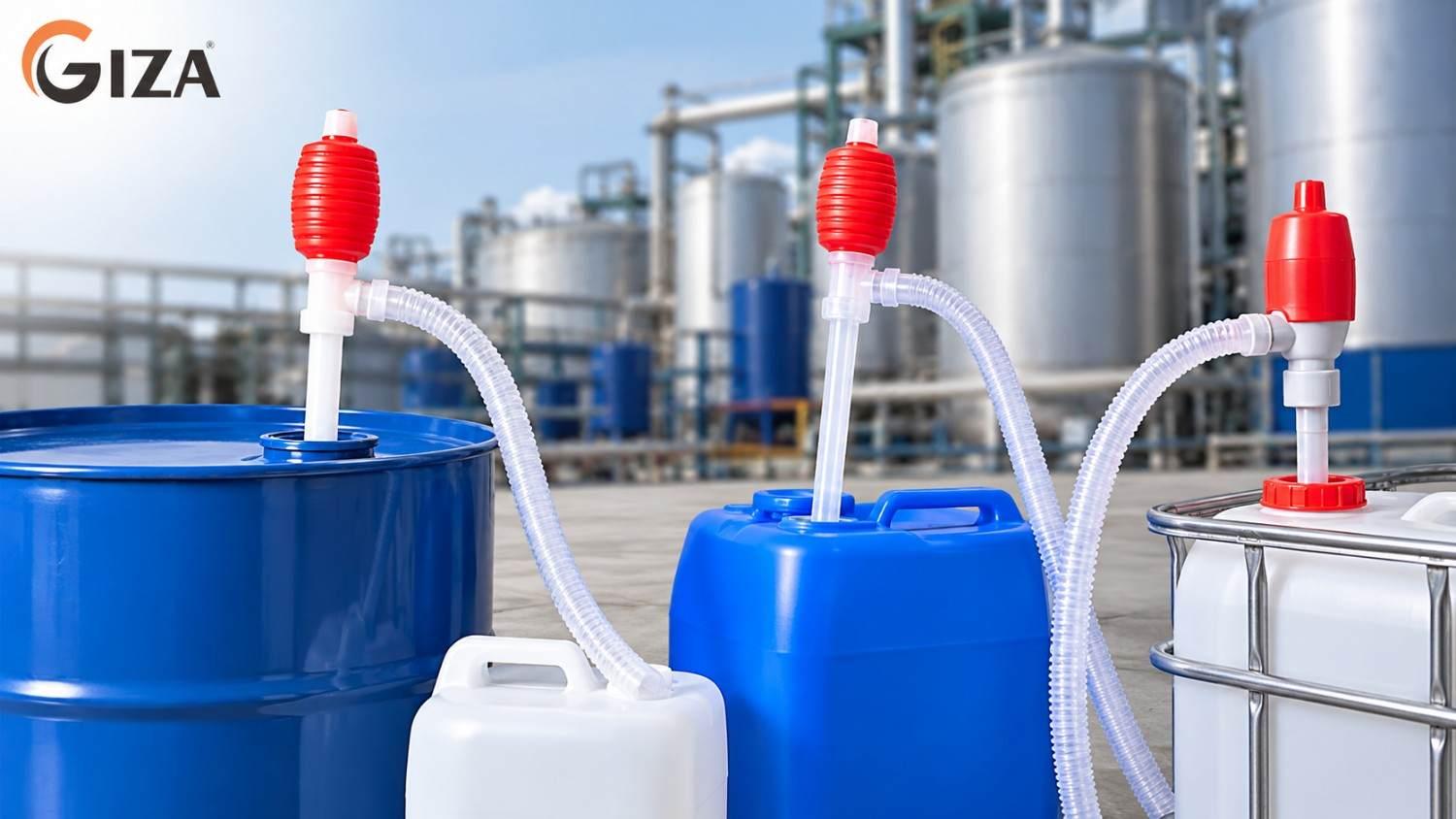
A chemical drum is almost empty, the next batch is waiting, and an operator is struggling to transfer the remaining liquid without spilling it. What looks like a minor handling issue can delay production, waste raw materials, and create unnecessary cleaning work. A Siphon Pump helps transfer suitable liquids between drums, containers, and tanks with better control. In manufacturing, these pumps are used for chemical handling, lubricant dispensing, maintenance, and other liquid-transfer operations.
The mistake? Many procurement teams purchase transfer equipment based on price alone. They overlook fluid compatibility, discharge height, and operating conditions. A cheap pump that fails during production is not a saving. Giza Pumps lists two relevant product categories: siphon drum pumps and siphon heavy barrel pumps, alongside other industrial fluid-transfer equipment.
Siphon Pump Specifications and Industrial Applications
How the Pump Works and Which Specifications Matter
A conventional siphon uses gravity and a difference in liquid levels to maintain flow after priming. Manual siphon-style transfer pumps may also use a hand-operated mechanism to initiate or assist liquid movement.
Before purchasing, check the wetted materials, tube length, seal composition, outlet diameter, liquid viscosity, and required transfer rate.
Here's the detail buyers regularly miss: a gravity siphon generally needs its discharge outlet below the source liquid level. A longer hose cannot compensate for an unsuitable height arrangement.
1. Chemical Manufacturing and Processing
Chemical plants use suitable siphon pumps to transfer compatible liquids from storage drums into smaller processing containers. These operations may involve cleaning solutions, additives, and selected industrial chemicals.
Not every pump is suitable for every chemical.
Material resistance must be checked against the actual chemical, concentration, and temperature. A supplier claiming that one plastic pump handles every solvent and acid is giving an answer procurement teams should reject.
2. Automotive and Lubricant Manufacturing
Lubricant manufacturers and automotive workshops regularly move oils and other service fluids between drums and smaller containers.
A suitable siphon pump can help operators dispense manageable quantities without lifting heavy containers. However, thicker lubricants may require a different pumping mechanism, particularly when a manual siphon cannot achieve the required flow.
3. Paints, Coatings, and Adhesive Production
Paint manufacturers handle thinners, solvents, additives, and other liquid ingredients during production.
Controlled dispensing helps reduce unwanted mixing and material loss. Yet solvent handling requires additional attention: the absence of an electric motor does not automatically make a pump safe for flammable liquids.
For example, OSHA's US industrial safety regulation, 29 CFR 1910.106, addresses ignition prevention and electrical interconnection during specified flammable-liquid transfers. Indian facilities must follow applicable Indian regulations and their own hazardous-area procedures.
4. Pharmaceutical and Specialty Chemical Manufacturing
Specialty manufacturing can involve transferring compatible process liquids between small containers and production equipment.
Here, cleanliness matters as much as transfer speed. An industrial-grade siphon pump is not automatically suitable for pharmaceutical product-contact applications.
Buyers must confirm cleaning procedures, material documentation, and any applicable hygienic or process-validation requirements before approving the equipment.
5. Metalworking and Engineering Workshops
Engineering facilities regularly handle cutting fluids, lubricants, and maintenance liquids.
A portable siphon pump can make occasional drum-to-container transfers more convenient, especially where fixed pumping equipment is unnecessary.
The practical challenge is contamination. Using the same pump for incompatible fluids can spoil the next container's contents, even when the pump itself remains functional.
6. Warehousing and Industrial Drum Handling
Manufacturing warehouses often receive liquids in drums but issue smaller quantities to different departments.
Siphon pumps can support controlled dispensing, inventory movement, and routine maintenance transfers. For frequent or high-volume use, however, a powered or dedicated drum pump may be more appropriate.
That distinction affects staffing time, operating costs, and the risk of interrupted supply.
Five Checks Before Approving a Siphon Pump Supplier
Procurement teams should evaluate Siphon Pump Manufacturers against measurable requirements, not catalogue promises.
-
Material compatibility: Ask for confirmation against the liquid's chemical name, concentration, and temperature. Bad answer: "Our pump works with all chemicals."
-
Actual transfer performance: Request the expected flow under your operating conditions. Bad answer: "The flow rate is always high."
-
Inspection records: Ask what is checked before dispatch. Bad answer: "Our products never leak."
-
Replacement components: Confirm which hoses, seals, and tubes can be replaced. Bad answer: "You must purchase another pump."
-
Order fulfilment: Request written confirmation of MOQ, stock, dispatch date, and warranty. Bad answer: "Everything is available immediately."
Six Benefits That Protect Manufacturing Costs
Lower Waste, Fewer Interruptions
-
Reduced spillage: Appropriate dispensing equipment helps protect valuable liquids from avoidable losses.
-
Better handling control: Operators can manage small-volume transfers without tipping large drums.
-
Lower equipment investment: Manual transfer may be economical for intermittent, low-volume tasks.
-
Less dependence on power: Non-electric operation can be useful in suitable locations, although additional safety controls may still be needed.
-
Simpler maintenance: Basic manual mechanisms may require fewer maintenance procedures than motor-driven systems.
-
Improved inventory handling: Dedicated pumps for different liquids help reduce cross-contamination and protect usable stock.
These benefits depend on correct pump selection. They are not guaranteed performance figures.
Availability of Siphon Pumps Across India
Finding Siphon Pump Suppliers in India is straightforward. Finding suppliers who can consistently deliver the correct configuration is harder. Manufacturers and distributors serving Gujarat, Maharashtra, Delhi NCR, Tamil Nadu, and other industrial regions should be evaluated for transport reliability, spare-part availability, and packaging quality.
Giza operates from Shapar, Rajkot, Gujarat, PIN 360024. Its published range includes siphon drum pumps and heavy barrel pumps. For Siphon Pump Dealers, regional stock availability can affect urgent replacement purchases. Meanwhile, Siphon Pump Wholesalers need to consider the landed cost per unit, including packaging, freight, and possible transit damage.
A lower ex-factory price means little when replacement stock arrives after the production schedule has already slipped.
About Giza Pumps: Built Around Industrial Liquid Handling
At Giza Pumps, we focus on industrial fluid-transfer equipment for manufacturing plants, chemical facilities, automotive workshops, and industrial distributors.
We offer siphon drum pumps and heavy barrel pumps as part of our wider pumping range. Our published product information states that we perform pressure, leakage, and output checks before dispatch. These are practical inspection points that matter when customers depend on repeatable operation.
We operate under Swastik Enterprise from Shapar, Rajkot, Gujarat, serving customers who need appropriate pumping equipment for their applications.
We invite manufacturers, procurement teams, and distributors to contact Giza Pumps for product selection and bulk pricing.
We aim to respond to enquiries within 48 hours, as stated on our website. We'll confirm the applicable minimum order quantity (MOQ), product availability, pricing, and estimated dispatch schedule against your specific requirement.
Conclusion
A Siphon Pump can support practical liquid handling across several manufacturing industries, provided the equipment matches the application. Chemical compatibility, safe operating conditions, and dependable supply matter more than marketing claims. As production requirements become more demanding, careful pump selection will remain an important part of controlling operating costs.
Frequently Asked Questions
1. What is a Siphon Pump used for in manufacturing?
It transfers suitable liquids between containers, drums, and tanks. Common applications include chemical dispensing, lubricant handling, paint production, and maintenance work. The pump type must match the liquid and transfer arrangement.
2. How should I compare Siphon Pump Manufacturers?
Compare wetted materials, transfer performance, leak-testing procedures, spare parts, and warranty terms. Ask for written specifications rather than accepting verbal performance claims.
3. Can Siphon Pump Dealers supply pumps for corrosive chemicals?
Some models may handle specific corrosive liquids. However, compatibility varies with chemical concentration, temperature, and seal material. Never assume that a general-purpose unit is suitable.
4. Do Siphon Pump Wholesalers offer bulk purchasing options?
Many do, including Giza's published wholesale offering. Actual MOQ, discount levels, and lead times must be confirmed before placing an order.
5. Can Siphon Pump Suppliers in India support factory maintenance requirements?
Yes, depending on stock and the required configuration. Buyers should check replacement-part availability and service arrangements before relying on a supplier for urgent maintenance.
6. Are manual siphon pumps suitable for diesel and solvents?
Only when the specific pump is rated for that liquid and operating environment. Fuel and flammable-solvent transfers may require dedicated equipment, static-control measures, ventilation, and other safety precautions. A manual pump is not inherently flameproof.
7. How do I determine the correct pump capacity?
Start with the liquid's viscosity, required volume, transfer height, and target filling time. Ask for a tested flow figure under comparable conditions. Nominal catalogue performance may not reflect actual factory operation.

 English
 Arabic
 French
 Spanish
 Portuguese
 Deutsch
 Turkish
 Dutch
Dutch
 Italiano
 Russian
 Romaian
 Portuguese (Brazil)