


What Is Performance Testing? Types, Tools, Benefits & Examples
Learn what performance testing is, why it matters, key types, tools, metrics and examples, plus a practical guide to COC certification for testers.
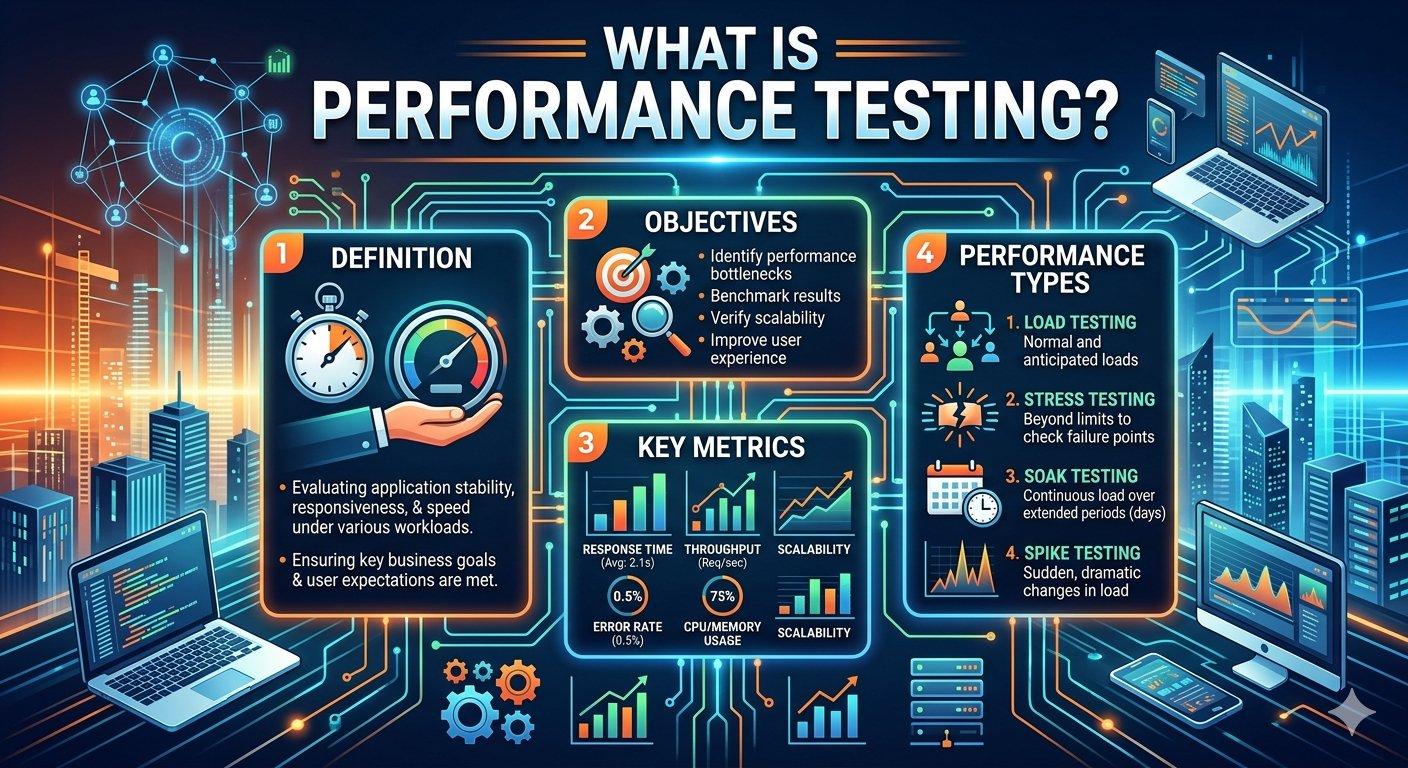
Performance testing is a type of non-functional software testing that measures how an application behaves under expected and extreme workloads. It checks speed, stability, scalability and resource use so teams can find bottlenecks before real users do. Common types include load, stress, spike, endurance and scalability testing.
Why Performance Testing Matters
An app can pass every functional test and still fail on launch day. A checkout page that works for one tester may crawl when thousands of people use it at once. Performance testing closes that gap.
The importance of performance testing comes down to four things:
- User experience: slow pages and timeouts push people away.
- Revenue protection: outages during sales, ticket releases or enrollment windows are expensive.
- Cost control: finding a bottleneck in staging is far cheaper than firefighting it in production.
- Capacity planning: you learn how much traffic your current setup can really handle, so you scale with evidence instead of guesses.
It also supports reliability goals such as SLAs and SLOs, because you can't promise a response time you have never measured.
What Is Performance Testing? A Closer Look
Importance What is Performance Testing testing (sometimes called load and performance testing) simulates realistic user activity against an application and records how the system responds. Instead of asking "does this feature work?", it asks "does it still work well when many people use it at once?"
It is usually run against web apps, APIs, databases, mobile backends and microservices, ideally in an environment that mirrors production.
Key Metrics You Should Track
Numbers only help if you know what to watch. These are the core performance testing metrics:
- Response time: how long a request takes to complete. Look at percentiles (such as p95 or p99), not just the average, because averages hide slow outliers.
- Throughput: requests or transactions handled per second.
- Concurrent users: how many users are active at the same moment.
- Error rate: the share of requests that fail or time out.
- Resource utilization: CPU, memory, disk and network use on servers and databases.
- Latency: the delay before a response begins.
Types of Performance Testing
|
Type |
What it checks |
Typical question |
|---|---|---|
|
Load testing |
Behavior under expected, normal traffic |
Can we handle a typical busy day? |
|
Stress testing |
Behavior beyond capacity, until something breaks |
Where is our breaking point, and how do we recover? |
|
Spike testing |
Reaction to sudden, sharp traffic jumps |
What happens when a promotion goes viral? |
|
Endurance (soak) testing |
Stability over many hours or days |
Do we have memory leaks or slow degradation? |
|
Scalability testing |
How performance changes as resources are added |
Does adding servers actually help? |
|
Volume testing |
Behavior with large amounts of data |
Do queries slow down with millions of records? |
Most teams start with load testing, then add stress and endurance tests as the product matures.
A Practical Example
Imagine an online store preparing for a seasonal sale. The team expects roughly ten times its usual traffic. (The numbers below are illustrative, not real benchmarks.)
- They script the main journey: browse, search, add to cart, check out.
- They run a load test at expected sale traffic and see response times stay steady.
- They run a stress test and notice the database connection pool is exhausted well before CPU becomes a problem.
- They increase the pool size, add caching for product pages and retest.
- An endurance test over several hours confirms memory use stays flat.
The fix was small, but only testing revealed it. That is the everyday value of this work.
How to Run Performance Testing: Step by Step
- Define goals. Set measurable targets, such as "checkout responds within two seconds for 95% of requests at expected peak load."
- Build a realistic test environment. The closer to production, the more trustworthy the results.
- Model real user behavior. Use analytics to decide which journeys matter and how users actually move through them.
- Prepare test data. Use varied, realistic data so caching doesn't flatter your results.
- Create and run scripts. Start small, then ramp up gradually.
- Monitor everything. Watch application, database and infrastructure metrics together.
- Analyze and fix. Identify the slowest component, change one thing at a time, and retest.
- Repeat regularly. Run tests in your CI/CD pipeline so regressions surface early.
Popular Performance Testing Tools
There is no single best tool. The right choice depends on your stack, team skills and budget.
|
Tool |
Type |
Good to know |
|---|---|---|
|
Apache JMeter |
Open source |
Widely used, GUI-based, large plugin ecosystem |
|
Gatling |
Open source core |
Tests written as code, good for developer-led teams |
|
k6 |
Open source |
JavaScript scripting, designed for automation and CI |
|
Locust |
Open source |
Python-based, easy to customize user behavior |
|
LoadRunner |
Commercial |
Broad protocol support, common in large enterprises |
|
BlazeMeter |
Commercial cloud |
Runs large-scale tests, compatible with JMeter scripts |
Pair your load tool with monitoring (for example, an APM platform or Prometheus and Grafana) so you can see why a test slowed down, not just that it did.
Benefits of Performance Testing
- Catches bottlenecks before launch
- Reduces downtime and emergency fixes
- Improves page speed and user satisfaction
- Helps plan infrastructure and cloud spend
- Builds confidence before major releases and traffic events
- Provides a baseline to detect regressions after code changes
Common Mistakes to Avoid
- Testing only at the end. Late testing leaves little time to fix architectural problems. Test early and often.
- Unrealistic scenarios. Hitting one endpoint with identical requests rarely reflects real use.
- Ignoring percentiles. A good average can hide a poor experience for your slowest users.
- Testing on a weak environment. Results from a tiny staging server won't predict production behavior.
- Changing many things at once. You won't know which change helped.
Performance Testing Certification: A Guide to COC Certification
If you want to turn hands-on skills into a credential, certification can help structure your learning. A Guide COC Certification is one option some learners consider, but programs using that name can differ in scope, issuing body and exam format. Before enrolling:
- Confirm who issues the certificate and whether employers in your field recognize it.
- Review the syllabus: it should cover test planning, workload modeling, scripting, metrics analysis and reporting.
- Check for hands-on labs, since practical experience matters more than theory.
- Compare it with widely known options, such as ISTQB's performance testing material, so you understand how it fits your career path.
Whatever you choose, practice on a real project. Run a small test against a demo app with JMeter or k6, and write up what you found. That portfolio piece often says more than a certificate alone.
FAQ's
1. What is performance testing in simple words?
It is checking how fast and stable an application is when many people use it at the same time.
2. What is the difference between load testing and stress testing?
Load testing uses expected traffic to confirm normal performance. Stress testing pushes past capacity to find the breaking point and see how the system recovers.
3. Is performance testing functional or non-functional?
Non-functional. It evaluates how well the system performs, not whether individual features work.
4. When should performance testing be done?
Early and continuously: on key components during development, on the full system before release, and again before expected traffic spikes.
5. Which tool is best for beginners?
Apache JMeter is a common starting point because it is free, well documented and has a graphical interface. k6 and Locust suit people who prefer writing scripts.
6. What is a good response time?
It depends on your application and users. Set targets from your own requirements and user expectations rather than a universal number.
7. Can performance testing be automated?
Yes. Tools like k6 and Gatling integrate with CI/CD pipelines so basic performance checks run on every build or release.
8. What is a bottleneck?
The component that limits overall performance, such as a slow database query, an undersized connection pool or limited CPU.
9. Do small websites need performance testing?
Yes, at a smaller scale. Even a simple test before a launch or campaign can reveal slow pages or weak hosting.
10. Is a COC certification worth it for performance testers?
It can help if the issuer is credible, the syllabus is practical and it matches your goals. Verify the details with the provider and pair it with real project experience.
Conclusion
Performance testing turns "we hope it holds up" into "we know where it holds up and where it doesn't." By understanding the types of performance testing, choosing suitable tools, tracking the right metrics and testing regularly, you protect user experience, revenue and your team's sanity. Start small: pick one critical user journey, set a clear target, run a load test and fix the biggest bottleneck. Then build the habit.

 English
 Arabic
 French
 Spanish
 Portuguese
 Deutsch
 Turkish
 Dutch
Dutch
 Italiano
 Romaian
 Portuguese (Brazil)
 Greek
Greek