


Custom Patch Manufacturers in the USA: How to Choose the Right Supplier
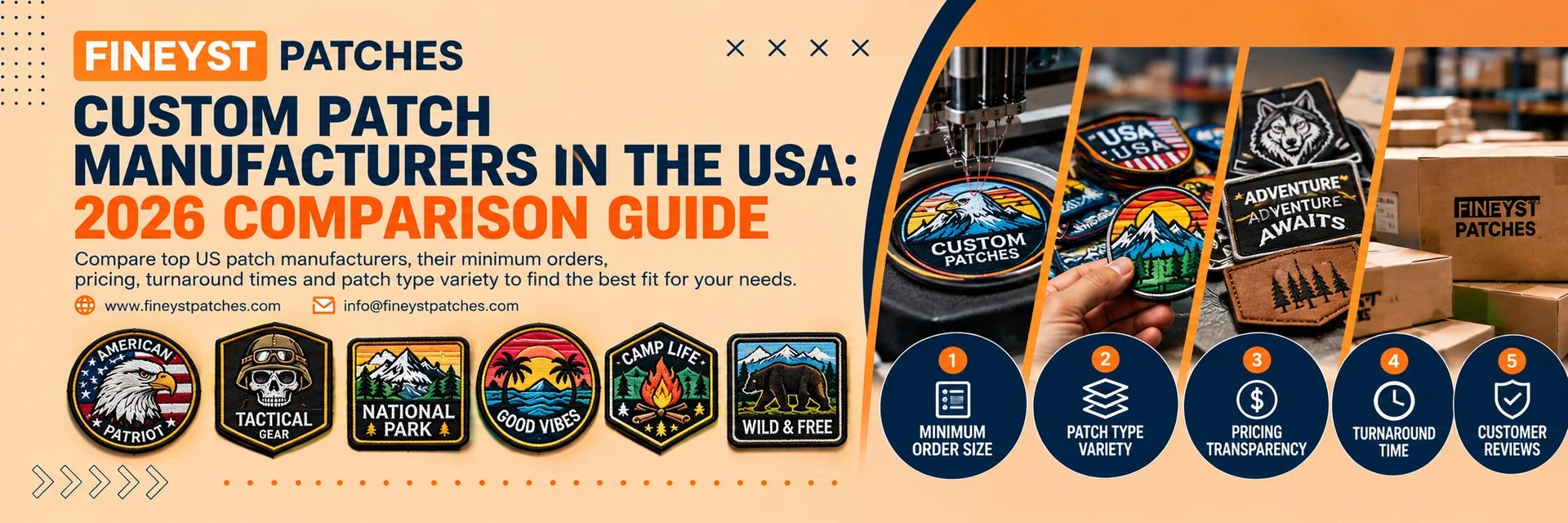
Custom Patch Manufacturers in the USA: How to Choose the Right Supplier
Finding reliable custom patch manufacturers in the USA is an important step for clothing brands, small businesses, sports teams, schools, and organizations that want high-quality personalized patches. The right supplier can help turn your artwork into a professional product while making the ordering process easier to manage.
However, not every manufacturer offers the same patch styles, minimum order quantities, customization options, or production timelines. Some specialize in embroidered patches, while others offer woven, chenille, PVC, leather, and printed designs.
In this guide, we explain how to evaluate custom patch manufacturers, compare important ordering factors, and choose a supplier that fits your design, budget, and business needs.
What Do Custom Patch Manufacturers in the USA Do?
Custom patch manufacturers produce patches based on customer-provided artwork, logos, text, shapes, and specifications. These patches can be attached to clothing, uniforms, hats, bags, jackets, and other fabric products.
Depending on the manufacturer, available services may include artwork preparation, digital proofs, material selection, backing options, sample production, bulk manufacturing, and shipping.
Custom patches are commonly used for:
-
Clothing brands and fashion collections
-
Corporate uniforms and workwear
-
Sports teams and athletic clubs
-
Schools, colleges, and student organizations
-
Motorcycle clubs and community groups
-
Promotional merchandise and special events
Before choosing a supplier, identify the type of patch you need and how it will be used. This makes it easier to compare manufacturers on the factors that matter most.
Types of Custom Patches Available From Manufacturers
Different patch construction methods produce different appearances and levels of detail. Understanding the options can help you select a suitable manufacturer.
1. Custom Embroidered Patches
Embroidered patches feature stitched thread on a fabric base, creating a textured and traditional appearance.
They are commonly used for company logos, uniforms, caps, jackets, and team emblems. They work particularly well for bold graphics, lettering, and designs with clearly defined shapes.
2. Custom Woven Patches
Woven patches use fine threads woven together to create a relatively smooth surface. Their construction can reproduce smaller lettering and finer details more effectively than traditional embroidery in many designs.
They are suitable for clothing labels, fashion branding, detailed logos, and lightweight garment decoration.
3. Custom Chenille Patches
Chenille patches have a soft, raised texture that is strongly associated with varsity and letterman jackets.
They are popular for large school letters, sports numbers, graduation designs, and collegiate-style apparel.
4. Custom PVC Patches
PVC patches are made from molded synthetic material and can feature raised shapes, recessed details, and multiple colors.
They are often used for outdoor equipment, bags, uniforms, and products that require a rubber-like appearance. Confirm the manufacturer's material specifications and intended-use guidance before ordering.
5. Custom Leather Patches
Leather patches can be made from genuine leather or suitable leather alternatives. Depending on the material and production method, designs may be embossed, debossed, engraved, or printed.
They are commonly used on denim jackets, jeans, caps, bags, and premium apparel.
6. Custom Printed Patches
Printed patches are useful when a design includes gradients, complex illustrations, or many colors that may be difficult to reproduce with stitching.
They can suit detailed artwork, promotional designs, and certain fashion applications.
How to Choose the Best Custom Patch Manufacturer in the USA
The best supplier is not necessarily the one with the lowest advertised price. You should evaluate the complete ordering process, from artwork approval to delivery.
1. Check the Manufacturer's Patch Options
Start by confirming that the supplier produces the specific patch type you need.
If you require embroidered patches for uniforms and chenille patches for varsity jackets, working with a supplier that offers both may simplify future orders.
Ask whether the manufacturer can accommodate your preferred size, shape, colors, border, and backing.
2. Review Artwork and Design Support
Your artwork must be suitable for the chosen production method. Some manufacturers offer design assistance, digitizing, or artwork adjustments, while others expect customers to provide production-ready files.
Before placing an order, ask:
-
Which artwork formats are accepted?
-
Is artwork preparation included in the price?
-
Can the manufacturer simplify details that are too small to reproduce?
-
Will you receive a digital proof before production?
-
How many proof revisions are included?
A clear proofing process helps you review the design before committing to a full production run.
3. Understand Minimum Order Quantities
Minimum order quantity, or MOQ, refers to the smallest number of patches a supplier accepts for a particular design.
Some suppliers accommodate individual samples or small orders, while others focus on larger production runs. Minimums may also differ between embroidered, woven, PVC, and other patch types.
If you are launching a new clothing brand, ask whether you can order a small test batch before placing a larger order.
For established brands and uniform programs, compare the total cost of larger quantities and ask whether repeat orders can use the same approved artwork.
4. Compare the Full Price
The cost of custom patches depends on several factors, including:
-
Patch dimensions and shape
-
Construction method and materials
-
Design complexity and number of colors
-
Backing and border choices
-
Order quantity
-
Artwork or setup charges
-
Shipping and applicable taxes or duties
Do not compare suppliers using the per-patch price alone. A low advertised price may exclude setup charges, shipping, or optional backing.
Request a written quotation that clearly explains the total cost, any additional fees, and what is included in the order.
5. Ask About Samples and Quality Control
A digital proof helps you evaluate the design, but it cannot show every aspect of the finished patch.
If color accuracy, texture, size, or material is especially important, ask whether a physical sample is available and whether sample costs are refundable against a larger order.
You should also ask how the manufacturer checks stitching, edges, backing, color consistency, and finished dimensions.
For repeat orders, confirm whether the supplier can retain the approved specifications so that future batches remain consistent.
6. Confirm Production and Shipping Timelines
Production schedules vary by patch type, order quantity, design complexity, and supplier capacity. Shipping time is separate from manufacturing time.
Before paying, request confirmation of:
-
Artwork approval deadlines
-
Estimated production time
-
Sample approval requirements
-
Shipping method and estimated transit time
-
Rush-order availability
-
Procedures for delayed or incorrect orders
If you need patches for a product launch, team event, or uniform rollout, leave enough time for proof revisions and unexpected delays.
7. Read Independent Customer Reviews
Customer reviews can provide useful information about communication, product consistency, shipping, and problem resolution.
Look for detailed reviews from customers with orders similar to yours. Pay attention to how a supplier responds when a customer reports a mistake or delivery issue.
Do not rely exclusively on testimonials displayed on a manufacturer's own website. Consider multiple sources and verify important claims directly with the supplier.
Questions to Ask Before Ordering Custom Patches
Before choosing a manufacturer, prepare a short checklist to help you compare quotations.
| Question | Why It Matters |
|---|---|
| What patch types are available? | Confirms the supplier can produce your design. |
| What is the minimum order? | Helps determine whether the supplier suits your quantity. |
| Are artwork and setup fees included? | Prevents unexpected charges. |
| Will I approve a proof before production? | Helps catch design errors early. |
| Are physical samples available? | Lets you evaluate the finished product when needed. |
| What backing options are offered? | Helps match the patch to its intended application. |
| What is the complete delivery estimate? | Helps you plan around deadlines. |
| What happens if an order arrives damaged or incorrect? | Clarifies the supplier's resolution policy. |
Comparing the answers side by side can help you make a more informed purchasing decision.
US-Based Manufacturing vs. Overseas Production
When comparing custom patch suppliers, distinguish between a company based in the United States and patches physically manufactured in the United States.
A supplier may operate a US office or customer service team while manufacturing products overseas. Neither arrangement automatically determines product quality, but the distinction can matter for delivery, communication, sourcing requirements, and business purchasing policies.
If US-made products are important to your organization, ask the supplier to confirm where the patches are manufactured and whether the specific order meets your requirements.
Also compare shipping costs, estimated delivery dates, import duties where applicable, and the process for handling defects.
How to Prepare Your Custom Patch Order
Preparing clear specifications can make the quotation and production process more efficient.
Step 1: Finalize Your Artwork
Prepare your logo or design in a high-quality format recommended by the manufacturer. Make sure all text is correct and important elements are easy to distinguish.
Step 2: Choose Your Patch Specifications
Determine the approximate dimensions, shape, patch construction, border, and backing. If you are uncertain, ask the supplier to recommend options based on your artwork and intended use.
Step 3: Confirm Your Quantity
Estimate how many patches you need for the initial order and whether you expect to reorder. Ask about quantity-based pricing.
Step 4: Request a Complete Quote
Provide the artwork, dimensions, preferred patch type, quantity, backing requirements, and delivery destination needed for an accurate quotation.
Step 5: Approve the Proof
Review spelling, colors, proportions, and layout carefully. Do not authorize production until the proof reflects the specifications you want.
Step 6: Confirm Delivery and Inspect the Order
Keep the order confirmation and approved proof. When the shipment arrives, inspect the patches for visible defects, dimensions, backing, and consistency with the approved design.
Why Custom Patches Matter for Clothing Brands
Custom patches can help clothing brands create a recognizable appearance across different products. A consistent logo patch can be used on jackets, denim, hoodies, caps, and bags, helping connect individual products to the same brand identity.
The best construction depends on the product. Woven patches may suit small lettering, embroidered patches can provide a classic textured finish, and leather patches can complement denim or premium casualwear.
For growing brands, it is worth choosing a supplier that communicates clearly, maintains approved specifications, and can support future orders as product demand changes.
Work With a Custom Patch Supplier That Fits Your Needs
Choosing among custom patch manufacturers in the USA requires more than comparing prices. Patch quality, construction options, artwork support, minimum quantities, proofing, and delivery commitments all influence the final result.
Start by identifying your requirements, then request complete quotations from suppliers that can meet them. Verify manufacturing location if it matters to your project, review samples when appropriate, and confirm the production timeline before placing an order.
At Fineyst Patches, explore custom patch options for clothing, branding, uniforms, and personalized projects. Share your design requirements and compare suitable patch styles, materials, and backing options to find the right fit for your next order.

 English
 Arabic
 French
 Spanish
 Portuguese
 Deutsch
 Turkish
 Dutch
Dutch
 Russian
 Romaian
 Portuguese (Brazil)
 Greek
Greek