


How Recyclable Polymers Are Influencing Thermoplastic Elastomer Demand
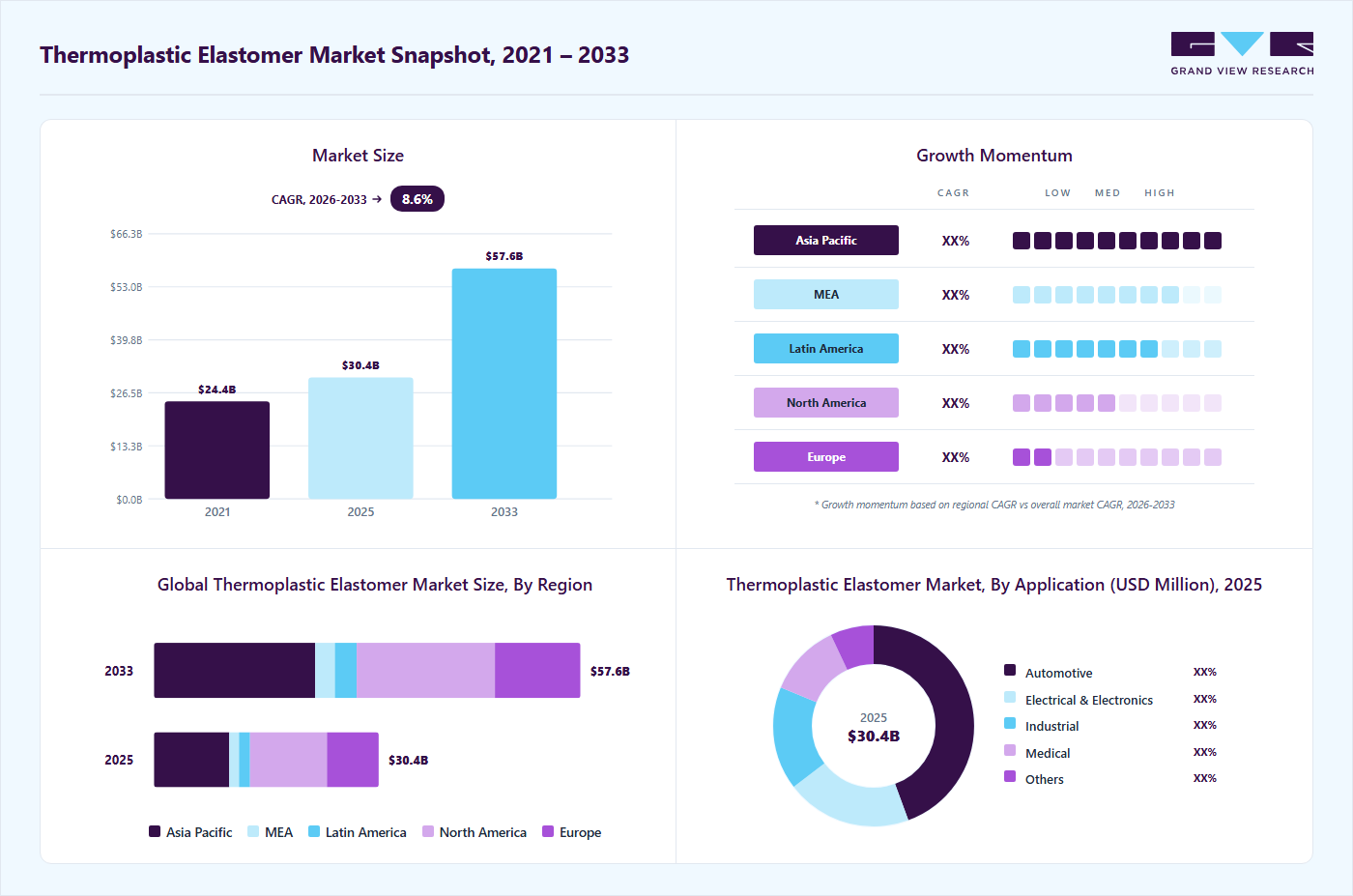
Manufacturers across automotive, healthcare, electronics, and consumer goods are increasingly seeking materials that combine flexibility, durability, and efficient processing. Thermoplastic elastomers (TPEs) address these requirements by combining the elastic properties of rubber with the processing advantages of thermoplastics. Their versatility is creating opportunities across applications that require lightweight construction, reliable performance, and adaptable product designs. The thermoplastic elastomer market was valued at USD 30.4 billion in 2025 and is projected to grow from USD 32.4 billion in 2026 to USD 57.6 billion by 2033, registering a CAGR of 8.6% from 2026 to 2033.
Lightweight and Recyclable Materials Support Market Expansion
Demand for lightweight, flexible, and durable materials is a major factor supporting the adoption of TPEs. Automotive manufacturers use these materials in seals, hoses, interior components, and other parts where flexibility and reduced weight are important. Replacing heavier materials can help manufacturers improve vehicle efficiency while meeting evolving performance requirements.
TPEs can be processed using conventional thermoplastic techniques, including injection molding and extrusion. These methods can support efficient manufacturing, shorter production cycles, and reduced material waste. Their potential recyclability also makes them attractive for manufacturers exploring more sustainable material options.
Beyond automotive applications, TPEs are used in electrical and electronic products, construction materials, medical devices, and consumer goods. Their ability to support multi-material designs and overmolding creates additional flexibility for product developers.
Polystyrene Materials Maintain a Leading Position
The polystyrene segment accounted for 32.01% of market revenue in 2025, making it the leading material category. Its balance of flexibility, durability, and cost efficiency supports applications across automotive components, packaging, and consumer products.
Polyamide-based TPEs are expected to record the fastest growth among material segments, with a 10.0% CAGR from 2026 to 2033. These materials combine flexibility with mechanical strength and thermal performance, making them suitable for demanding automotive and industrial environments. Their potential use in applications requiring heat resistance and durability creates opportunities for specialized material suppliers.
Other material categories include polyolefins, polyether imides, polyurethanes, and polyesters. Each category offers distinct performance characteristics, allowing manufacturers to select materials according to their product design, processing requirements, and operating conditions.
Automotive Applications Lead End-Use Demand
The automotive segment accounted for 40.15% of market revenue in 2025, establishing it as the leading application. TPEs are used in vehicle seals, hoses, interior trim, and other components that require flexibility, durability, and resistance to repeated use.
The shift toward electric vehicles is creating additional opportunities for these materials. TPEs can be used in cable insulation, sealing systems, battery-related components, and vibration-damping applications. Their compatibility with overmolding and complex component designs also supports their use in modern vehicle manufacturing.
Medical applications are projected to grow at the fastest rate, registering a 10.1% CAGR from 2026 to 2033. Flexibility, softness, and suitability for specialized medical products make TPEs relevant to tubing, catheters, and syringe components. Continued product development and demand for advanced medical devices could expand this application area.
Electrical and electronics, industrial products, consumer goods, and other applications further diversify market demand.
North America Leads as Asia Pacific Expands
North America accounted for 34.21% of market revenue in 2025, supported by demand from automotive, construction, and consumer goods manufacturers. Established manufacturing capabilities and investment in material innovation contribute to regional demand. The United States represented 74.50% of North America's market revenue in 2025.
Asia Pacific is projected to register the fastest regional growth, with a 10.2% CAGR from 2026 to 2033. Industrialization, urbanization, vehicle manufacturing, and growing demand for lightweight and recyclable materials support the region's expansion. China held the largest country-level market share in Asia Pacific in 2025, while India's expanding industrial and automotive sectors provide additional opportunities.
Innovation and Sustainability Shape Competition
Manufacturers are investing in new formulations, recycled materials, and improved thermal and chemical resistance. These developments aim to expand the range of applications for TPEs while addressing performance and sustainability requirements.
In February 2025, Prism Worldwide collaborated with Sherwood Industries to commercialize sustainable TPE sheets made from recycled material sourced from discarded tires. Such developments demonstrate growing interest in circular material solutions.
Although higher costs and limitations in heat, oil, or chemical resistance can affect material selection, continued innovation is creating new opportunities. Growing demand for lightweight automotive components, medical products, and recyclable materials is expected to support market development through 2033.
Frequently Asked Questions
How large is the thermoplastic elastomer market expected to become by 2033?
The market is projected to reach USD 57.6 billion by 2033, growing at a CAGR of 8.6% from 2026 to 2033.
Which application segment dominated the thermoplastic elastomer market in 2025?
Automotive was the leading application segment, accounting for 40.15% of market revenue in 2025.
Key Thermoplastic Elastomer Companies:
· BASF SE
· Arkema
· DuPont
· Covestro AG
About us:
Grand View Research, a market research and consulting company, provides syndicated research reports, customized research reports, and consulting services. Grand View Research database is used by the world's renowned academic institutions and Fortune 500 companies to understand the global and regional business environment. Our database features thousands of statistics and in-depth analysis on 46 industries in 25 major countries worldwide.

 English
 Arabic
 French
 Spanish
 Portuguese
 Deutsch
 Turkish
 Dutch
Dutch
 Italiano
 Russian
 Romaian
 Greek
Greek