


Dayforce Training: Advanced HCM Implementation and Optimization
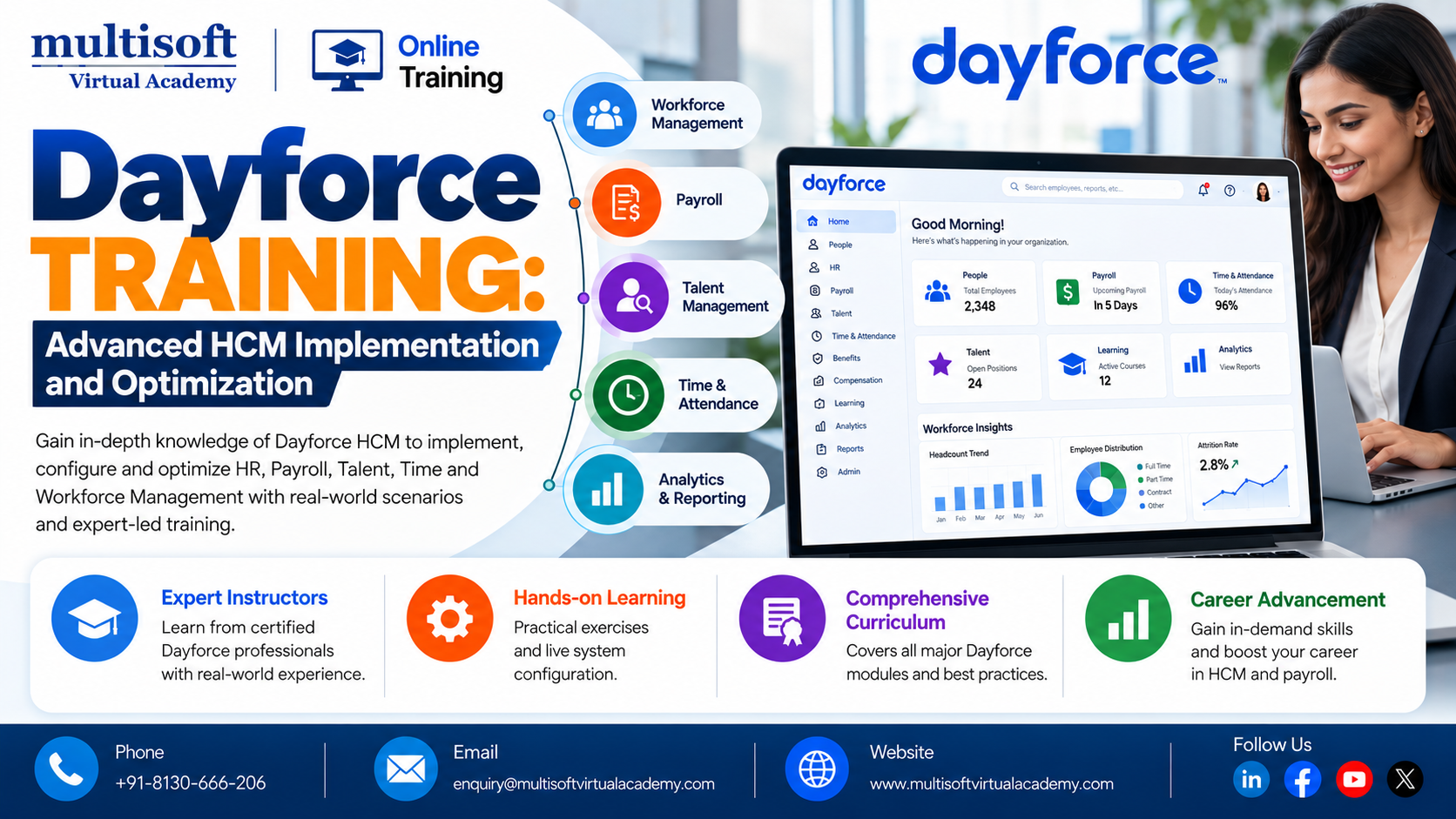
Modern enterprises require integrated human capital management systems that can coordinate workforce operations, maintain reliable employee data, streamline payroll processing, and support strategic workforce planning. As organizations expand across departments, locations, and jurisdictions, managing these activities through disconnected HR applications can create data inconsistencies, administrative delays, and compliance challenges.
Dayforce provides a connected human capital management (HCM) platform that supports core HR, payroll, workforce management, talent management, and related employee processes. Its capabilities help organizations establish more consistent workflows and improve visibility into workforce operations.
Dayforce Training at an advanced level focuses on understanding how these capabilities interact within enterprise environments. Beyond routine application navigation, learners can explore system configuration, payroll validation, workforce rules, integration strategies, reporting, security, and implementation governance.
For HR technology specialists, payroll professionals, HRIS analysts, and HCM consultants, advanced Dayforce knowledge can help bridge the gap between business requirements and technology-enabled workforce operations. Understanding the platform's functional relationships is particularly important when supporting complex organizations with multiple employee groups, compensation structures, and regulatory requirements.
Understanding Dayforce Architecture and HCM Functionality
Dayforce is a cloud-based HCM platform that connects workforce information and processes across different functional areas. The precise functionality available depends on the organization's subscriptions, configuration, jurisdiction, and implementation design.
At an enterprise level, the value of an integrated HCM platform comes from maintaining consistent employee information across relevant business processes.
For example, a change in an employee's position, work location, pay rate, or employment status may affect several downstream activities. Depending on the configuration, these changes can influence scheduling eligibility, payroll calculations, reporting, benefits administration, and approval workflows.
Advanced Dayforce learning should therefore examine the relationships between functional modules rather than treating each module as an independent application.
Key areas of study include:
- Employee and organizational data structures
- HR business processes and approval workflows
- Role-based access and permissions
- Payroll and timekeeping dependencies
- Workforce management configuration
- Reporting and data validation
- Integration and implementation considerations
Understanding these relationships helps professionals investigate issues more systematically and recognize the wider impact of configuration decisions.
Advanced Dayforce Configuration and Business Process Design
Configuration is an important aspect of adapting an HCM platform to organizational requirements. The objective is to translate approved business policies into consistent system behavior while avoiding unnecessary complexity.
Organizational Structures and Employee Data
Enterprise HR systems must represent reporting relationships, departments, locations, job assignments, and employment arrangements accurately.
Advanced training can explore how organizational structures and employee records support workforce reporting, security, approvals, and operational processes.
Learners should understand the importance of data ownership, effective dates, validation rules, and consistent terminology. Poorly maintained organizational data can affect reporting accuracy and create downstream administrative problems.
Business Rules and Workflow Configuration
HR processes frequently involve multiple steps, including submission, review, approval, and completion. Examples include employee transfers, compensation changes, leave requests, and onboarding activities.
Training may introduce the configuration concepts used to support such workflows, depending on the learner's access and course scope.
The focus should be on translating documented business requirements into appropriate system behavior. Professionals should also consider exception handling, escalation procedures, authorization boundaries, and auditability.
Configuration Governance
Enterprise configuration changes should follow a controlled process. A change that appears minor may affect payroll, reporting, or workforce operations.
A sound governance approach includes documenting requirements, reviewing dependencies, testing changes, obtaining appropriate approvals, and maintaining implementation records.
Advanced learners should understand how controlled configuration management reduces the risk of unexpected operational issues.
Dayforce Payroll Training: Advanced Processing and Controls
Payroll is one of the most sensitive areas of HCM because errors can affect employee payments, financial reporting, tax obligations, and regulatory compliance.
Advanced Dayforce Payroll Training should emphasize the relationships between employee data, time records, compensation rules, payroll processing, and reconciliation.
Payroll Data Dependencies
Payroll outcomes depend on several inputs, which may include employee status, compensation details, approved time entries, earnings, deductions, and applicable tax information.
When an input is incorrect or incomplete, the resulting payroll calculation may require investigation.
Professionals should learn how to trace discrepancies to their underlying causes rather than correcting only the visible symptom.
Payroll Validation and Reconciliation
A structured payroll control process may include reviewing employee changes, validating time and attendance records, examining exceptions, comparing expected and calculated results, and reconciling payroll totals.
Depending on the organization's procedures, teams may also compare current results with previous payroll periods and investigate significant variances.
Important control considerations include:
- Employee population completeness
- Changes in salary and recurring payments
- Overtime and timekeeping exceptions
- Earnings and deduction accuracy
- Retroactive adjustments
- Payroll register validation
- Reconciliation with financial records
- Approval and audit documentation
These controls should be adapted to the organization's payroll policies and legal obligations.
Multi-Jurisdiction Payroll Considerations
Organizations operating across regions may need to manage different tax rules, statutory deductions, reporting obligations, and payment requirements.
Advanced payroll professionals must understand the importance of jurisdiction-specific configuration and regulatory review.
Training should distinguish general payroll concepts from requirements that depend on a particular country, state, or employment arrangement.
Workforce Management and Labor Optimization
Workforce management connects employee availability, staffing requirements, scheduling, attendance, and labor-related reporting.
In industries with variable demand, such as retail, healthcare, hospitality, and manufacturing, effective workforce planning can help balance operational coverage with employee availability and labor budgets.
Workforce Scheduling
Advanced learning may cover scheduling principles, shift patterns, employee availability, qualification requirements, and coverage considerations.
Professionals should understand how organizational policies and configured rules affect schedule creation and maintenance.
Scheduling decisions must also account for applicable working-time regulations, contractual obligations, and employee requirements.
Time and Attendance Controls
Timekeeping information can influence payroll accuracy, labor reporting, and workforce planning.
Advanced training should address exception management, approval workflows, missed time entries, attendance discrepancies, and the validation of recorded working hours.
Organizations should establish clear procedures for investigating exceptions and correcting records with appropriate authorization.
Labor Cost and Productivity Analysis
Workforce reporting can help managers understand staffing levels, overtime patterns, scheduled versus actual hours, and labor expenditure.
These indicators should be interpreted in context. For example, higher overtime may reflect a temporary demand increase, insufficient staffing, scheduling inefficiencies, or other operational factors.
Advanced professionals should learn to investigate the underlying causes before recommending changes to workforce policies.
Dayforce Integrations and Enterprise Data Management
Large organizations commonly connect HCM systems with finance applications, identity management platforms, benefits providers, recruitment systems, timekeeping solutions, and other enterprise technologies.
Integration design is therefore an important area for professionals supporting complex Dayforce environments.
Integration Requirements and Data Mapping
Before designing an integration, teams should identify the business purpose, source and destination systems, data ownership, frequency of exchange, and validation requirements.
Data mapping defines how information in one system corresponds to fields in another.
For example, an employee identifier, organizational unit, employment status, or compensation value may need to be represented consistently across connected systems.
Advanced learning should cover field mapping, mandatory data, transformation rules, effective dates, and error-handling requirements.
Integration Monitoring and Troubleshooting
An integration can fail because of invalid data, connectivity issues, authentication problems, unexpected format changes, or configuration errors.
A structured troubleshooting approach begins by identifying the affected process and examining available logs, status information, and error details.
Professionals should determine whether the issue originates in the source data, transformation logic, destination system, or integration mechanism.
Where the implementation supports automated monitoring, teams can establish appropriate alerts and exception-handling procedures.
API and Data Exchange Concepts
Technical learning paths may cover APIs, supported integration mechanisms, file-based exchanges, and data synchronization concepts.
The exact methods available depend on Dayforce's supported interfaces, product configuration, and the organization's integration architecture.
Learners should understand authentication, data permissions, validation, error responses, and secure handling of employee information.
Reporting, Analytics, and Workforce Intelligence
Advanced HCM reporting involves more than generating operational reports. It requires understanding data definitions, reporting objectives, access controls, and the limitations of the available information.
HR and Payroll Reporting
Reports can support employee administration, payroll review, workforce planning, absence analysis, and management oversight.
Training may cover report requirements, filters, data selection, aggregation, and validation, depending on the reporting capabilities available in the environment.
Professionals should confirm that reports use consistent definitions and include the appropriate employee population and reporting period.
Key Workforce Metrics
Common workforce indicators include employee turnover, absence rates, overtime hours, workforce composition, and recruitment activity.
Each metric requires a clear definition. For instance, turnover calculations may differ according to whether an organization measures voluntary departures, total separations, or another defined population.
Advanced learners should understand how reporting assumptions affect comparisons and management decisions.
Data Quality and Governance
Reliable analytics depend on accurate and consistent information.
Organizations should establish data ownership, validation procedures, access restrictions, retention policies, and correction processes.
Sensitive employee information must be protected through appropriate permissions and organizational security controls.
Dayforce Security, Privacy, and Compliance
HCM platforms contain confidential information, including employee identities, compensation details, organizational relationships, and other personal records.
Security should therefore be considered throughout system configuration, integration, reporting, and ongoing administration.
Role-Based Access Management
Access should reflect job responsibilities and the principle of least privilege. Users should receive the permissions necessary to perform their duties without unnecessary access to sensitive information.
Advanced training may explore role assignments, permission reviews, segregation of duties, and the relationship between access controls and business workflows.
Auditability and Change Control
Changes to employee records, payroll settings, and system configuration may require traceability.
Organizations should maintain appropriate records of changes, approvals, testing, and operational reviews in accordance with their internal policies and applicable requirements.
Privacy and Regulatory Responsibilities
Organizations must consider relevant employment, tax, privacy, and data protection requirements in the jurisdictions where they operate.
Training should encourage professionals to work with authorized compliance and legal specialists when interpreting requirements that affect system configuration or employee information handling.
Dayforce Implementation and Optimization
A successful HCM implementation requires coordination between HR, payroll, IT, finance, security, and other stakeholders.
The implementation process should begin with a clear understanding of existing business processes and the desired future state.
Requirements Analysis
Implementation teams document business needs, identify process variations, define reporting requirements, and establish priorities.
They should distinguish mandatory legal or operational requirements from preferences that may not justify additional complexity.
Configuration and Testing
Configuration should be based on approved requirements and tested in an appropriate environment.
Testing may include functional scenarios, integration validation, payroll calculations, access permissions, exception handling, and regression testing after changes.
Data Migration and Validation
Moving employee information from legacy systems requires careful data preparation and validation.
Organizations should identify duplicate records, missing fields, inconsistent formats, and historical data requirements before migration.
Reconciliation helps confirm that transferred information is complete and consistent with the agreed migration scope.
User Acceptance and Change Management
Users need to understand how updated workflows affect their responsibilities.
User acceptance testing helps stakeholders confirm that the system supports the agreed business requirements. Training materials, process documentation, and support procedures can also improve adoption.
Continuous Improvement
After implementation, organizations should review operational issues, user feedback, data quality, reporting needs, and configuration effectiveness.
A controlled improvement process helps teams prioritize changes and reduce unnecessary disruption.
Artificial Intelligence and the Future of HCM
AI and advanced analytics are influencing how organizations approach workforce planning, employee development, and HR service delivery.
Potential applications include assistance with routine information requests, learning recommendations, content creation, and the analysis of workforce trends.
However, organizations should evaluate AI capabilities carefully, particularly when employee data or employment decisions are involved.
Important considerations include data quality, privacy, transparency, human oversight, and the risk of inaccurate or biased outputs.
Advanced Dayforce professionals should understand how emerging capabilities fit within existing HR processes and governance arrangements. They should also verify which capabilities are available in their specific environment rather than assuming every feature is included in every implementation.
Career Opportunities After Advanced Dayforce Training
Advanced Dayforce knowledge can be relevant to professionals pursuing roles in enterprise HCM, payroll, HR technology, and workforce management.
Potential career paths include:
- Dayforce HCM Functional Consultant
- Dayforce Payroll Consultant
- HRIS Business Analyst
- Dayforce Implementation Consultant
- Workforce Management Consultant
- HCM Integration Specialist
- HR Technology Analyst
- HCM Application Support Specialist
Functional roles generally emphasize requirements analysis, business process configuration, testing, and stakeholder coordination. Technical roles may focus on integrations, data exchange, reporting, security, and troubleshooting.
Career requirements vary by employer. Practical implementation experience, knowledge of HR or payroll operations, and the ability to investigate complex issues can strengthen a candidate's professional profile.
Training supports skill development but does not guarantee employment or certification.
How to Select an Advanced Dayforce Training Program
Selecting an advanced course requires matching the curriculum with your intended responsibilities.
Evaluate the technical depth: Check whether the program covers configuration, payroll controls, integrations, reporting, security, or implementation topics relevant to your role.
Confirm the product scope: Verify which Dayforce functionality and learning environment the course covers.
Prioritize scenario-based exercises: Practical scenarios help learners understand dependencies between employee data, payroll, workforce rules, and reporting.
Review trainer expertise: Look for relevant experience with HCM workflows, implementation projects, and enterprise system support.
Consider learning support: Access to explanations, exercises, documentation, and opportunities to discuss technical questions can improve learning outcomes.
Check official resources: Consult current Dayforce education and documentation resources to verify available learning paths and any credential requirements.
Conclusion
Advanced Dayforce expertise involves understanding how HCM configuration, payroll controls, workforce management, integrations, reporting, and security work together to support enterprise operations. Dayforce Training can help professionals build the functional and technical knowledge needed to analyze business requirements, improve data quality, support implementation projects, and manage complex workforce processes. By combining structured learning with realistic scenarios and a strong understanding of compliance and governance, learners can develop capabilities relevant to modern HR technology environments. For professionals seeking guided learning and industry-oriented instruction, Multisoft Virtual Academy offers Dayforce training designed to strengthen understanding of HCM processes and prepare learners for responsibilities across payroll, workforce management, HRIS, and enterprise application support.
Originally Content Posted at: https://www.multisoftvirtualacademy.com/blog/dayforce-training-advanced-hcm-implementation-and-optimization

 English
 Arabic
 Spanish
 Portuguese
 Deutsch
 Turkish
 Dutch
Dutch
 Italiano
 Russian
 Romaian
 Portuguese (Brazil)
 Greek
Greek