


Local SEO for Small Businesses: A Practical Guide to Getting Found in 2026
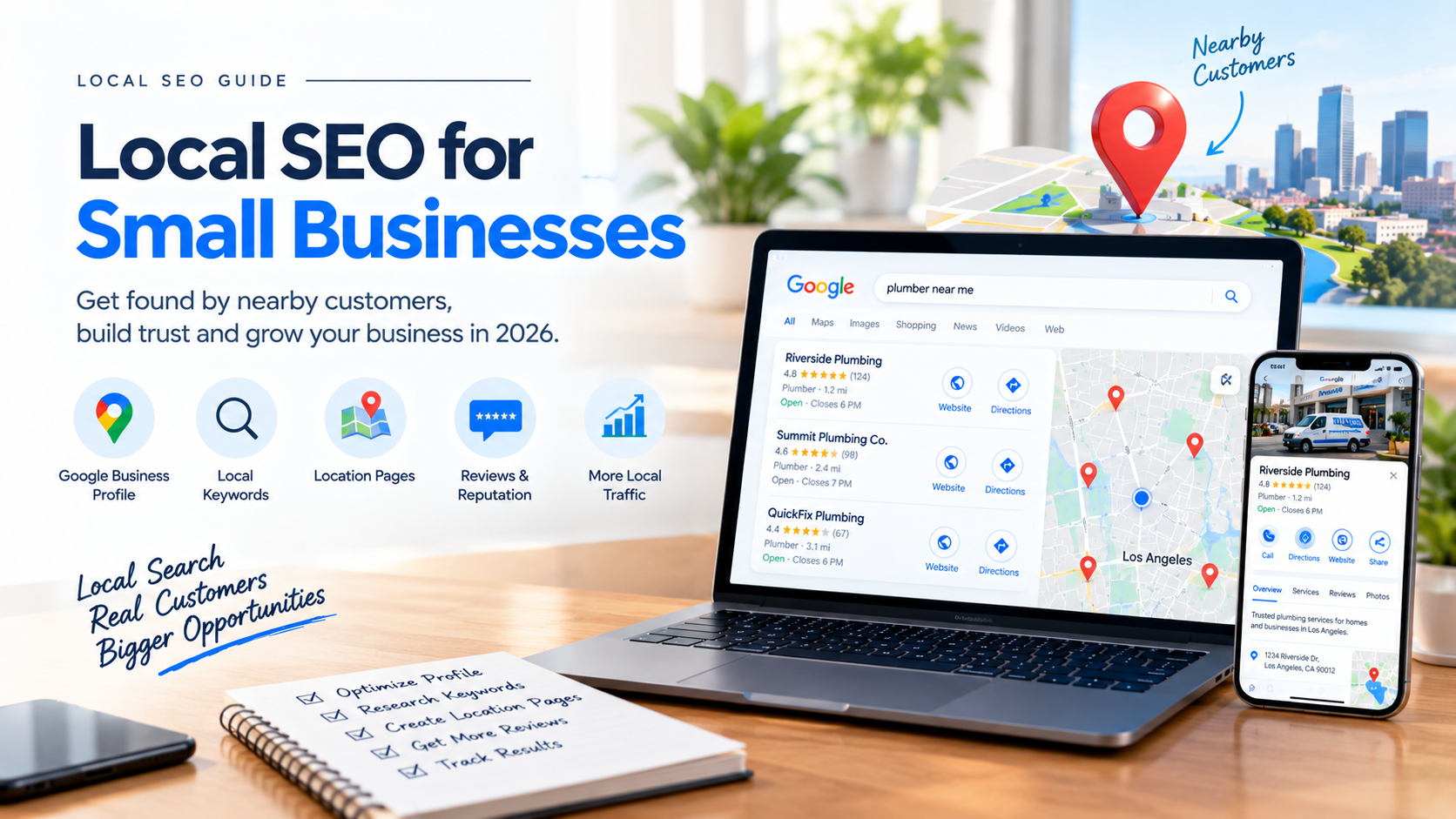
Local customers often turn to Google when they need a nearby service, whether they are searching for a dentist, plumber, restaurant, law firm, or marketing agency. If your business does not appear prominently in local search results, potential customers may choose a competitor before they even discover your website.
This is why local search engine optimization (SEO) matters. It helps businesses improve their visibility in location-based searches, connect with nearby customers, and generate more relevant website visits, calls, and inquiries.
In 2026, an effective local SEO strategy for small businesses involves more than adding a city name to a webpage. Businesses need accurate information, a well-optimized Google Business Profile, helpful website content, consistent business details, and a trustworthy online reputation.
This guide explains how small businesses can strengthen local search visibility, avoid common mistakes, and build a sustainable strategy for attracting customers in their service areas.
What Is Local SEO and Why Does It Matter?
Local SEO is the process of improving a business's visibility in search results for location-specific queries. These searches often include a city, neighborhood, service area, or phrase such as “near me.”
For example, a customer might search for “emergency plumber in Lahore,” “dentist near me,” or “best marketing agency in California.” Search engines use various signals to determine which businesses and webpages are relevant to the search.
Local SEO can help small businesses:
-
Reach people searching for nearby products and services.
-
Improve visibility in Google Maps and relevant local results.
-
Build trust through accurate business information and customer reviews.
-
Attract more qualified visitors to service and location pages.
-
Increase calls, appointment requests, direction requests, and inquiries.
Local optimization is especially valuable for businesses that depend on customers in a particular geographic area. However, results depend on competition, location, relevance, and the quality of the overall online presence. No SEO tactic can guarantee a specific ranking.
1. Optimize Your Google Business Profile
A Google Business Profile is one of the most important starting points for eligible businesses seeking greater visibility in local Google Search and Maps results.
The profile helps customers understand what your business offers, where it operates, and how they can contact you.
Start by claiming or verifying your profile, then review the following details:
-
Business name: Use your real-world business name rather than adding extra keywords.
-
Primary category: Choose the category that most accurately describes your main business.
-
Address or service area: Enter accurate details according to your business model and Google's guidelines.
-
Phone number and website: Make sure both direct customers to the correct destinations.
-
Business hours: Keep regular and holiday hours up to date.
-
Services: Add relevant services and descriptions where the available profile features support them.
-
Photos: Upload genuine images of your premises, team, products, or completed work when appropriate.
For example, a small plumbing company should select the most relevant business category and clearly explain the services it provides. Adding unrelated categories or stuffing the business name with phrases such as “Best Affordable Emergency Plumber” can create problems rather than improve visibility.
Businesses that serve customers at their locations and service-area businesses may have different profile requirements. Follow Google's eligibility and representation rules rather than creating unnecessary profiles for every neighborhood.
2. Research Local Keywords Your Customers Actually Use
Keyword research helps you understand how potential customers describe their needs and which searches are relevant to your services.
For local businesses, useful keywords often combine a service with a geographic modifier. However, not every keyword needs to include a city name. Google can also understand location intent from the searcher's context.
Consider these examples:
|
Business type |
Example local keyword |
|---|---|
|
Dental practice |
Family dentist in Alexandria |
|
Plumbing company |
Emergency plumbing services in Lahore |
|
Digital marketing agency |
Local SEO services in California |
|
Cleaning business |
House cleaning near me |
|
Custom tailoring business |
Custom suits in Alexandria |
Use tools such as Google Keyword Planner, Google Search Console, or an SEO platform to research search demand and related queries. You can also review Google's search suggestions and the questions customers ask your team.
Prioritize keywords based on three factors: relevance to your services, the likelihood that the searcher needs your offering, and whether your business can realistically serve that location.
Avoid targeting every variation of a city name simply because it appears in a keyword tool. Your goal is to understand customer intent and create useful pages that address it.
3. Create Useful Location-Specific Landing Pages
If your business serves multiple cities or neighborhoods, dedicated location pages can help potential customers find information relevant to their area. However, each page should provide genuine value rather than simply replacing one city name with another.
A strong location page should include:
-
Services available in that location
-
Relevant local customer needs and questions
-
Accurate contact information and service-area details
-
Examples of work completed in the area, where available
-
Helpful answers to location-specific questions
-
Clear calls to action, such as requesting a quote or booking an appointment
For example, a business serving Alexandria and Arlington could create separate pages if it genuinely offers services in both locations and can provide useful, distinct information for each audience.
Avoid publishing dozens of nearly identical pages for cities you do not serve. Repetitive location pages with little unique value can create a poor experience for visitors and may fall short of Google's people-first content guidance.
4. Keep Your Business Information Consistent Across the Web
Customers should be able to find accurate information about your business wherever they encounter it online.
Review your business name, address, phone number, website, and other important details across relevant directories, professional associations, and industry platforms. Correct outdated listings and remove duplicates when possible.
This process is often called local citation management.
Focus on legitimate platforms that matter to your customers, such as established business directories, relevant industry organizations, and local chambers of commerce. A smaller number of accurate, relevant listings is more useful than submitting your information to hundreds of unrelated directories.
For service-area businesses, make sure the information reflects how the business actually operates. Do not use a false address or create misleading listings to appear closer to customers in other locations.
Consistent information helps customers verify your business and supports the broader effort to establish a clear online identity. Google also uses information from multiple sources to understand businesses and their official websites.
5. Encourage Genuine Customer Reviews and Respond Professionally
Online reviews help potential customers evaluate a business before contacting it. They can also contribute to a business's prominence in local search results.
Create a simple process for requesting honest feedback from customers after a completed purchase, appointment, or service.
You can encourage reviews by:
-
Sending a follow-up email with a direct review link.
-
Providing a QR code at an appropriate point of service.
-
Asking customers for feedback after a successful project.
-
Responding professionally to positive and negative reviews.
-
Using recurring feedback to identify service improvements.
When responding to a negative review, acknowledge the customer's concern, remain respectful, and offer an appropriate way to resolve the issue. Avoid disclosing private customer information.
Never buy reviews, create fake customer accounts, or offer incentives in exchange for positive ratings. The goal is to build a trustworthy reputation through genuine customer experiences.
Google recommends responding to reviews and keeping business information accurate as part of its guidance for improving local visibility.
6. Publish Content That Answers Local Customers' Questions
A business website should do more than list services and contact details. Helpful content can address common questions, explain purchasing decisions, and demonstrate the business's knowledge of its industry.
Consider publishing:
-
Practical how-to guides
-
Answers to frequently asked customer questions
-
Service comparisons and buying guides
-
Local project examples and case studies
-
Seasonal advice relevant to your industry
-
Explanations of pricing factors and service processes
For instance, a roofing company could publish a guide explaining how homeowners can identify roof damage after a storm. A dental practice might explain what patients should expect during a routine appointment. A local SEO agency could explain how businesses can improve their Google Business Profile.
The best topics are connected to your actual services and the needs of your target audience.
For businesses that need help planning content, SEOCALI can be a relevant resource for exploring SEO strategies that support local search visibility. A well-planned approach can help small businesses identify content gaps, improve important website pages, and build a stronger connection between their services and the searches their customers perform.
Prioritize useful, original information over articles written solely to repeat keywords. Google's guidance recommends creating helpful content for people rather than producing pages primarily to manipulate rankings.
7. Improve Website Speed, Mobile Usability, and Technical SEO
Many local searches happen on mobile devices, often when people need information quickly. If your website loads slowly, displays poorly on smaller screens, or makes contact details difficult to find, visitors may leave before taking action.
Review these essential technical elements:
Mobile-friendly design: Make sure text is readable, navigation works properly, and buttons are easy to tap.
Page speed: Optimize large images, reduce unnecessary scripts, and review performance issues that affect the user experience.
Secure browsing: Use HTTPS across your website.
Indexing: Check Google Search Console for important pages that are excluded from indexing or experiencing crawling issues.
Internal linking: Connect relevant service pages, location pages, and educational articles so visitors can find related information easily.
Contact accessibility: Make phone numbers, addresses, opening hours, and inquiry forms easy to locate.
You should also ensure that your website clearly explains what the business offers and where it operates. Technical improvements support discoverability, but they work best alongside useful content and accurate business information.
8. Add Appropriate Local Business Structured Data
Structured data gives search engines additional context about the information on a webpage. For eligible businesses, LocalBusiness structured data can describe details such as the business name, address, telephone number, URL, and opening hours.
For implementation, use the most appropriate schema type for your actual business and make sure the markup reflects information visible on the website.
A practical implementation process includes:
-
Identify the correct business or organization schema type.
-
Add accurate and relevant properties.
-
Validate the markup using Google's supported testing tools.
-
Check the page in Google Search Console after publishing.
-
Update the markup when business details change.
Do not add false addresses, fabricated reviews, or unsupported information. Structured data should accurately describe the business rather than attempt to manufacture credibility.
Local business schema can help Google understand business information, but it does not guarantee a particular local ranking or a rich search result.
9. Earn Relevant Local Links and Build Community Connections
Local link building is most effective when it connects your business with organizations, publications, and websites that are relevant to your customers.
Instead of focusing only on the number of backlinks or third-party authority scores, look for opportunities that make sense for your industry and geographic market.
Potential opportunities include:
-
Local chambers of commerce and business associations
-
Community organizations and event websites
-
Relevant regional publications
-
Industry-specific professional directories
-
Local partnerships and sponsorships
-
Editorial coverage of useful research or community projects
For example, a custom tailoring business could build relationships with wedding planners, formalwear resources, and local lifestyle publications. A home services company might contribute useful advice to a neighborhood publication or participate in a community event.
The strongest opportunities are those where a prospective customer might realistically discover the business. Avoid mass submissions to irrelevant websites or paid links intended to manipulate rankings.
Relevant editorial mentions can help people learn about your business and contribute to a more credible online presence.
10. Measure Results and Improve Your Local SEO Strategy
Local SEO is an ongoing process. Regular monitoring helps you identify what is working, which pages need attention, and where customers are finding your business.
Use Google Search Console, Google Business Profile performance data, and an analytics platform to track useful indicators.
|
Metric |
What to evaluate |
|---|---|
|
Local keyword visibility |
Changes in rankings for important service and location terms |
|
Google Business Profile interactions |
Calls, website clicks, and other available customer actions |
|
Organic website traffic |
Visits from relevant non-paid search results |
|
Conversion rate |
The percentage of visitors who complete meaningful actions |
|
Review activity |
New genuine reviews and response quality |
|
Landing-page performance |
Which service and location pages attract visitors |
|
Leads and inquiries |
Whether SEO contributes to business opportunities |
Review results monthly and compare similar periods when possible. Seasonal demand, competition, business changes, and other factors can influence performance, so avoid judging the entire strategy based on a short-term ranking fluctuation.
If a location page attracts traffic but generates few inquiries, review whether the content matches search intent and whether the next step is clear. If your Google Business Profile receives views but few customer actions, check the accuracy of your information, service descriptions, photos, and overall customer experience.
Use the data to prioritize practical improvements rather than making changes simply because a competitor appears to rank higher.
Common Local SEO Mistakes Small Businesses Should Avoid
Even a well-intentioned SEO campaign can waste resources when it relies on shortcuts or outdated practices.
Avoid these common mistakes:
-
Keyword stuffing: Repeating city and service keywords unnaturally across pages.
-
Fake business locations: Using addresses where your business is not legitimately eligible to maintain a profile.
-
Duplicate location pages: Publishing near-identical pages with no meaningful local value.
-
Fake reviews: Purchasing reviews or asking people to post feedback about experiences they never had.
-
Irrelevant backlinks: Building links from unrelated websites simply to increase backlink counts.
-
Neglecting mobile users: Making contact details and forms difficult to use on phones.
-
Ignoring performance data: Continuing ineffective activities without evaluating their results.
-
Expecting instant rankings: Assuming that a new profile, page, or backlink will produce immediate results.
A sustainable strategy emphasizes accuracy, genuine customer value, and continuous improvement.
Conclusion
Local SEO gives small businesses a practical way to connect with customers who are searching for relevant products and services in their area. A strong strategy combines an optimized Google Business Profile, thoughtful keyword research, useful location pages, consistent business information, genuine customer reviews, and technically sound website content.
Businesses should also build relevant local relationships, use appropriate structured data, and measure performance through meaningful metrics such as qualified traffic, inquiries, and conversions.
The key is to focus on the needs of real customers rather than chasing shortcuts. With a consistent, data-driven approach, small businesses can strengthen their local search presence and create more opportunities to attract customers over time.

 English
 Arabic
 French
 Spanish
 Portuguese
 Deutsch
 Turkish
 Dutch
Dutch
 Italiano
 Russian
 Romaian
 Portuguese (Brazil)