


SailPoint IdentityNow Training: Advance Your IAM Expertise
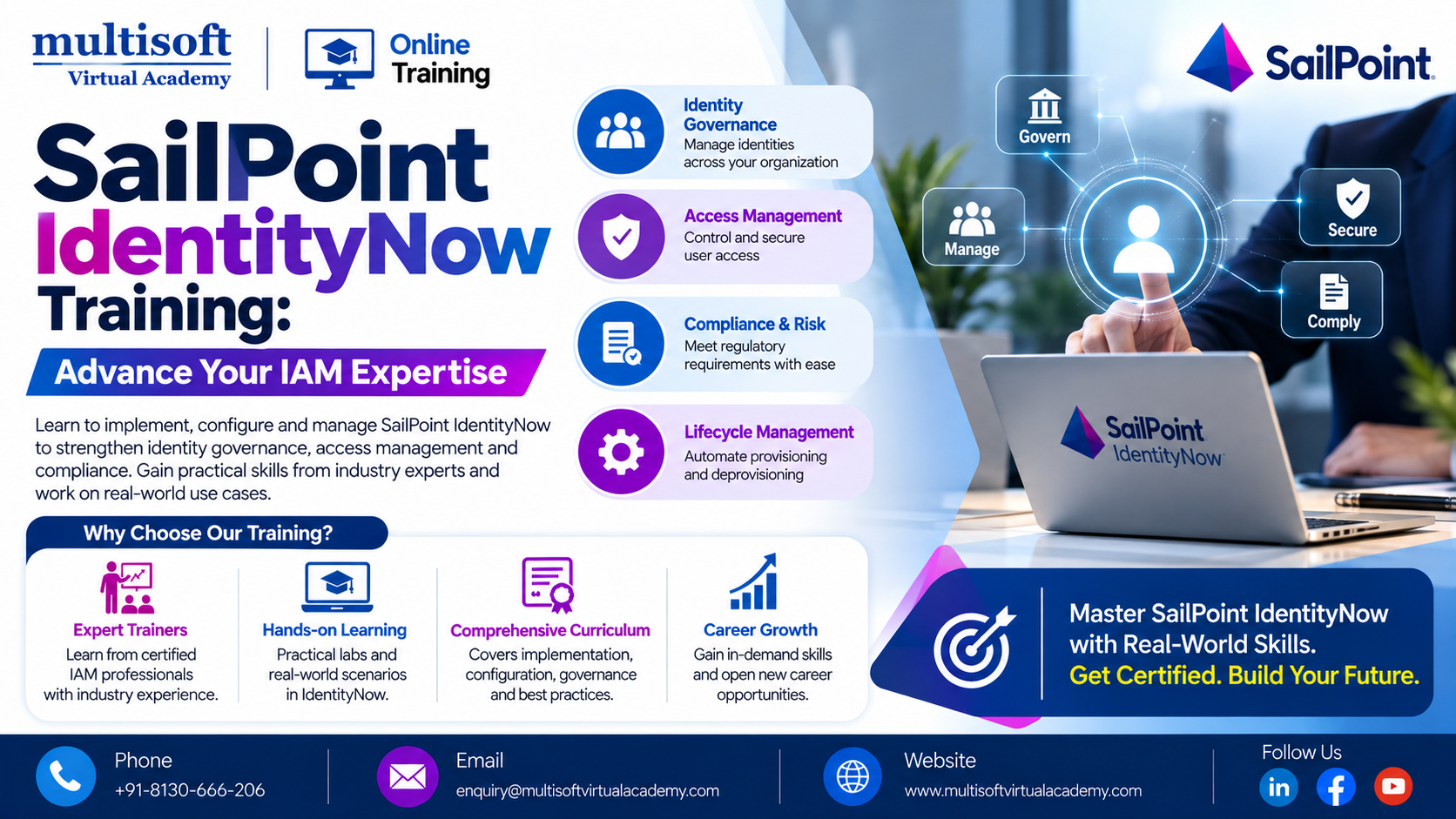
Digital identities have become a critical part of enterprise cybersecurity. Organizations depend on cloud applications, business platforms, databases, and interconnected IT infrastructure to support daily operations. Managing access across these environments requires more than creating user accounts. Businesses must ensure that every identity receives appropriate permissions, access changes are handled correctly, and unnecessary privileges are removed promptly.
SailPoint IdentityNow Training introduces professionals to identity governance and administration (IGA), automated provisioning, access certifications, identity lifecycle management, and enterprise access controls. These capabilities help organizations establish consistent identity processes while improving visibility into who can access business resources.
IdentityNow is the former name associated with SailPoint's cloud-based identity governance offering, which subsequently became known as Identity Security Cloud. SailPoint's newer product terminology includes SailPoint Human Fabric. Understanding these naming changes helps learners navigate existing implementations, technical documentation, and current learning resources.
For IAM engineers, cybersecurity specialists, system administrators, and identity governance consultants, developing SailPoint skills can support professional growth in an increasingly identity-focused security landscape.
Understanding SailPoint Identity Governance
Identity governance focuses on controlling and reviewing access to organizational resources throughout the identity lifecycle. It establishes processes for determining which permissions users need, how access is approved, and when privileges should be modified or revoked.
SailPoint's identity security platform helps organizations connect identity information with enterprise applications and automate selected governance processes.
Consider an employee who joins an organization as a financial analyst. The employee may require access to financial applications, reporting systems, and collaboration tools. When the employee transfers to another department, those permissions must be reassessed. When employment ends, appropriate access must be removed.
Identity governance helps coordinate these activities through defined policies and workflows.
A well-designed implementation can support:
- Identity creation and lifecycle processing
- Application account aggregation
- Access request and approval workflows
- Automated provisioning and deprovisioning
- Periodic access certifications
- Role and entitlement management
- Governance reporting and audit support
The precise functionality depends on the SailPoint product, licensed services, connected applications, and implementation configuration.
Why Is SailPoint IdentityNow Training Valuable?
Identity security requires continuous attention because employee responsibilities, application access, and organizational structures change over time.
Strengthen Identity Lifecycle Management
Identity lifecycle management covers the creation, modification, and deactivation of digital identities.
Training helps learners understand how identity attributes, employment events, and configured policies influence access decisions. This knowledge is important when implementing consistent joiner, mover, and leaver processes.
Automate Access Provisioning
Provisioning establishes or modifies accounts and permissions in connected applications. Deprovisioning removes access when it is no longer authorized or required.
Training introduces the relationship between identity data, approval workflows, entitlements, and target application operations.
These processes can reduce repetitive administrative work and improve consistency when configured and monitored correctly.
Improve Access Governance
Employees can accumulate unnecessary permissions as their roles change. Excessive access increases the potential impact of compromised accounts and may create compliance concerns.
Identity governance processes help organizations review access assignments and determine whether permissions remain appropriate.
Training helps professionals understand access reviews, approval decisions, remediation, and governance policies.
Support Audit and Compliance Requirements
Organizations often need evidence that access is authorized, reviewed, and managed according to internal policies and applicable regulations.
SailPoint governance capabilities can support access certifications, approval records, and reporting processes that contribute to audit readiness.
The actual compliance outcome depends on implementation quality, organizational procedures, and the requirements being addressed.
Core Learning Modules in SailPoint IdentityNow Training
A comprehensive course should combine identity security fundamentals with platform configuration and practical exercises.
1. Identity and Access Management Fundamentals
Learners begin by studying identity management, authentication, authorization, access control, and least-privilege principles.
Important topics include:
- Digital identities and application accounts
- Roles, permissions, and entitlements
- Identity governance principles
- Identity lifecycle events
- Access control policies
- Audit and compliance concepts
These fundamentals help learners understand how identity governance fits into a broader cybersecurity architecture.
2. Identity Profiles and Attribute Management
Identity information provides the foundation for access decisions.
Training may cover identity attributes, identity profiles, data sources, attribute mapping, identity correlation, and lifecycle states.
Learners should understand how identity records are associated with application accounts and why consistent data is essential for reliable provisioning.
For example, an inaccurate department attribute may lead to incorrect access assignments if the implementation uses that attribute to determine eligibility.
3. Application Onboarding and Source Configuration
Application onboarding connects enterprise applications and identity data sources to the identity governance platform.
Training may introduce source configuration, connector selection, account aggregation, schema attributes, entitlement discovery, and identity correlation.
Learners should understand how source data is collected and how application accounts are associated with the appropriate identities.
Practical exercises can demonstrate the importance of validating mappings and confirming that aggregated information accurately represents the target application.
4. Access Requests and Approval Management
Access request processes allow users or authorized administrators to request permissions through defined workflows.
Training may cover requestable access, approval routing, policy evaluation, request status, and provisioning outcomes.
Learners should understand how approval requirements can differ according to the application, entitlement, user role, or organizational policy.
Well-designed workflows should balance efficient access delivery with appropriate security controls.
5. Provisioning and Deprovisioning Workflows
Provisioning connects governance decisions with account operations in target systems.
Depending on the connector and configuration, workflows may create accounts, update attributes, assign permissions, or remove access.
Training should explain how to validate the resulting changes and investigate failed operations.
Professionals should also understand that not every application supports the same provisioning capabilities. Some integrations require additional configuration, custom development, or manual processes.
6. Access Certifications and Review Campaigns
Access certifications enable designated reviewers to evaluate whether users should retain their existing access.
A review may focus on application accounts, entitlements, roles, or other governed resources.
Training may cover campaign configuration, reviewer assignments, access decisions, remediation, completion tracking, and governance reporting.
Learners should understand how certification processes help organizations identify inappropriate permissions and document the decisions made during access reviews.
7. Role Management and Policy Enforcement
Role-based access control associates permissions with defined responsibilities or organizational functions.
Training may introduce role design, entitlement assignments, policy evaluation, and access governance considerations.
Advanced learners should understand the importance of maintaining roles that accurately reflect business requirements. Poorly designed roles can create excessive permissions or unnecessary administrative complexity.
8. Reporting and Governance Analytics
Reporting provides visibility into identities, application access, outstanding certifications, and governance activities.
Training may cover available search capabilities, reporting workflows, dashboards, and investigation techniques, depending on the platform version.
Learners should understand how to interpret governance information and identify issues requiring further analysis.
Advanced SailPoint Concepts for IAM Professionals
Professionals pursuing implementation or engineering responsibilities may need deeper technical knowledge of identity integrations and automation.
Connector Development and Troubleshooting
Connectors enable communication between SailPoint and connected applications.
Advanced learning may cover connector behavior, authentication, schema configuration, account aggregation, provisioning operations, and troubleshooting.
When an integration fails, engineers should examine error details, configuration settings, access permissions, and target application responses before modifying the implementation.
Workflow Automation
Automation can coordinate selected identity processes, including approvals, notifications, and account-related actions.
Training may introduce workflow triggers, conditions, actions, error handling, and process design, depending on the supported platform capabilities.
Effective automation should be based on documented requirements and include appropriate exception handling and security controls.
API-Based Integrations
Some enterprise implementations require integration with applications through supported APIs.
Technical learning may cover authentication, request and response structures, permissions, data mapping, and error handling.
Developers should consult the documentation for the specific SailPoint platform and API version they are using. Integration methods and available capabilities can differ across products and environments.
Identity Analytics and AI-Supported Security
Identity security platforms increasingly incorporate analytics and AI-assisted capabilities to support selected administrative and governance activities.
These capabilities may help teams investigate identity information, identify patterns, or streamline specific workflows, depending on the implementation.
However, AI does not replace access governance policies, reliable identity data, or human oversight. Organizations should evaluate recommendations carefully and maintain appropriate controls over sensitive identity operations.
SailPoint IdentityNow vs. Identity Security Cloud
Understanding product terminology is important when selecting training materials.
IdentityNow is a legacy product name that continues to appear in existing environments, historical documentation, and search queries. Identity Security Cloud became the subsequent name for SailPoint's cloud identity governance offering, while SailPoint Human Fabric represents newer platform terminology.
The correct terminology depends on the specific product and documentation being referenced.
When choosing a course, verify which platform version, architecture, APIs, and implementation model are covered. This helps ensure that the training aligns with your workplace environment and professional objectives.
Who Should Enroll in SailPoint IdentityNow Training?
SailPoint training can benefit professionals across cybersecurity, enterprise IT, and identity management.
IAM engineers: Develop knowledge of identity lifecycle processes, provisioning, and access governance.
Cybersecurity professionals: Understand identity-related controls, excessive permissions, and governance workflows.
System administrators: Learn how identities and application access are managed across connected systems.
Identity governance consultants: Build knowledge relevant to requirements analysis, platform configuration, and implementation projects.
Integration developers: Explore connectors, supported APIs, identity data mapping, and troubleshooting.
Compliance specialists: Understand access certifications, approval records, and governance evidence.
IT graduates: Establish a foundation in identity security before progressing to specialized IAM technologies.
Previous experience with directories, enterprise applications, REST APIs, or cybersecurity can be beneficial. Beginners should first understand identity and access management fundamentals.
Career Opportunities After SailPoint Training
SailPoint expertise can be relevant to organizations that manage access across cloud platforms, business applications, and hybrid IT environments.
Potential career paths include:
- SailPoint Identity Security Consultant
- Identity and Access Management Engineer
- Identity Governance Analyst
- SailPoint Implementation Consultant
- IAM Technical Specialist
- Identity Security Administrator
- Identity Integration Engineer
- Access Governance Consultant
Functional professionals often focus on business requirements, lifecycle processes, access reviews, and platform configuration. Technical specialists may work with connectors, integrations, APIs, automation, and troubleshooting.
Employers may also expect experience with directory services, cloud platforms, scripting, enterprise security principles, and application architecture.
Training can strengthen technical preparation, but career progression depends on practical skills, relevant experience, and the ability to solve real identity security challenges.
How to Choose the Right SailPoint Training Course
Selecting an appropriate training program requires attention to curriculum quality and practical relevance.
Evaluate the Curriculum
Check whether the course includes identity lifecycle management, source onboarding, provisioning, access requests, certifications, and governance reporting.
Advanced learners should look for suitable coverage of connectors, APIs, automation, and troubleshooting.
Prioritize Practical Exercises
Hands-on learning helps professionals understand how identity data and configuration choices affect governance outcomes.
Where an authorized training environment is available, practice onboarding a source, reviewing identity attributes, processing access requests, and investigating provisioning failures.
Verify Platform Compatibility
Confirm which SailPoint product and version the course covers. Training should reflect the capabilities and terminology relevant to your intended environment.
Review Trainer Experience
Look for trainers who understand identity governance principles as well as implementation challenges. Practical examples and structured troubleshooting exercises can make the course more valuable.
Explore Official Learning Resources
Consult SailPoint's official learning and documentation resources to verify current training paths, supported capabilities, and credential requirements.
Certification options and eligibility requirements can change, so confirm the current details before enrolling.
Best Practices for Building SailPoint Expertise
Start by learning identity governance fundamentals and understanding the relationships between identities, accounts, entitlements, and roles.
Progress to application onboarding and lifecycle management before studying access certifications, provisioning workflows, and advanced integrations.
Use realistic scenarios to understand how a department change affects access or how an unsuccessful provisioning operation can be investigated.
Document configuration assumptions, testing results, and troubleshooting steps. This helps develop a repeatable problem-solving approach.
Finally, stay current with official SailPoint documentation and relevant identity security practices. Product terminology, APIs, and platform capabilities can evolve, making continuous learning an important part of professional development.
Conclusion
SailPoint identity security technology helps organizations govern digital identities, automate access provisioning, review permissions, and strengthen enterprise access controls. SailPoint IdentityNow Training can help professionals develop practical knowledge of identity lifecycle management, application integration, access certifications, provisioning workflows, and identity governance. Selecting training that matches your experience and the relevant platform version is essential for building useful technical skills. For structured learning and professional guidance, Multisoft Virtual Academy offers SailPoint IdentityNow training designed to help learners strengthen their understanding of IAM processes and prepare for responsibilities in identity governance, cybersecurity, and enterprise access management. By combining practical exercises with sound security principles, learners can build a stronger foundation for working with modern identity security solutions.
Originally Content Posted at: https://www.multisoftvirtualacademy.com/blog/sailpoint-identitynow-training-advance-your-iam-expertise

 English
 Arabic
 French
 Portuguese
 Deutsch
 Turkish
 Dutch
Dutch
 Italiano
 Russian
 Romaian
 Portuguese (Brazil)
 Greek
Greek