


SAP FICO Training: Master Finance with SAP
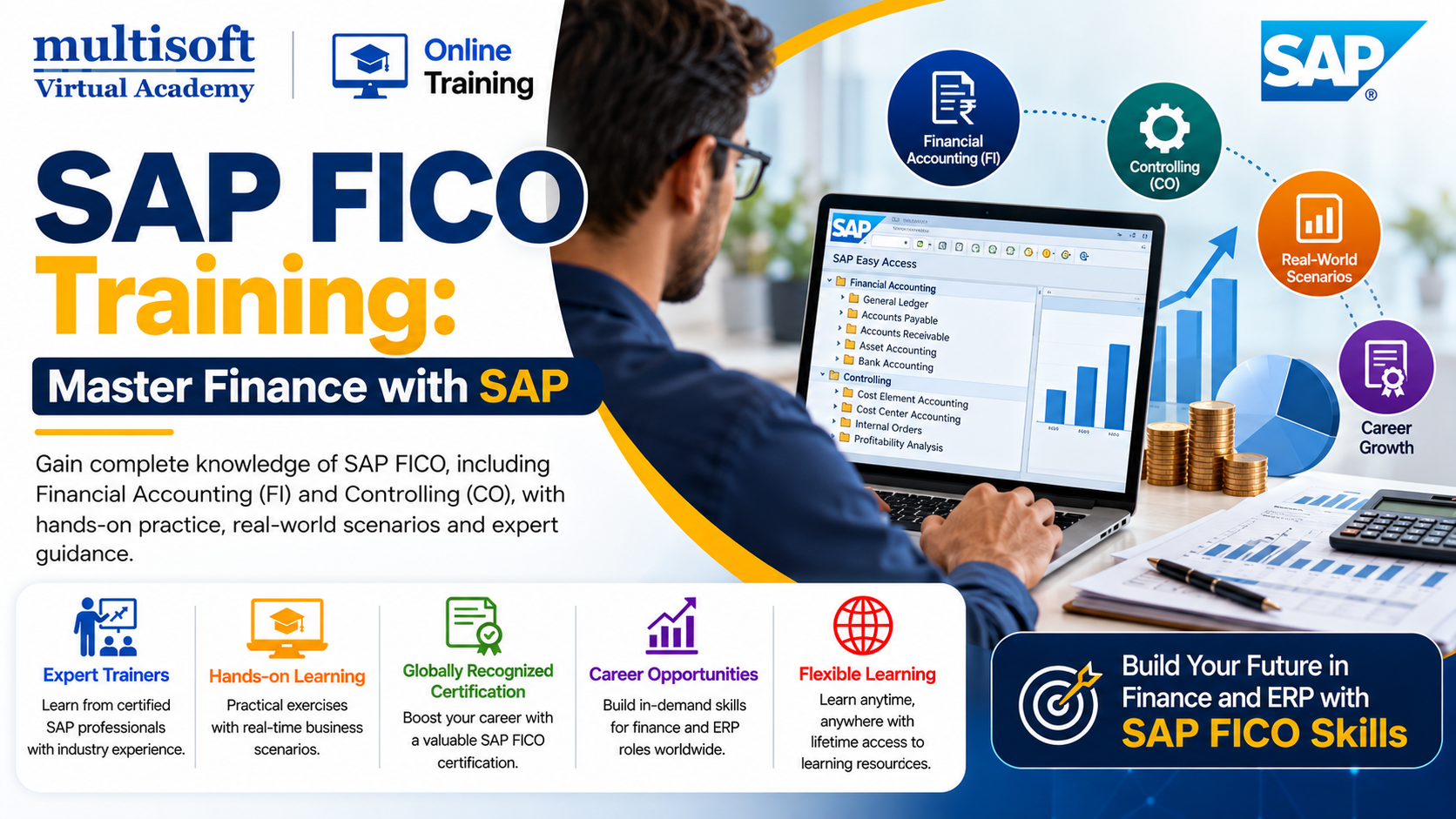
Financial management is essential for every successful business. Organizations need accurate financial records, effective cost management, transparent reporting, and reliable financial information to make informed decisions. As businesses adopt enterprise resource planning (ERP) solutions, professionals with expertise in SAP Financial Accounting and Controlling are becoming increasingly valuable.
SAP FICO Training helps professionals understand how organizations manage financial transactions, monitor expenses, prepare financial statements, and evaluate business performance using SAP systems.
The training combines financial accounting principles with practical SAP applications, enabling learners to understand how financial information moves across different business processes.
Whether you are an accounting graduate, finance professional, ERP consultant, or business analyst, developing SAP FICO skills can strengthen your understanding of enterprise financial operations.
This guide explores SAP FICO modules, essential skills, practical applications, career opportunities, and the growing importance of SAP S/4HANA Finance.
What Is SAP FICO?
SAP FICO is a commonly used term for two closely connected components of SAP ERP: Financial Accounting (FI) and Controlling (CO).
Both components support financial management, but they serve different business purposes.
SAP FI (Financial Accounting) focuses on recording financial transactions and preparing financial information for external reporting. It supports general ledger accounting, accounts payable, accounts receivable, asset accounting, and financial closing activities.
SAP CO (Controlling) focuses on internal cost management and performance analysis. It helps organizations monitor operational expenses, allocate costs, evaluate profitability, and support management decisions.
Together, these capabilities provide a comprehensive view of an organization's financial position and operational performance.
For example, when a manufacturing company purchases raw materials, SAP FI records the relevant financial transactions, while SAP CO helps analyze the associated production costs.
Understanding this relationship is essential for professionals working with integrated enterprise financial systems.
Why Is SAP FICO Training Important?
Modern finance departments handle more than bookkeeping and financial reporting. They contribute to budgeting, operational planning, regulatory compliance, profitability analysis, and strategic decision-making.
SAP FICO skills help professionals understand how these responsibilities are managed within an integrated ERP environment.
1. Strengthens Financial Accounting Knowledge
Training develops practical knowledge of financial transactions, accounting structures, reconciliation processes, and reporting activities.
Professionals learn how financial information is organized and processed within SAP.
2. Improves Cost Management Capabilities
Organizations must understand where money is spent and whether business activities generate expected returns.
SAP Controlling supports cost allocation, cost center monitoring, internal orders, and profitability analysis.
3. Supports ERP Implementation Projects
Businesses implementing SAP require professionals who understand financial requirements and system configuration.
Trained individuals can contribute to requirement gathering, process documentation, configuration, testing, and user support.
4. Develops Cross-Functional Understanding
Financial transactions frequently originate in procurement, sales, manufacturing, and other operational departments.
SAP FICO knowledge helps professionals understand these connections and their accounting implications.
5. Prepares Professionals for SAP S/4HANA Finance
Learning traditional SAP FI and CO concepts establishes a foundation for understanding modern SAP S/4HANA financial processes.
Core Modules Covered in SAP FICO Training
A comprehensive learning program should cover essential financial accounting and controlling functions through structured explanations and practical exercises.
General Ledger Accounting
General Ledger Accounting provides the foundation for recording and organizing financial transactions.
Learners explore:
- Chart of accounts and account groups
- Company codes and fiscal year variants
- General ledger master data
- Journal entries and document posting
- Posting periods and document types
- Financial statement structures
- Period-end closing activities
Practical exercises help participants understand how business transactions affect financial statements.
Accounts Payable
Accounts Payable manages financial obligations to suppliers and vendors.
Training typically covers vendor master data, invoice processing, outgoing payments, payment terms, and reconciliation.
Participants also learn how supplier transactions interact with procurement processes.
Understanding these activities is valuable for professionals involved in purchasing, finance operations, and payment management.
Accounts Receivable
Accounts Receivable focuses on financial transactions involving customers.
Important concepts include customer master records, customer invoices, incoming payments, credit management concepts, and outstanding balance monitoring.
Practical scenarios demonstrate how customer transactions affect cash flow and financial reporting.
Asset Accounting
Asset Accounting supports the financial management of fixed assets, including machinery, buildings, equipment, and vehicles.
Learners study asset master records, acquisitions, depreciation, transfers, retirements, and asset reporting.
These activities help organizations maintain accurate fixed-asset records throughout the asset lifecycle.
Bank Accounting
Bank Accounting covers financial transactions involving organizational bank accounts.
Participants learn about bank master data, payment processing, bank statement handling, and reconciliation procedures.
Understanding these processes helps finance teams monitor payments and maintain accurate cash records.
Cost Center Accounting
Cost Center Accounting enables organizations to monitor expenses associated with departments, functions, or operational units.
Training introduces cost center structures, planning concepts, allocations, and reporting.
For example, a business may track administrative, production, and marketing expenses separately to evaluate departmental performance.
Profit Center Accounting
Profit Center Accounting supports performance evaluation across business divisions or responsibility areas.
Learners understand profit center structures, financial assignments, and reporting concepts.
These skills help organizations assess profitability across different operational segments.
Internal Orders
Internal Orders are used to monitor costs associated with specific activities, events, or short-term initiatives.
Participants explore order creation, cost collection, budgeting concepts, settlement, and reporting.
This functionality is useful when businesses need to track expenses for individual projects or internal activities.
Product Cost Controlling
Product Cost Controlling helps manufacturing organizations understand production-related expenses.
Training may introduce material costs, production costs, cost estimates, variance analysis, and cost object controlling.
These concepts support pricing decisions, cost transparency, and manufacturing performance analysis.
Profitability Analysis
Profitability Analysis helps organizations evaluate financial performance across products, customers, markets, and other business dimensions.
Learners explore how revenue and cost information supports profitability reporting.
This knowledge is particularly useful for professionals working in financial planning and business performance management.
SAP FICO and SAP S/4HANA Finance: Understanding the Difference
Traditional SAP ERP environments commonly use FI and CO terminology to describe financial accounting and controlling functionality.
SAP S/4HANA Finance builds on these concepts while introducing a modern data architecture and enhanced financial reporting capabilities.
One important development is the Universal Journal, which integrates financial accounting and management accounting information into a unified journal structure.
This integration helps organizations maintain consistent financial data and supports more immediate reporting and analysis.
SAP S/4HANA also provides SAP Fiori applications that offer role-based interfaces for various financial activities.
Professionals pursuing advanced SAP Finance roles should understand both established accounting concepts and the capabilities available in modern SAP S/4HANA environments.
Essential Skills Developed Through Practical Training
Understanding SAP terminology is only the beginning. Effective learning requires applying concepts to realistic financial situations.
A practical SAP FICO course should help participants develop several important capabilities.
Financial configuration: Understand organizational structures, accounting settings, master data, and financial process configuration.
Transaction processing: Practice creating, posting, reviewing, and correcting accounting documents.
Business process integration: Explore how procurement, sales, inventory, and finance processes exchange information.
Financial reporting: Learn to interpret financial statements, account balances, cost reports, and profitability information.
Problem-solving: Develop the ability to investigate posting errors, incorrect account assignments, and reconciliation differences.
Implementation awareness: Understand common activities such as requirements analysis, testing, documentation, and user acceptance testing.
These capabilities help learners connect theoretical knowledge with everyday ERP responsibilities.
Who Should Enroll in SAP FICO Training?
SAP FICO is relevant to individuals from different educational and professional backgrounds.
Accounting and finance graduates can use the training to understand how financial principles are implemented in enterprise software.
Working accountants may benefit from learning SAP-based transaction processing, reconciliation, and reporting.
Finance managers can strengthen their understanding of integrated financial operations and management reporting.
ERP professionals interested in functional consulting can develop foundational knowledge of SAP financial configuration and business processes.
Business analysts and implementation team members can also benefit from understanding financial requirements and cross-functional workflows.
Although accounting knowledge is helpful, beginners can start with foundational concepts before progressing to advanced configuration topics.
Career Opportunities After SAP FICO Training
SAP FICO Courses knowledge can support several professional career paths, depending on experience, qualifications, and practical expertise.
SAP FICO Functional Consultant
Functional consultants analyze business requirements and help configure SAP financial processes.
Their responsibilities may include process mapping, system configuration, testing, documentation, and implementation support.
SAP Finance Support Consultant
Support consultants assist organizations with financial system issues, transaction errors, reporting problems, and operational improvements.
They often work closely with finance teams and technical specialists.
SAP S/4HANA Finance Consultant
These professionals work with financial processes in SAP S/4HANA environments.
Their responsibilities may involve configuration, process optimization, migration support, and financial reporting requirements.
Financial Systems Analyst
Financial systems analysts connect accounting operations with enterprise technology.
They help evaluate business requirements, improve financial workflows, and support reporting processes.
SAP Finance Business User
Professionals working in accounting departments may use SAP knowledge to manage invoices, payments, reconciliations, financial closing, and other operational activities.
Career progression depends on demonstrated competence, business knowledge, project exposure, and continued learning rather than course completion alone.
How SAP FICO Supports Business Operations
Consider a manufacturing organization that purchases materials, produces finished goods, and sells products to customers.
When materials are purchased, the procurement process generates accounting-relevant information.
Supplier invoices create financial obligations that must be managed through Accounts Payable.
Production activities generate costs that can be monitored through controlling processes.
When finished products are sold, sales-related transactions contribute to customer accounting and revenue reporting.
Management can then analyze financial results, departmental expenses, and product profitability.
This example demonstrates why SAP FICO professionals need to understand complete business processes rather than isolated accounting transactions.
Emerging Skills Relevant to SAP Finance Professionals
Enterprise finance continues to evolve through automation, cloud technology, integrated analytics, and changing reporting requirements.
Professionals preparing for long-term SAP careers should consider expanding their knowledge in several areas.
SAP S/4HANA Finance: Understand modern financial processes, the Universal Journal, and integrated reporting.
SAP Fiori: Become familiar with role-based financial applications and user experiences.
SAP S/4HANA Cloud: Explore cloud-based finance implementation concepts and standardized business processes.
Financial automation: Understand automated postings, reconciliation workflows, and process efficiency.
Financial analytics: Develop the ability to interpret operational and financial information for business decisions.
Group reporting: Build awareness of consolidated financial reporting requirements.
These subjects complement core SAP FICO knowledge and provide opportunities for continued professional development.
How to Choose the Right SAP FICO Course
Selecting an appropriate training program requires evaluating more than the course title.
A useful program should provide a structured curriculum covering both Financial Accounting and Controlling.
Learners should review whether the course includes practical exercises, relevant business scenarios, and opportunities to understand system configuration.
Instructor experience is another important consideration. Trainers with implementation or support experience can explain how financial processes operate in real organizations.
Participants should also evaluate the coverage of SAP S/4HANA Finance, particularly if their career goals involve modern SAP environments.
Before enrolling, review the course objectives, prerequisites, delivery format, practice opportunities, and learning support.
It is also important to distinguish a training completion certificate from an official SAP certification, which follows SAP's separate assessment requirements.
Frequently Asked Questions About SAP FICO Training
Is SAP FICO suitable for beginners?
Yes. Beginners can start by learning accounting fundamentals, SAP organizational structures, and basic financial transactions before progressing to configuration.
Is coding required to learn SAP FICO?
Coding is generally not required for entry-level SAP FICO functional learning. However, understanding technical concepts can be beneficial for advanced consulting responsibilities.
What is the difference between SAP FI and SAP CO?
SAP FI primarily supports financial accounting and external reporting, while SAP CO focuses on internal cost management and performance analysis.
Does SAP FICO training include SAP S/4HANA?
Coverage varies by program. Learners should verify whether the curriculum includes SAP S/4HANA Finance concepts, practical exercises, and relevant applications.
Can SAP FICO knowledge help with ERP consulting?
Yes. SAP FICO provides foundational knowledge for financial process consulting. Practical project experience and configuration expertise are important for developing consulting capabilities.
Conclusion
Developing expertise in SAP Financial Accounting and Controlling can help professionals understand integrated financial operations, improve their ERP knowledge, and prepare for responsibilities involving accounting, cost management, reporting, and business process optimization. With growing emphasis on SAP S/4HANA Finance, practical learning and continuous skill development remain essential. Multisoft Virtual Academy offers SAP FICO Training designed to help learners strengthen their understanding of financial accounting, controlling processes, and real-world SAP applications through structured, instructor-led learning. Professionals seeking to develop relevant enterprise finance skills can explore its training programs to support their learning and career development.
Originally Content Posted at: https://www.multisoftvirtualacademy.com/blog/sap-fico-training-master-finance-with-sapb

 English
 Arabic
 French
 Spanish
 Portuguese
 Deutsch
 Turkish
 Italiano
 Russian
 Romaian
 Portuguese (Brazil)
 Greek
Greek