


SOC Services Companies in India: An Ultimate Manufacturing Guide
Where SOC Services Companies Fit in Indian Manufacturing Security
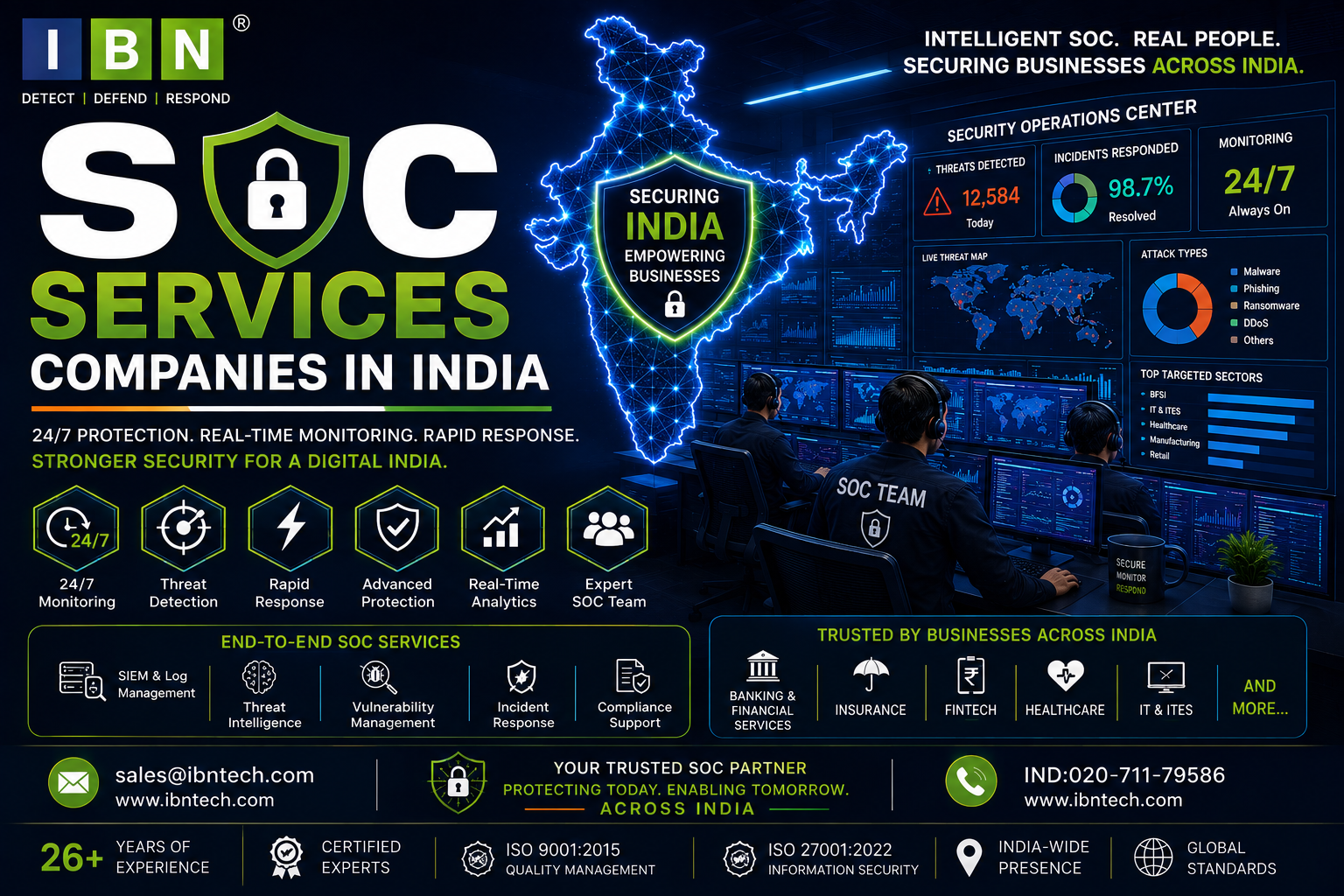
Indian manufacturers increasingly depend on connected machines, remote vendor access, cloud applications and multi-site networks. SOC services companies in India fit into this environment by monitoring security signals across corporate IT and selected plant systems, investigating unusual activity and coordinating escalation without disrupting production. The provider’s role is to give plant IT and group security teams timely visibility, not to take over operational technology decisions.
Why manufacturing needs a practical SOC model
Manufacturing security is shaped by physical operations. A cyber incident may affect production schedules, machine availability, supplier coordination or safety-related processes. Unlike a typical office environment, the response cannot always prioritise isolation over continuity; shutting down a system may halt a line or create an operational risk.
Top SOC as a service providers for manufacturing in India therefore need to work within operational constraints. They should understand which systems can generate logs safely, which networks are segmented, who owns plant technology and what actions require engineering approval. A provider that ignores these realities may deliver alerts that are technically accurate but operationally unusable.
The business case is straightforward. Manufacturers face risks from ransomware, compromised remote-access accounts, unpatched systems, third-party maintenance connections and lateral movement between corporate and plant networks. SOC services companies in India help detect these patterns early and give the organisation a documented basis for response.
What does a SOC services company do for a manufacturer?
A SOC services company collects and reviews security logs from approved sources, correlates events across systems and escalates suspicious activity to the manufacturer’s designated contacts. The provider may monitor identity systems, firewalls, remote-access gateways, endpoints, cloud platforms and, where appropriate, security-relevant signals from plant environments.
The manufacturer retains ownership of production systems and operational decisions. If the SOC identifies suspicious remote access to a plant network, it can analyse the activity, preserve the timeline and recommend containment. Plant engineering and IT leaders then decide what action is safe for production and safety.
This division is essential. Security monitoring should never become a reason to make untested changes to industrial systems. The provider’s value is in detection, analysis and coordination; the manufacturer’s value is in operational judgement.
Where does a SOC fit in a multi-site manufacturer?
Should every plant be monitored in the same way?
No. Plants differ in size, network maturity, system criticality and remote-access usage. A practical SOC model begins with the sites and systems where an incident would most affect production, safety, customer commitments or sensitive design data.
A manufacturer may start by monitoring corporate identity systems, remote-access gateways and the highest-risk plant environments. After that, coverage can expand to additional sites as logging improves and escalation processes stabilise.
How should remote vendor access be handled?
Vendor remote access is one of the most important areas for manufacturing monitoring. Equipment suppliers and maintenance partners often need temporary access to machines or plant applications, but these connections can become weak points if they are not reviewed.
A SOC services company should monitor unusual login times, unfamiliar source locations, excessive privilege use and activity that does not match a maintenance window. The manufacturer should also maintain an approval process for vendor access, with expiry dates and accountability for each connection.
What happens when IT and OT risks overlap?
An incident may begin in corporate IT and later touch plant systems, or a compromised vendor account may reach both environments. The SOC should correlate signals across these boundaries and escalate the case to the right combination of IT, plant engineering and security stakeholders.
The provider should avoid treating every event as a technical alert. In manufacturing, the same event may require a production-impact assessment, a safety review and a decision on whether to isolate a system. Clear escalation roles make that coordination possible.
What should manufacturers compare between providers?
|
Evaluation area |
What a suitable provider demonstrates |
What creates operational risk |
|
Environment understanding |
Asks about plants, segmentation, critical systems and vendor access |
Offers a standard package without discovery |
|
Monitoring scope |
Names IT, identity, remote-access and approved plant log sources |
Coverage is vague or excludes critical systems |
|
Response boundaries |
Separates SOC analysis from plant operational decisions |
Suggests unilateral containment of OT systems |
|
Multi-site support |
Defines escalation across plants and corporate teams |
No consistent process between locations |
|
Evidence and review |
Provides incident timelines and periodic coverage reviews |
Records are incomplete or unavailable |
Why traditional plant IT monitoring falls short
Many manufacturers rely on plant IT teams to manage security alongside infrastructure, ERP support, user administration and vendor coordination. These teams understand operations well, but they may not have the capacity to investigate alerts continuously.
Alerts also arrive from different systems. A firewall may report blocked traffic, an endpoint tool may flag suspicious behaviour and a remote-access gateway may record repeated login attempts. Without correlation, these signals remain isolated and easy to dismiss.
Staffing continuity is another challenge. In a smaller plant, one or two people may hold most of the operational knowledge. If they are unavailable, security alerts may wait. SOC services companies in India add continuity through defined procedures, shift coverage and documented escalation paths.
The provider does not replace plant knowledge. It complements it. Plant teams know which systems matter most and which changes could affect production; the SOC brings focused monitoring capacity and investigative discipline.
What does a realistic manufacturing incident look like?
Consider a manufacturer with three plants and a central corporate office. During a non-production window, the SOC observes repeated remote-access attempts from an unfamiliar location. The attempts target a vendor account used for equipment maintenance.
A basic monitoring setup may log the failed attempts and move on. A SOC services company reviews whether any attempt succeeded, checks recent activity for the account and examines whether the connection reached a plant network. If the activity appears suspicious, the provider escalates it to the manufacturer’s security and plant IT contacts.
The manufacturer can then disable the account, restrict the source, review vendor access approvals and verify whether any equipment system was affected. The SOC documents the sequence of events, preserving evidence for management review and future improvement.
The outcome is not merely an alert. It is a coordinated response that protects production continuity while addressing a real access risk.
How should a manufacturer implement SOC support?
Begin with a criticality assessment. Identify plants, production lines, enterprise applications, remote-access gateways and vendor connections where an incident would have the greatest business impact. These areas should shape the initial monitoring scope.
Then improve logging where needed. A system that cannot produce reliable security logs cannot be monitored effectively. Before adding it to the SOC, the manufacturer should confirm that timestamps, event sources and access to logs are dependable.
After that, define a joint operating procedure. The document should cover alert severities, escalation contacts, approval boundaries, maintenance windows and reporting expectations. It should also state how new plants, systems or vendor connections will be added.
Finally, test the arrangement with a tabletop exercise. Use a scenario such as ransomware affecting corporate systems or suspicious vendor access to a plant network. The exercise should include IT, plant engineering, security and leadership so everyone understands their role before a real event occurs.
What should manufacturing leadership track?
Leadership should track whether critical sites and systems remain within monitoring scope, whether high-priority alerts are escalated promptly and whether incident records are complete. These measures show whether the SOC is improving response readiness.
They should also review recurring risks. Repeated suspicious remote-access attempts, unpatched systems or noisy alerts may indicate a control weakness that monitoring alone cannot solve. A good SOC services company highlights these patterns and recommends practical follow-up.
Vendor access should receive separate attention. The manufacturer should periodically review who has remote access, why the access exists, when it expires and what activity occurred during each session. This review reduces one of the most common blind spots in industrial environments.
Frequently asked questions
Can SOC services companies monitor plant-floor systems safely?
Yes, where the systems can produce appropriate security logs and the monitoring approach respects production and safety constraints. The provider should work with plant engineering to define safe visibility and response boundaries.
Does a SOC services company replace the manufacturer’s IT team?
No. The provider adds monitoring, investigation and escalation capability. The manufacturer’s IT and plant teams continue to own systems, remediation, operational decisions and production continuity.
What should a multi-site manufacturer prepare before engaging a provider?
A critical-system inventory, site-wise contact list, remote-access register and logging assessment are practical starting points. These documents help the provider design a relevant monitoring scope and escalation process.
For Indian manufacturers, SOC services companies in India create value by connecting corporate and plant-level security visibility with practical operational judgement. IBN Technologies helps manufacturing and industrial organisations define SOC scope, strengthen escalation readiness and assess monitoring coverage across sites.
Contact Us
IBN Technologies
Phone: +91 20 6768 0404
Email: sales@ibntech.com

 English
 Arabic
 French
 Spanish
 Portuguese
 Deutsch
 Turkish
 Dutch
 Italiano
 Russian
 Portuguese (Brazil)
 Greek