


What Validation Tests Are Performed During Turnkey Modular IVF Lab Solutions?
Introduction
Altus Airflow recognizes that IVF laboratories require carefully controlled environmental conditions, reliable equipment, and verified operating systems to support sensitive reproductive procedures. Turnkey Modular IVF Lab Solutions involve more than installing modular panels and laboratory equipment; they also require systematic validation to confirm that critical systems perform according to approved design specifications. Validation activities may cover HVAC performance, air quality, temperature stability, pressure differentials, electrical safety, monitoring systems, and equipment functionality. Proper testing helps fertility clinics identify deficiencies before routine operations, maintain documented quality standards, and establish a dependable laboratory environment.
1. Why Validation Is Essential in Modular IVF Laboratories?
Validation helps demonstrate that a laboratory's infrastructure and equipment are suitable for their intended use. IVF laboratories handle sensitive biological materials, so environmental deviations, equipment failures, and poorly controlled workflows can create operational risks.
A structured validation program checks whether installed systems meet predefined acceptance criteria. It also provides documented evidence that equipment has been installed correctly and that critical environmental parameters can be maintained under specified operating conditions.
Validation generally includes several complementary activities:
-
Design qualification to confirm that the proposed design meets user and technical requirements.
-
Installation qualification to verify that equipment and systems are installed correctly.
-
Operational qualification to confirm that systems operate as specified.
-
Performance qualification to assess performance under defined, representative operating conditions.
The precise approach depends on the facility's quality-management system, applicable regulations, risk assessment, and equipment requirements. Not every building component requires the same level of qualification.
For Turnkey Modular IVF Lab Solutions, validation planning should begin during the design stage. Establishing test methods, responsibilities, acceptance criteria, and documentation requirements early helps avoid delays and makes the handover process more organized.
2. HVAC Performance and Airflow Validation
The heating, ventilation, and air-conditioning system plays a central role in maintaining the IVF laboratory environment. HVAC validation evaluates whether the installed system can deliver the airflow, temperature, humidity, and pressure relationships specified in the approved design.
Testing may include:
-
Verification of supply and return airflow volumes.
-
Assessment of air distribution across designated areas.
-
Measurement of air changes per hour where specified.
-
Inspection of ductwork, filters, dampers, and terminal units.
-
Verification of temperature and humidity control.
-
Assessment of room pressure differentials.
-
Confirmation that controls respond appropriately to operating changes.
Airflow measurements can help identify areas with insufficient delivery, excessive turbulence, or unexpected flow patterns. Where the design specifies particular airflow directions between rooms, testing should confirm that the required relationships are achieved.
The number of air changes per hour should not be treated as a universal pass-or-fail value. Required performance depends on the laboratory design, intended activities, contamination-control strategy, and applicable standards.
Test instruments should be suitable for the parameters being measured and calibrated as required. Results should be recorded and compared against predefined acceptance criteria. Any deviation should be investigated and corrected before the relevant system is accepted.
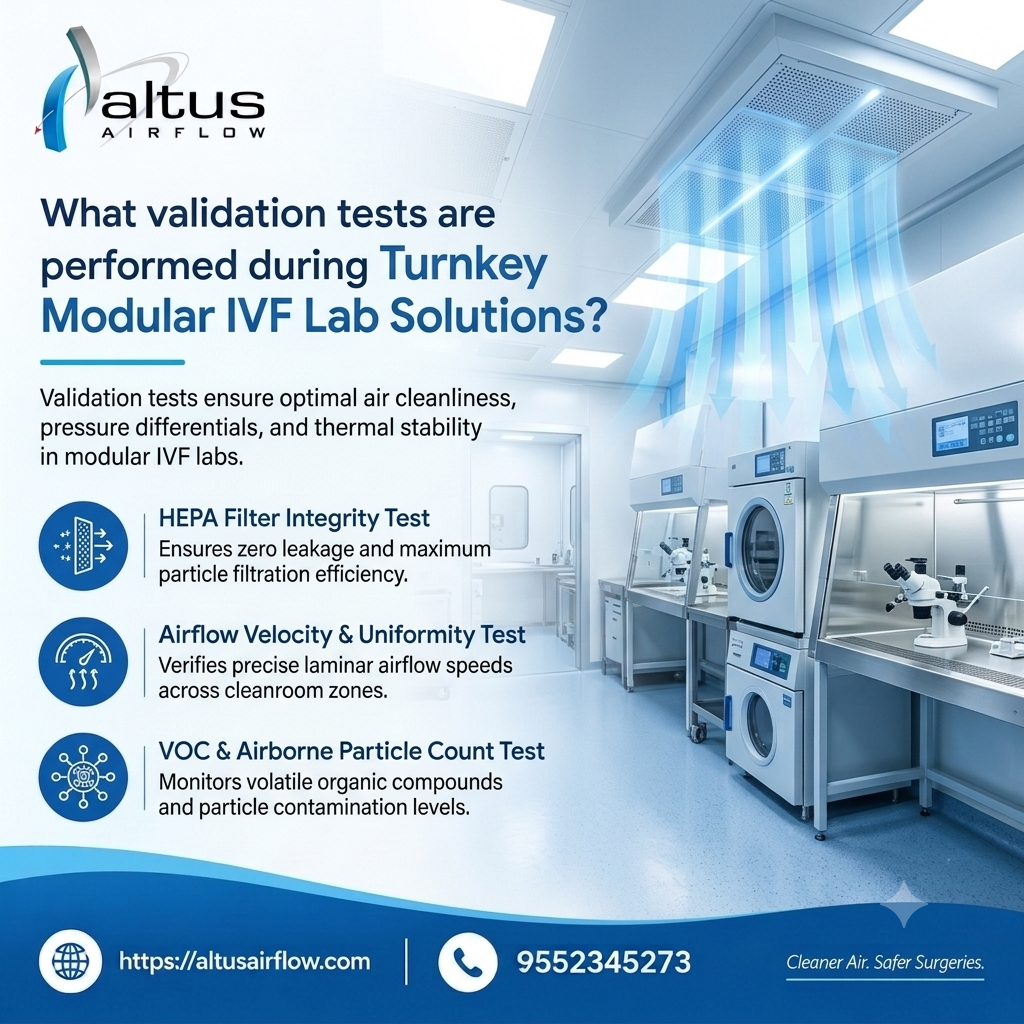
3. HEPA Filter Integrity Testing
High-efficiency particulate air (HEPA) filtration may form part of an IVF laboratory's air-quality strategy. Where HEPA filters are installed, integrity testing can help identify leaks through the filter media, seals, or mounting arrangements.
A commonly used method involves introducing an appropriate aerosol challenge upstream of the filter and measuring downstream penetration with a compatible detector. The test procedure, challenge material, instrument configuration, and acceptance criteria must follow the applicable standard, filter specification, and approved testing protocol.
HEPA filter integrity testing typically examines:
-
Filter media for localized leakage.
-
Perimeter seals and gaskets.
-
Filter-to-housing interfaces.
-
Installation quality and mounting arrangements.
-
Areas where leakage could bypass the filter media.
A filter may be correctly rated but still fail an installed-system integrity test if it has been damaged or poorly sealed. Testing therefore evaluates the installed assembly rather than relying solely on product documentation.
Where required, results should identify the filter tested, instrument used, test method, measured findings, and any corrective action. Repairs or filter replacements should be followed by appropriate retesting.
The required filtration configuration and testing frequency should be determined from the facility's design and risk assessment rather than assuming every IVF laboratory needs an identical system.
4. Room Pressure Differential Testing
Pressure differential testing verifies that pressure relationships between designated laboratory spaces meet the approved design requirements. These relationships can contribute to contamination control by helping manage the direction of air movement between connected areas.
The testing process generally involves measuring pressure differences across room boundaries, such as doors or designated partitions, using suitable calibrated instruments or permanently installed monitoring devices.
The validation team should confirm that:
-
Specified pressure relationships are achieved.
-
Monitoring instruments display credible readings.
-
Alarm thresholds are configured according to approved requirements.
-
Door operation does not create unacceptable system instability.
-
Pressure conditions recover appropriately after routine disturbances, where required.
Measurements should be performed under defined conditions, with relevant doors and HVAC systems in the required operating states. If the design specifies different modes, each applicable mode should be assessed.
A pressure reading alone does not establish the complete direction of airflow under every condition. Additional airflow visualization or other approved testing may be appropriate when the design or risk assessment calls for it.
Results should be documented and compared with the acceptance criteria. Deviations may require adjustments to air balancing, control settings, door seals, or other components before retesting.
5. Temperature and Humidity Mapping
Temperature and humidity can influence laboratory operations, equipment performance, and the stability of controlled environments. Mapping helps determine whether conditions remain within specified limits across relevant locations and operating periods.
Temperature and humidity validation may involve placing calibrated sensors at selected positions throughout the room. Sensor placement should reflect room dimensions, equipment locations, potential hot or cold spots, and the intended use of the space.
A mapping study may assess:
-
Temperature uniformity across the designated area.
-
Relative humidity at representative locations.
-
Variations during normal HVAC operation.
-
Conditions during defined operating or recovery periods.
-
Performance after relevant disturbances, where specified.
-
Accuracy of permanently installed monitoring sensors.
The duration of monitoring depends on the study protocol and the characteristics of the room. It should be long enough to assess the operating conditions and variability identified in the approved plan.
Acceptance limits should be based on the laboratory's requirements, equipment specifications, and relevant quality procedures. There is no single temperature or humidity range suitable for every room and every IVF-related process.
If the study identifies unacceptable variations, the team may need to review air distribution, sensor placement, control settings, insulation, equipment heat loads, or room-use patterns. Corrective changes should be documented, and affected tests repeated as necessary.
6. Particulate and Air Quality Testing
Air-quality testing helps assess whether airborne particulate levels meet the laboratory's specified cleanliness requirements. Depending on the room classification and project requirements, particle counting may be conducted at selected locations and under defined conditions.
The testing plan should specify the particle-size channels, sampling locations, sample volumes, operating state, and acceptance criteria. Sampling may be performed under an appropriate at-rest or operational condition, as defined by the relevant standard and approved protocol.
Important considerations include:
-
Selection of a suitable calibrated particle counter.
-
Representative sampling locations.
-
Correct sampling procedures and instrument handling.
-
Comparison with the specified cleanliness classification.
-
Documentation of room conditions during testing.
-
Investigation of results that exceed the permitted limits.
Particulate testing provides information about airborne particles, but it does not by itself identify all possible chemical contaminants or microbiological hazards. Where risk assessment or applicable requirements call for additional testing, separate methods may be necessary.
Testing should also be interpreted alongside HVAC performance, filter integrity, cleaning procedures, room use, and personnel practices. A satisfactory particle count at one point in time does not guarantee that the laboratory will remain compliant under all future operating conditions.
For this reason, initial qualification should be supported by a suitable ongoing environmental monitoring program.
7. Electrical Safety and Backup Power Testing
Electrical reliability is important because IVF laboratories depend on equipment that may need uninterrupted or carefully controlled operation. Electrical validation confirms that installed systems meet relevant safety requirements and that planned backup arrangements function as intended.
Testing may include:
-
Inspection of electrical panels and circuit identification.
-
Verification of grounding and bonding.
-
Appropriate protective-device testing.
-
Confirmation of outlet locations and circuit capacity.
-
Inspection of connections serving critical equipment.
-
Testing of emergency power or uninterruptible power supply systems, where installed.
-
Verification of alarms associated with power failure.
Backup power testing should follow an approved procedure that protects sensitive equipment and does not expose laboratory materials to unnecessary risk. The test should verify the intended transfer or continuity arrangements and confirm that critical loads are supported as specified.
The team should identify which devices require backup power and establish the required duration based on risk assessment and operational needs. Not every outlet or piece of equipment necessarily requires the same backup arrangement.
All electrical testing should be performed by qualified personnel using suitable instruments. Test results, identified deficiencies, corrective actions, and approvals should be included in the commissioning records.
8. Laboratory Equipment Qualification and Functional Testing
Laboratory infrastructure must work effectively with the equipment installed inside it. Equipment qualification verifies that individual instruments are installed, operate, and perform according to their intended use and manufacturer specifications.
Depending on the equipment, the process may involve:
-
Checking model, serial number, and installation details.
-
Confirming utility and environmental requirements.
-
Reviewing calibration certificates.
-
Testing alarms and safety functions.
-
Verifying control displays and operating settings.
-
Assessing temperature stability in incubators.
-
Confirming the function of microscopes and micromanipulation systems.
-
Reviewing service access and preventive maintenance requirements.
Incubators may require particular attention because they support controlled conditions for embryo culture. Appropriate testing can include temperature verification, gas-control checks, alarm verification, and other tests specified by the equipment manufacturer and the clinic's quality procedures.
Testing should be appropriate to each device rather than applying one generic checklist to all equipment. Equipment used for critical procedures may require additional qualification or performance verification.
Where systems exchange data with centralized monitoring platforms, the connection and alarm reporting should also be tested. Equipment manuals, qualification records, maintenance instructions, and staff training records should be available before routine use.
9. Monitoring, Alarm, and Data Integrity Testing
Environmental monitoring systems help staff observe important parameters and identify deviations. Validation should establish that sensors, displays, alarms, and records function reliably under the defined test conditions.
Typical checks include sensor accuracy, display consistency, alarm activation, notification delivery, data recording, and recovery following a power or communication interruption where relevant.
The validation team should verify that:
-
Alarm thresholds match approved settings.
-
Alerts are delivered to the designated recipients or systems.
-
Date and time records are correct.
-
Historical readings can be retrieved.
-
Access permissions are appropriately configured.
-
Relevant records are protected against unauthorized alteration.
-
Backup and recovery procedures work as intended.
If monitoring software is used, its qualification should reflect the system's intended function and risk. The laboratory should also establish who can change settings, acknowledge alarms, review trends, and authorize corrective actions.
Testing should include realistic scenarios without placing sensitive samples or ongoing clinical work at risk. Alarm-response procedures should be documented, and relevant personnel should receive training.
10. Documentation, Corrective Actions, and Final Acceptance
Validation is not complete when measurements have been taken. Results must be reviewed, deviations addressed, and the evidence organized into a clear record that supports the laboratory's acceptance decision.
A comprehensive validation package may contain:
-
Approved protocols and acceptance criteria.
-
Equipment and instrument identification.
-
Calibration information.
-
Raw readings and summarized results.
-
Drawings and system specifications.
-
Test reports and inspection records.
-
Deviation reports and root-cause investigations.
-
Corrective and preventive action records.
-
Retest results and final approvals.
-
Operating, maintenance, and training documentation.
When a test fails, the responsible team should investigate the cause, document the corrective action, and determine which tests need to be repeated. A system should not be accepted solely because a later measurement passes if the original failure remains unexplained or unresolved.
Final handover should also include operating procedures, maintenance schedules, warranty information where applicable, and guidance for ongoing monitoring. The laboratory's authorized personnel should review the completed documentation before approving the facility for its intended use.
A structured process helps ensure that test results remain traceable and that the clinic understands its responsibilities after the installation team has completed the project.
Conclusion
Validation testing is an essential part of establishing a reliable IVF laboratory. HVAC performance, HEPA filter integrity, pressure differentials, temperature and humidity mapping, particulate testing, electrical safety, equipment qualification, and alarm verification each provide evidence about different aspects of system performance. The exact tests and acceptance criteria should reflect the approved design, risk assessment, equipment specifications, and applicable standards. By planning testing early and maintaining complete documentation, Altus Airflow supports a systematic approach to laboratory readiness. Choosing Turnkey Modular IVF Lab Solutions with a clear commissioning and validation plan can help fertility clinics establish organized, well-controlled facilities, while Altus Airflow emphasizes the importance of verification, maintenance, and continuous quality improvement after handover.
Frequently Asked Questions (FAQs)
1. What validation tests are included in Turnkey Modular IVF Lab Solutions?
Turnkey Modular IVF Lab Solutions may include HVAC performance testing, HEPA filter integrity testing, pressure differential checks, temperature and humidity mapping, particulate testing, electrical safety checks, equipment qualification, and alarm verification.
2. Why is HEPA filter integrity testing important?
It helps identify leaks in filter media, seals, or mounting arrangements that could affect the installed filtration system's performance.
3. Is temperature mapping required in an IVF laboratory?
Temperature mapping may be required by the laboratory's qualification plan, risk assessment, equipment needs, or applicable quality requirements.
4. When should laboratory validation be performed?
Testing is generally planned during commissioning before routine use, with additional testing after relevant changes, repairs, or scheduled reviews as required.
5. What documents should be provided after validation?
Documentation may include approved protocols, test reports, calibration records, deviation reports, corrective actions, qualification records, and final acceptance approvals.
Read Our Previous Blog ---------------> How do Modular IVF Labs Manufacturers improve laboratory efficiency?

 English
 Arabic
 French
 Spanish
 Deutsch
 Turkish
 Dutch
 Italiano
 Russian
 Romaian
 Portuguese (Brazil)
 Greek