


Workwear Market Developments Reflect a Stronger Focus on Workforce Well-Being
Workwear has evolved from basic workplace uniforms into specialized clothing designed to improve employee safety, comfort, durability, and professional appearance. Industries such as construction, manufacturing, healthcare, energy, logistics, and food processing require apparel suited to different working environments. As occupational safety receives greater attention, businesses are increasingly investing in workwear that combines protective performance with practical design.
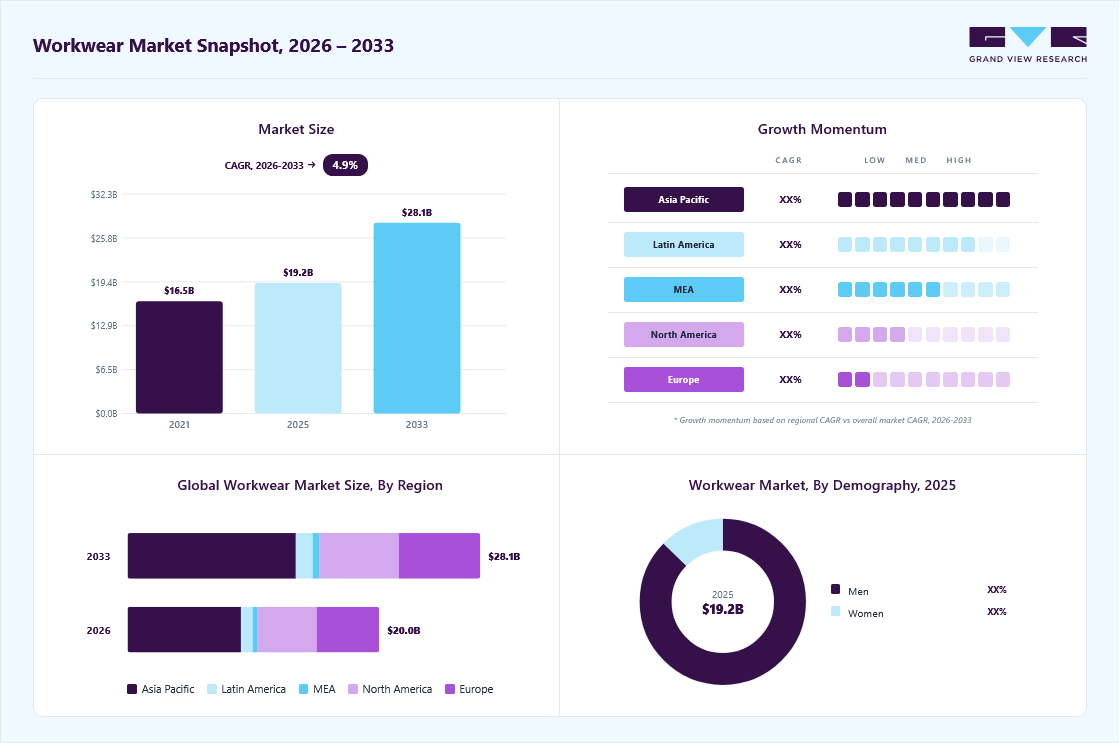
The workwear market was valued at USD 19.2 billion in 2025 and is projected to reach USD 20.0 billion in 2026. By 2033, the market is expected to reach USD 28.1 billion, registering a compound annual growth rate (CAGR) of 4.9% from 2026 to 2033. Growing industrial activity, workplace safety requirements, and demand for comfortable, task-specific garments are important factors shaping this expansion.
Essential Workwear Market Highlights
· Market size: USD 19.2 billion in 2025.
· Market estimate: USD 20.0 billion in 2026.
· Market forecast: USD 28.1 billion by 2033.
· Growth rate: 4.9% CAGR from 2026 to 2033.
· Leading product: Workwear apparel, accounting for 74.7% of revenue in 2025.
· Leading demographic: Men, representing 87.2% of revenue in 2025.
· Leading application: Construction, with a 23.8% revenue share in 2025.
· Largest regional market: Asia Pacific, accounting for 44.7% of revenue in 2025.
Workplace Safety Is Influencing Purchasing Decisions
Workplace safety is a central factor in workwear procurement. Employees operating in construction sites, manufacturing facilities, chemical plants, and energy installations may encounter heat, hazardous substances, mechanical risks, and challenging weather conditions. Employers therefore require garments that offer appropriate protection while supporting movement and comfort throughout working hours.
Stricter occupational health and safety requirements are encouraging organizations to prioritize suitable protective clothing and footwear. High-visibility garments, flame-resistant fabrics, chemical-resistant clothing, and other specialized products serve different operational needs. The expansion of infrastructure projects and industrial facilities further strengthens demand for durable workwear.
Apparel Remains the Leading Product Category
Workwear apparel accounted for 74.7% of market revenue in 2025, reflecting its essential role across industrial and service-based occupations. General workwear supports daily professional requirements, while protective workwear addresses more demanding operating environments.
Fabric innovation is helping manufacturers develop garments with moisture-wicking properties, improved flexibility, weather resistance, and antimicrobial features. Ergonomic construction, multi-directional stretch, and breathable materials are also becoming important considerations for employees who wear uniforms for extended periods.
Workwear footwear represents another important category. Protective footwear is projected to grow at a CAGR of 5.6% from 2026 to 2033. Demand is supported by requirements across construction, mining, and logistics, alongside improvements in anti-slip soles, waterproof materials, shock absorption, and protective toe designs.
Inclusive Design Creates New Opportunities
Men accounted for 87.2% of market revenue in 2025, supported by employment patterns in construction, manufacturing, and transportation. However, workwear manufacturers are increasingly addressing the requirements of a more diverse workforce.
The women's segment is projected to grow at a CAGR of 5.2% from 2026 to 2033. Demand for better-fitting garments, functional designs, and comfortable protective clothing is encouraging product development tailored to women's body shapes and occupational needs. Greater attention to workplace inclusion is also creating opportunities for companies to expand their size ranges and improve garment fit without compromising safety or mobility.
Construction and Biological Applications Support Demand
Construction accounted for 23.8% of market revenue in 2025, making it the leading application segment. Infrastructure development, urbanization, and the need for protective clothing in demanding environments contribute to purchasing requirements. High-visibility apparel, flame-resistant materials, and ergonomic designs remain relevant to construction workers.
The biological application segment is projected to grow at a CAGR of 5.7% from 2026 to 2033. Healthcare facilities require specialized clothing that supports hygiene, infection control, and comfort during extended shifts. Growing healthcare infrastructure and interest in reusable medical textiles are influencing demand for suitable garments and department-specific uniforms.
Sustainability and Smart Textiles Reshape Product Development
Workwear purchasing decisions increasingly consider durability, ease of maintenance, and environmental impact. Longer-lasting garments can help organizations manage replacement requirements, while recycled materials and responsible production practices support sustainability objectives.
Manufacturers are also exploring advanced textiles and wearable technologies that improve functionality. Moisture management, anti-odor treatments, liquid-repellent coatings, and climate-adaptive materials help address changing workplace conditions. Digital procurement platforms further simplify product discovery and purchasing for businesses seeking consistent specifications across distributed workforces.
Frequently Asked Questions
1. What is driving workwear market growth?
Workwear market growth is supported by increasing awareness of workplace safety, occupational health regulations, expansion in construction and manufacturing, and demand for durable, comfortable, and specialized clothing. Fabric innovation, customized uniforms, and protective footwear also contribute to market development.
2. Which segment leads the workwear market?
Workwear apparel led the product categories with a 74.7% revenue share in 2025. Construction was the leading application segment, accounting for 23.8% of revenue, while men represented 87.2% of market revenue.
Key Workwear Companies:
· Carhartt, Inc.
· Aramark (Vestis)
· Alsico Group
· Alexandra
· A. Lafont SAS
· Hard Yakka
· 3M
· Ansell Ltd.
· Honeywell International, Inc.
· Snickers Workwear
About us:
Grand View Research, a market research and consulting company, provides syndicated research reports, customized research reports, and consulting services. Grand View Research database is used by the world's renowned academic institutions and Fortune 500 companies to understand the global and regional business environment. Our database features thousands of statistics and in-depth analysis on 46 industries in 25 major countries worldwide.

 English
 Arabic
 French
 Spanish
 Portuguese
 Turkish
 Dutch
 Italiano
 Russian
 Romaian
 Portuguese (Brazil)
 Greek