


How should the andrology section be incorporated into Laminar Airflow System Setup Services?
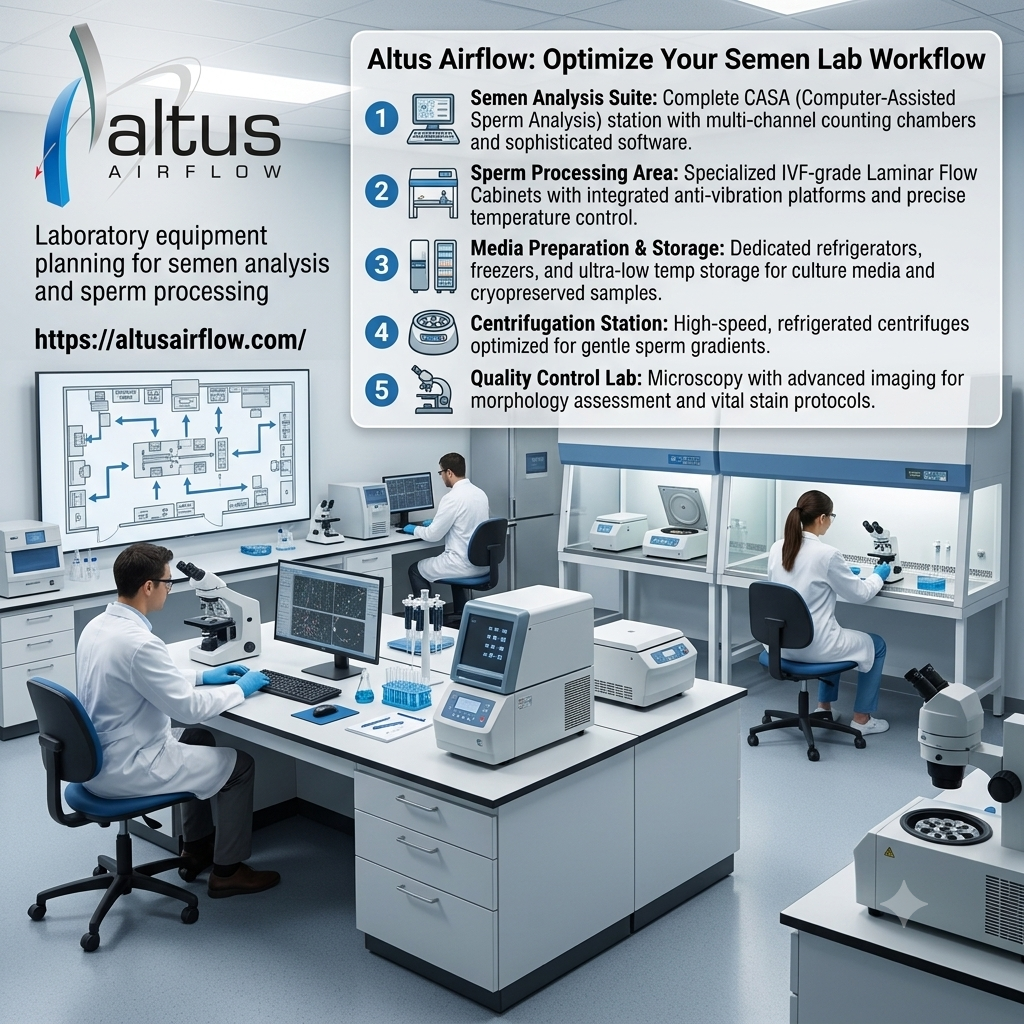
INTRODUCTION
The andrology section is an essential component of many fertility and assisted reproductive technology (ART) laboratories, supporting semen analysis, sperm preparation, sperm selection, and cryopreservation. Integrating this section correctly into Laminar Airflow System Setup Services requires careful planning of laboratory zoning, ventilation, workstations, equipment, contamination control, and staff movement. Unlike an embryology laboratory, which focuses heavily on oocyte handling and embryo culture, an andrology laboratory performs several diagnostic and processing activities with different environmental and biosafety requirements. A well-designed facility should therefore balance appropriate air quality, safe working conditions, efficient workflow, and the specific requirements of each procedure. The 2026 European Society of Human Reproduction and Embryology (ESHRE) recommendations expand their guidance on sperm preparation to cover general andrological procedures, highlighting the importance of purpose-designed laboratory planning. [1]
Understanding the Role of the Andrology Section
An andrology laboratory evaluates semen and sperm-related parameters and may support procedures associated with fertility treatment. Depending on the services provided, its activities can include:
- Diagnostic semen analysis
- Sperm concentration and motility assessment
- Sperm morphology evaluation
- Computer-assisted semen analysis
- Sperm preparation for assisted reproduction
- Sperm washing and selection procedures
- Sperm cryopreservation
- Processing of surgically retrieved sperm samples
- Record keeping and laboratory quality control
Each activity has its own requirements for equipment, sample handling, cleanliness, staff safety, and workflow.
The design should begin with a clear list of procedures and the expected workload. This helps determine how much space is needed, which activities require physical separation, and where ventilation, filtration, and specialized workstations should be installed.
1. Assessing Laboratory Space and Functional Requirements
The first step is to determine the available space and establish a layout that supports the intended andrology services.
The design team should consider:
- Number of samples processed daily
- Number of laboratory personnel
- Type of diagnostic and processing equipment
- Requirements for sterile sperm preparation
- Sample receipt and identification
- Consumable and reagent storage
- Waste handling
- Documentation and computer workstations
- Equipment maintenance access
The andrology section may share certain laboratory support facilities with other departments when appropriate. However, activities requiring sterile technique, such as sperm preparation for intrauterine insemination, should be separated from other activities according to the applicable laboratory guidance and risk assessment. [2]
Modular construction can help organize the workspace, but the layout should be developed around clinical procedures rather than simply fitting standard panels into the available room.
2. Separating Andrology and Embryology Workflows
Andrology and embryology are closely related in fertility treatment, but their work processes are not identical.
An andrology section may handle diagnostic semen samples, sperm preparation, and related procedures. An embryology section may handle oocytes, fertilization, embryo culture, embryo transfer preparation, and cryopreservation.
A well-planned facility should define how samples, staff, equipment, consumables, and waste move between these areas.
Important design considerations include:
- Clearly designated work zones
- Controlled movement of samples
- Appropriate separation of sterile and non-sterile activities
- Defined routes for supplies and waste
- Suitable access to shared support facilities
- Protection of sensitive reproductive-cell handling areas
Physical separation should be determined by the actual procedures performed and the associated risks. It is not necessary to assume that every andrology activity requires the same environmental classification or air quality as embryo culture. ASRM guidance specifically notes that an andrology laboratory does not necessarily need the same level of air quality and design features as an IVF laboratory. [2]
3. Planning the Laminar Airflow System
Laminar airflow technology may be appropriate for selected workstations where controlled airflow is needed for particular procedures. However, a laminar airflow cabinet is not interchangeable with the room's HVAC system or a biological safety cabinet.
During Laminar Airflow System Setup Services, engineers should identify which activities require a clean work zone and which require biological containment. The correct equipment depends on the procedure and the risks involved.
For example, a clean bench may provide filtered air over a work surface to protect the work from airborne particles. It does not necessarily protect the operator from biological aerosols. Where containment is required, a suitable biological safety cabinet or other engineered control should be selected following a risk assessment.
The design should specify:
- Type and purpose of each workstation
- Required airflow pattern
- Filter configuration
- Equipment dimensions and clearances
- Electrical connections
- Service and maintenance access
- Testing and certification requirements
The selected system should be appropriate for the task, rather than applying one airflow solution to every activity in the andrology section.
4. Integrating HVAC and Room Ventilation
Room ventilation supports environmental control and safe working conditions. Its design should account for room occupancy, heat-generating equipment, outdoor air quality, chemical use, and the activities performed.
The HVAC plan may include:
- Temperature and humidity control
- Appropriate air filtration
- Air distribution and return-air positioning
- Ventilation requirements for chemicals
- Pressure relationships between adjoining spaces
- Maintenance access
- Environmental monitoring
The andrology section should not automatically be assigned the same pressure regime as the embryology laboratory. Pressure relationships should be established according to the facility layout, contamination-control objectives, applicable guidance, and occupational safety requirements.
Where toxic or volatile reagents are used, appropriate local exhaust ventilation or a chemical fume hood may be necessary. A laminar airflow clean bench should not be used as a substitute for a fume hood when chemical containment is required.
5. Selecting HEPA Filtration Appropriately
HEPA filtration can help reduce airborne particles when incorporated into a correctly designed and maintained system.
For the andrology section, filtration requirements should be established according to the activity being performed. A diagnostic semen analysis area may have different requirements from a workstation used for a procedure requiring sterile technique.
The engineering plan should consider:
- Filter efficiency and compatibility
- Airflow capacity
- Filter housing and seal integrity
- Pressure drop
- Access for replacement
- Filter testing and certification
- Manufacturer maintenance recommendations
HEPA filtration addresses airborne particles; it does not automatically remove all gaseous contaminants or provide biological containment. The overall environmental strategy should therefore consider the sources and types of contamination that may be present.
6. Coordinating Equipment and Workstation Placement
Equipment placement affects workflow, operator comfort, cleaning access, and the performance of the selected airflow system.
Depending on the services provided, the andrology section may require:
- Microscopes
- Semen analysis systems
- Computer-assisted semen analysis equipment
- Centrifuges
- Heated stages or temperature-controlled work surfaces
- Pipettes and sample preparation tools
- Refrigerators or freezers
- Sperm cryopreservation equipment
- Computer workstations
- Biological safety cabinets or chemical fume hoods where indicated
The layout should allow staff to handle samples without unnecessary movement or crossing incompatible workflows. Workstations should also have adequate space for cleaning, maintenance, electrical connections, and safe equipment operation.
Equipment that generates heat or vibration should be considered during HVAC and furniture planning. Manufacturer requirements should guide installation and servicing.
7. Maintaining Appropriate Temperature Conditions
Temperature management is important for reliable laboratory operations and the correct functioning of specialized equipment. Requirements vary according to the procedure and the manufacturer's specifications.
The design team should identify equipment that requires controlled temperature conditions and determine whether room-level monitoring, equipment-level monitoring, or both are necessary.
Planning should include:
- Suitable temperature-controlled equipment
- Calibration of thermometers and sensors
- Documented operating ranges
- Alarm systems where necessary
- Backup arrangements for critical equipment
- Procedures for responding to temperature excursions
The room's temperature should not be assumed to be the same as the temperature needed for every sample or procedure. Specific laboratory protocols and validated equipment settings should determine the required conditions.
8. Managing Chemical and Biological Safety
Andrology laboratories handle human biological specimens and may use reagents or chemicals that require specific safety controls.
The facility design should support appropriate sample handling, personal protective equipment, hand hygiene, cleaning, disinfection, waste management, and spill response.
Where chemicals or fixatives are used, their handling requirements should be reviewed before selecting ventilation and workstation equipment. Biological samples may require different controls from chemical reagents, so the risk assessment should address both.
Other considerations include:
- Appropriate specimen containers
- Clear sample identification
- Controlled access
- Safe reagent storage
- Biohazard waste disposal
- Chemical spill procedures
- Suitable local exhaust ventilation where required
Environmental controls should support the laboratory's documented biosafety and quality-management procedures.
9. Supporting Sample Identification and Traceability
Correct sample identification is essential throughout fertility laboratory workflows. The design should provide suitable areas for sample receipt, labeling, preparation, analysis, storage, and documentation.
The layout should reduce the likelihood of samples being mixed up or handled in an inappropriate sequence. Separate work zones, organized storage, clear labeling practices, and validated identification systems can support this objective.
Digital records and barcode-based systems may be incorporated where appropriate. However, technology should complement documented procedures and staff verification rather than replace them.
10. Integrating Cryopreservation and Storage Facilities
Some andrology laboratories provide sperm cryopreservation or process samples collected through surgical sperm retrieval procedures.
If cryopreservation is included in the project scope, the design must account for appropriate storage equipment, safe access, monitoring, emergency procedures, and the hazards associated with cryogenic materials.
Liquid nitrogen storage and handling require particular attention to oxygen-deficiency risks. Depending on the facility and equipment, suitable room ventilation, oxygen monitoring, alarms, and emergency arrangements may be necessary.
Storage should be planned in accordance with equipment instructions, local safety requirements, and laboratory procedures. Cryogenic storage areas should not obstruct routine sample processing or compromise safe access.
11. Environmental Monitoring and System Validation
A completed installation should be tested to verify that the airflow and ventilation systems operate according to their approved specifications.
Depending on the equipment and project scope, commissioning may include:
- Airflow volume and velocity measurements
- HEPA filter integrity testing where applicable
- Workstation airflow visualization
- Pressure-differential verification where specified
- Temperature and humidity checks
- Alarm and control-system testing
- Biological safety cabinet certification where applicable
- Electrical and equipment checks
The laboratory should establish acceptance criteria before testing and maintain documentation of results, deficiencies, and corrective actions.
Environmental monitoring should then continue according to the laboratory's risk assessment and maintenance programme. Regular equipment calibration and certification are important for maintaining reliable performance. ASRM guidance discusses the need for appropriate equipment, regular calibration, and certification of certain laboratory devices. [2]
12. Planning Maintenance and Future Expansion
Laboratory requirements may change as testing volumes grow or new technologies are introduced. A flexible modular design can help accommodate future equipment and workflow adjustments when expansion provisions are planned in advance.
The design should provide access for servicing filters, HVAC components, sensors, workstations, and other equipment. Maintenance work should be coordinated to reduce disruption and prevent contamination of active work areas.
A preventive maintenance programme should define:
- Inspection and servicing schedules
- Filter replacement and testing
- Equipment calibration
- Workstation certification
- Environmental monitoring reviews
- Maintenance records
- Staff responsibilities
- Procedures for system failures
Planning for future requirements can reduce the need for disruptive modifications and help preserve the intended functionality of the andrology section.
Choosing the Right Setup Partner
Selecting a provider for Laminar Airflow System Setup Services requires evaluating more than construction capability. Hospitals should look for experience with controlled laboratory environments, airflow engineering, HVAC integration, filtration, workstation selection, testing, and commissioning.
The provider should coordinate with the IVF laboratory director, embryologists, andrologists, biosafety personnel, and facilities team. This multidisciplinary approach helps ensure that the design supports the actual procedures, sample workflows, and safety requirements of the facility.
The final design should be based on the laboratory's service scope and relevant professional guidance, not on a universal layout or an assumption that all laboratory areas need identical airflow systems.
Conclusion
Incorporating an andrology section into a modular laboratory project requires coordinated planning of space, sample workflows, ventilation, filtration, specialized workstations, biological and chemical safety, and maintenance. The objective is to create an environment that supports accurate diagnostic work, appropriate sperm processing, and safe laboratory operations while keeping the distinct requirements of andrology and embryology in view. Careful equipment selection, risk assessment, commissioning, and ongoing quality management are essential to the success of the installation. For fertility clinics planning reliable laboratory infrastructure, Altus Airflow offers engineering and turnkey solutions tailored to controlled-environment project requirements.
Frequently Asked Questions
1. How should the andrology section be incorporated into Laminar Airflow System Setup Services?
Laminar Airflow System Setup Services should incorporate the andrology section through procedure-based zoning, appropriate ventilation, suitable workstations, equipment coordination, sample-handling workflows, and testing before use.
2. Does an andrology laboratory require the same air quality as an embryology laboratory?
No. Laminar Airflow System Setup Services should account for the different activities and environmental risks of each section. ASRM guidance states that an andrology laboratory does not necessarily require the same level of air quality and design features as an IVF laboratory.
3. Which equipment should be considered when designing an andrology section?
Laminar Airflow System Setup Services should consider the laboratory's intended equipment, which may include microscopes, semen analysis systems, centrifuges, temperature-controlled work surfaces, sample preparation tools, and cryopreservation equipment.
4. Is HEPA filtration necessary in every andrology laboratory room?
The requirement depends on the activity and risk assessment. Laminar Airflow System Setup Services should determine where HEPA filtration is appropriate and specify the correct filter configuration, airflow, testing, and maintenance arrangements.
5. Can a laminar airflow clean bench replace a biological safety cabinet?
No. Laminar Airflow System Setup Services should distinguish clean benches from biological safety cabinets. A clean bench may protect the work from airborne particles but does not necessarily protect personnel from biological aerosols.
Read Our Previous Blog------>What role does an air quality monitoring system play in IVF Labs Design?

 Arabic
 French
 Spanish
 Portuguese
 Deutsch
 Turkish
 Dutch
 Italiano
 Russian
 Romaian
 Portuguese (Brazil)
 Greek