


Can a Modular Cardiac OT Engineering Company Integrate Digital OT Technologies?
Introduction
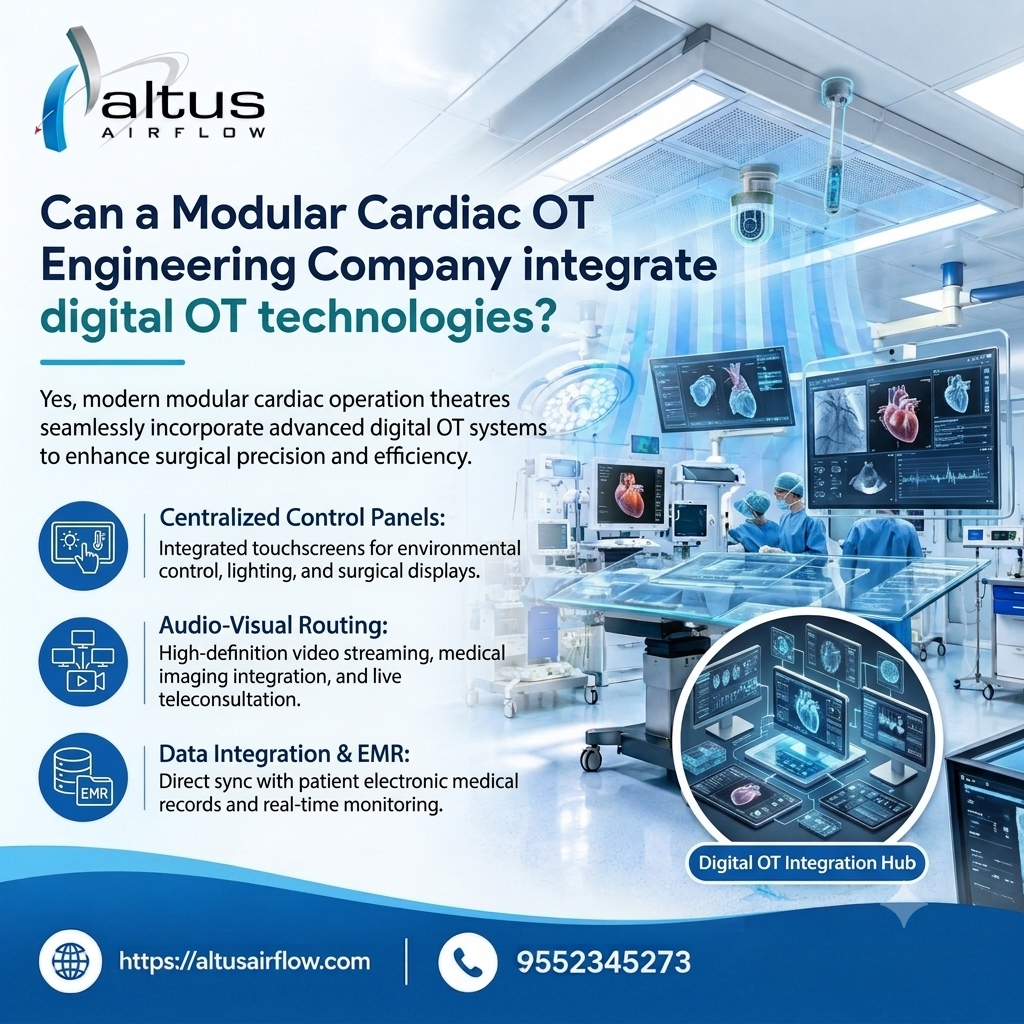
Altus Airflow recognizes that digital technology is transforming modern cardiac operating theatres by improving equipment coordination, information access, and surgical workflow management. A Modular Cardiac OT Engineering Company can integrate digital systems such as surgical displays, centralized equipment controls, operating theatre management software, audiovisual solutions, and real-time environmental monitoring. When these technologies are planned alongside modular construction, ventilation, electrical systems, and medical equipment, hospitals can create a connected operating environment that supports clinical teams and operational efficiency. Successful integration requires careful planning, cybersecurity safeguards, equipment compatibility, and testing to ensure reliable performance.
What Are Digital OT Technologies?
Digital operating theatre technologies are systems that connect medical equipment, clinical information, environmental controls, and communication tools within the surgical environment. Their purpose is to help authorized staff access relevant information, coordinate equipment, and manage selected operating theatre functions more efficiently.
In cardiac surgery, these technologies may support complex procedures that require multiple devices, detailed imaging, continuous monitoring, and coordination among multidisciplinary teams.
Common digital technologies include:
-
Integrated surgical displays and audiovisual systems.
-
Digital operating theatre management platforms.
-
Equipment control interfaces.
-
Environmental monitoring and alarm systems.
-
Electronic medical record connectivity.
-
Networked surgical imaging equipment.
-
Video conferencing and remote consultation tools.
-
Digital maintenance and equipment-status monitoring.
Not every operating theatre needs every technology. The right configuration depends on the hospital's clinical workflows, existing information systems, equipment requirements, budget, and long-term digital strategy.
1. Integrated Surgical Displays and Audiovisual Systems
Integrated displays allow authorized clinical staff to view relevant surgical images and information within the operating theatre. Depending on the equipment installed, these displays may show images from endoscopic cameras, ultrasound systems, fluoroscopy, patient monitoring devices, or other compatible sources.
A coordinated audiovisual system can reduce the need for staff to move between separate screens or equipment stations. It may also help the team view selected information from appropriate positions around the operating table.
Key features may include:
-
High-resolution medical-grade displays.
-
Switching between compatible image sources.
-
Multiple display configurations.
-
Centralized audiovisual routing.
-
Integration with approved surgical cameras.
-
Secure connections to authorized information systems.
The engineering team must check resolution, latency, signal compatibility, mounting requirements, and the intended clinical use of each display. Equipment used for clinical decision-making should meet relevant medical-device and performance requirements.
Display locations should also be coordinated with surgical lights, ceiling-mounted equipment, ventilation outlets, and staff movement. This prevents unnecessary clashes and helps preserve a practical working layout.
2. Digital Operating Theatre Management Systems
Operating theatre management platforms can bring selected room functions and equipment information into a unified interface. Depending on the solution, the platform may display equipment status, room readiness, procedure information, or operational alerts.
These systems can help theatre staff coordinate activities before, during, and after a procedure. For example, authorized users may be able to check whether selected equipment is available, review room status, or access supported workflow information without checking each system separately.
Possible capabilities include:
-
Operating room status dashboards.
-
Equipment availability information.
-
Procedure scheduling integration.
-
Workflow and room-readiness indicators.
-
Centralized access to compatible controls.
-
Reporting on selected operational activities.
The exact capabilities vary by vendor and installation. A management platform should not be assumed to control every device in the theatre, and safety-critical equipment must retain its required independent controls and safeguards.
During planning, the hospital should define which systems will be connected, which users may access them, and how information will be displayed. This reduces unnecessary complexity and supports a more usable interface for clinical staff.
3. Integration with Patient Monitoring Systems
Patient monitoring is fundamental to cardiac surgery. Digital integration may allow compatible monitoring information to be displayed at selected locations or transferred to authorized clinical information systems.
Depending on the installed devices, relevant information may include heart rate, blood pressure, oxygen saturation, electrocardiographic waveforms, and other monitored parameters. The clinical team must continue to rely on approved monitoring equipment and established alarm-response procedures.
Integration planning should address:
-
Compatibility between monitoring devices and receiving systems.
-
Accurate data transmission.
-
Appropriate display of waveforms and numerical values.
-
Alarm visibility and audibility.
-
System behavior during network or power interruptions.
-
User permissions and access controls.
Integration should never introduce delays or confusion that could interfere with clinical decisions. Alarm management requires particular attention because poorly configured notifications can create unnecessary distractions or cause important alerts to be overlooked.
Clinical engineering and information technology teams should work together to validate connections and confirm that each system performs as intended. The original monitoring device's safety functions should not be compromised by integration with other platforms.
4. Digital Environmental Monitoring
An operating theatre depends on suitable environmental conditions, including temperature, humidity, ventilation performance, and pressure relationships where specified by the design. Digital monitoring can help facility teams observe these parameters and identify deviations that require investigation.
Depending on the installed sensors and building management system, environmental information may be available through local displays or centralized dashboards.
Potential monitoring functions include:
-
Room temperature and relative humidity.
-
Differential pressure between designated spaces.
-
Selected HVAC operating conditions.
-
Filter or equipment status where supported.
-
Alerts for defined deviations.
-
Historical records for maintenance and review.
The monitored parameters and alarm limits must be established according to the theatre's engineering specifications and applicable requirements. A digital dashboard is only as reliable as its sensors, calibration, data connections, and alarm configuration.
Environmental monitoring also does not replace formal testing. Ventilation performance, filter integrity, and other specified requirements must be verified using appropriate commissioning and maintenance procedures.
5. Integration with Electronic Medical Records and Hospital IT
Connecting selected operating theatre systems with the hospital's electronic medical record (EMR) or other clinical information platforms can reduce repetitive data entry and improve information availability.
Depending on system capabilities and hospital policy, integration may support the transfer of patient information, procedure details, selected monitoring data, or authorized surgical records. The information exchanged should be limited to what is necessary for the intended clinical workflow.
Important considerations include:
Interoperability: Systems should use supported interfaces and data formats so that information can be exchanged reliably.
Data accuracy: The hospital should verify that information is associated with the correct patient and procedure.
Access control: Only authorized personnel should be able to view or modify protected clinical information.
Auditability: Access and changes should be logged where required by the hospital's security policy.
Downtime procedures: Staff should know how to continue essential work if a network or software platform becomes unavailable.
The hospital should confirm compatibility with its existing IT infrastructure before purchasing integrated equipment. Standards-based interfaces can help, but compatibility still requires testing because implementation details vary across vendors.
6. Surgical Video, Recording, and Remote Collaboration
Digital video systems can support surgical documentation, teaching, multidisciplinary discussion, and authorized remote consultation. Depending on the installation, compatible cameras may be integrated into surgical lights, mounted separately, or connected to approved imaging equipment.
Video may be routed to local displays, teaching rooms, or remote participants through authorized systems. This can help specialists discuss selected information without requiring everyone to be physically present in the theatre.
A well-planned system should consider:
-
Image quality and transmission latency.
-
Camera positioning and field of view.
-
Integration with compatible displays.
-
Secure network transmission.
-
Recording storage and retrieval.
-
Patient consent and privacy requirements.
-
Access permissions for remote participants.
Recording should never be enabled without appropriate authorization and compliance with hospital policy. Patient information must be protected, and remote access should be limited to approved users.
Network capacity should also be evaluated before implementation. High-resolution video can require substantial bandwidth, particularly when several sources are active simultaneously.
7. Centralized Equipment Controls and Smart Interfaces
Modern operating theatres may contain several devices with separate controls, including lights, displays, audiovisual systems, and environmental interfaces. A centralized control interface can simplify access to compatible functions and reduce unnecessary movement around the room.
For example, an approved interface may allow users to adjust surgical light settings, select a display source, or operate supported room features from a designated control point.
Potential benefits include:
-
Easier access to selected equipment functions.
-
Reduced need to reach individual control panels.
-
Consistent presentation of compatible controls.
-
Preset configurations for routine activities.
-
Improved coordination between selected systems.
However, centralization should not create a single point of failure for critical functions. Devices must retain required independent controls, and staff must understand what happens if the central interface becomes unavailable.
Control design should prioritize clear labels, intuitive navigation, appropriate access permissions, and safe responses to errors. Clinical staff should participate in interface reviews and testing to ensure the controls match actual operating theatre workflows.
8. Planning Digital Infrastructure During Modular OT Design
Digital systems need suitable infrastructure, including electrical power, network connections, cable routes, equipment mounting points, and maintenance access. Incorporating these requirements during the design stage is generally more practical than adding them after the modular theatre has been completed.
A Modular Cardiac OT Engineering Company can coordinate digital requirements with architectural layouts, HVAC systems, electrical installations, and medical equipment plans.
Planning should address:
-
Network points and cable pathways.
-
Power requirements for displays and controllers.
-
Equipment racks and technical spaces.
-
Structural supports for monitors and cameras.
-
Separation of systems where required.
-
Access for maintenance and future upgrades.
-
Compatibility with hospital IT standards.
The design team should also consider future expansion. Spare network capacity, accessible cable routes, and adaptable mounting arrangements may make later upgrades easier, provided these provisions are properly specified.
All connections should be documented in the project drawings, and the final handover should include relevant equipment schedules, network information, configuration records, and maintenance instructions.
9. Cybersecurity and Patient Data Protection
As operating theatres become more connected, cybersecurity becomes an essential part of engineering design. Networked medical devices and information systems can create risks if they are poorly configured, inadequately maintained, or accessible to unauthorized users.
The hospital should involve its IT security team, clinical engineering department, medical-device suppliers, and relevant vendors from the beginning of the project.
Recommended safeguards include:
-
Network segmentation where appropriate.
-
Strong authentication and role-based permissions.
-
Secure configuration of connected devices.
-
Timely security updates following vendor guidance.
-
Monitoring for unusual access or activity.
-
Protected data transmission and storage.
-
Documented incident-response and downtime procedures.
Updates should be tested and managed according to the device manufacturer's recommendations and the hospital's change-control process. Unapproved software changes may affect device performance or regulatory compliance.
Cybersecurity measures should also account for clinical continuity. If a digital platform becomes unavailable, the theatre team must have documented procedures for maintaining essential functions safely.
10. Testing, Commissioning, and Staff Training
Digital technology integration is complete only when connected systems have been tested under the intended operating conditions. Installing compatible-looking equipment does not automatically guarantee that the complete system will work reliably.
Commissioning should include:
-
Connectivity checks: Confirm that approved devices can communicate through their intended interfaces.
-
Display testing: Verify image quality, routing, and source selection.
-
Data validation: Check that exchanged information is accurate and correctly associated with the relevant workflow.
-
Alarm verification: Confirm that configured alerts are visible or audible as intended.
-
Cybersecurity review: Check access permissions and required security settings.
-
Downtime testing: Verify that staff can follow approved procedures when selected systems are unavailable.
-
Documentation: Record test results, configurations, known limitations, and maintenance requirements.
Staff training is equally important. Surgeons, nurses, technicians, and facility personnel may need different levels of training depending on their responsibilities.
The hospital should establish a process for reporting faults, managing configuration changes, and reviewing performance after handover. Regular maintenance and periodic reassessment help keep the connected theatre aligned with evolving clinical and technical requirements.
Conclusion
Digital OT technologies can improve information access, equipment coordination, environmental monitoring, and communication when they are integrated around the hospital's clinical needs. Surgical displays, monitoring connections, operating theatre management platforms, centralized controls, and secure video systems are among the options available for modern cardiac facilities.
Altus Airflow supports coordinated planning that brings modular construction, engineering services, medical equipment, and digital infrastructure together. With appropriate cybersecurity, interoperability checks, commissioning, and staff training, Altus Airflow helps project teams develop connected operating theatres designed to meet defined clinical and operational requirements.
Frequently Asked Questions
1. Can a Modular Cardiac OT Engineering Company integrate digital OT technologies?
Modular Cardiac OT Engineering Company projects can incorporate surgical displays, audiovisual systems, environmental monitoring, equipment controls, and compatible hospital IT integrations according to the facility's requirements.
2. Which digital technologies are commonly used in cardiac operating theatres?
Common options include integrated displays, patient monitoring connections, digital room-management platforms, surgical video systems, and environmental monitoring.
3. Can digital OT systems connect with electronic medical records?
Yes, where compatible interfaces are available and the hospital approves the integration, data scope, and security arrangements.
4. Why is cybersecurity important in a digital operating theatre?
Cybersecurity helps protect patient information, restrict unauthorized access, and reduce risks to connected equipment and clinical workflows.
5. Can digital systems monitor OT environmental conditions?
Yes. Compatible sensors and building management systems can monitor specified parameters such as temperature, humidity, and room pressure.
Read Our Previous Blog --------------->What surgical lighting systems are provided with Modular Cardiac OT Setup Services?

 English
 French
 Spanish
 Portuguese
 Deutsch
 Turkish
 Dutch
 Italiano
 Russian
 Romaian
 Portuguese (Brazil)
 Greek