


A Guide to Python Sentiment Analysis Libraries and Models
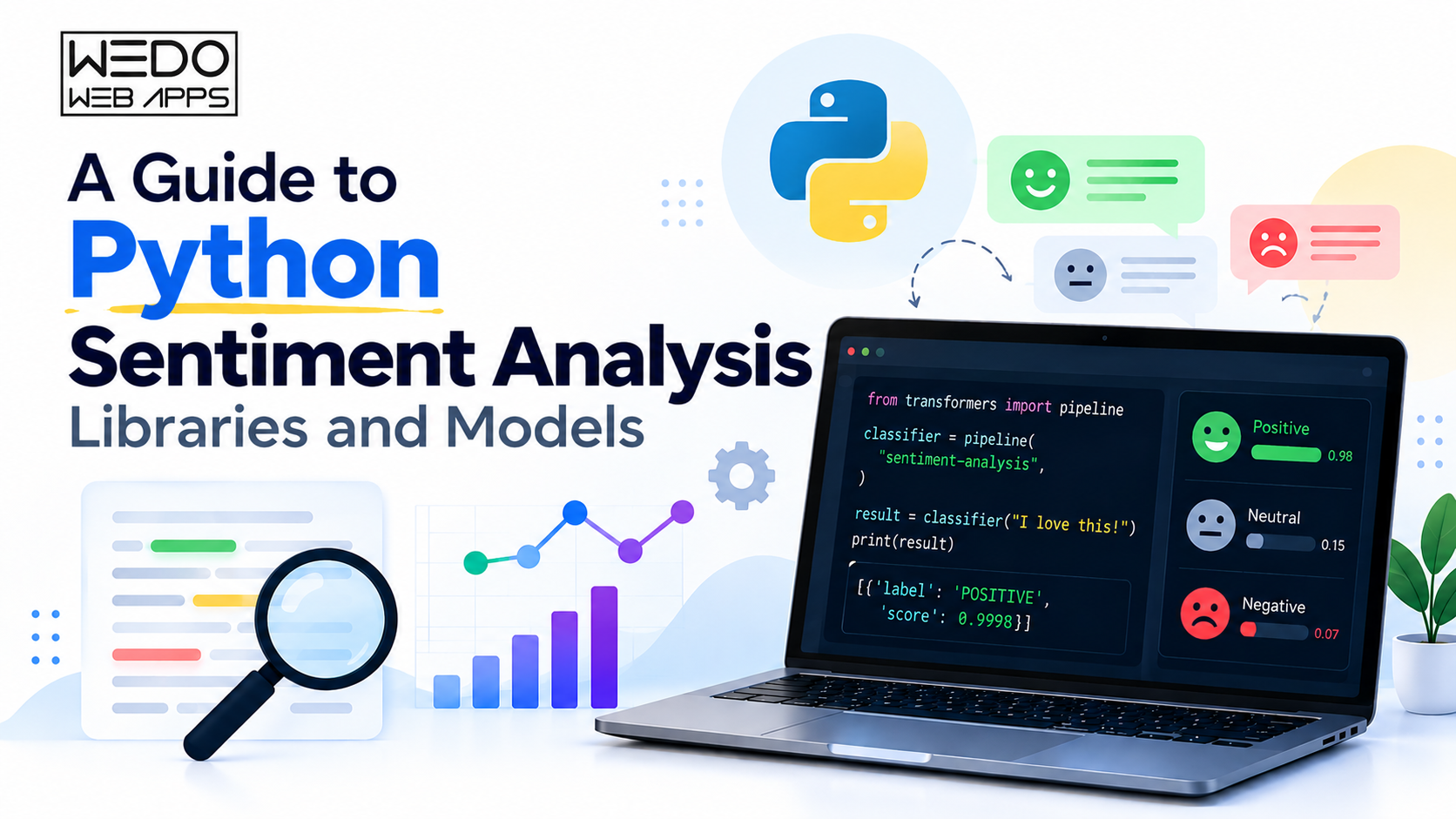
Businesses receive customer opinions through online reviews, social media posts, surveys, and support messages. These comments can reveal what customers like, where they face problems, and what they expect from a product or service. Python sentiment analysis helps process this feedback by identifying the emotional tone of written text.
Sentiment analysis is a natural language processing (NLP) technique that classifies text as positive, negative, or neutral. Python provides several libraries and machine learning models for performing this task, from simple text analysis to advanced language processing.
What Are the Best Python Sentiment Analysis Libraries?
The right library depends on your data, project requirements, and expected accuracy. Here are four popular options.
1. NLTK
The Natural Language Toolkit (NLTK) provides tools for text processing, tokenization, and linguistic analysis. Developers can use its VADER sentiment analyzer to calculate sentiment scores for short texts, including social media comments and customer reviews.
2. TextBlob
TextBlob is a beginner-friendly Python library for basic sentiment analysis. It calculates polarity and subjectivity scores, making it useful for simple text classification tasks. However, it may struggle with sarcasm, complex sentences, and context-dependent meanings.
3. VADER
VADER stands for Valence Aware Dictionary and Sentiment Reasoner. This rule-based tool is designed for sentiment analysis of informal English text. It considers factors such as punctuation, capitalization, and common expressions when calculating sentiment scores.
4. Hugging Face Transformers
Hugging Face Transformers provides access to pre-trained models, including BERT-based models, for sentiment classification. These models can consider the context of words and are suitable for more complex text analysis tasks. Performance depends on the selected model, language, and quality of the training data.
How Is Sentiment Analysis Used in Business?
An eCommerce company can analyze product reviews to identify recurring complaints about quality, delivery, or customer service. Marketing teams can examine public reactions to campaigns, while support teams can identify negative feedback that needs attention.
For businesses developing custom NLP applications, Python development services can help assess software requirements, data processing needs, and integration options.
How Do You Choose the Right Sentiment Analysis Model?
Start by identifying the type of text you want to analyze. VADER may suit short, informal comments, while transformer-based models may work better for context-sensitive language. Test different options against real examples before selecting a model for production.
Remember that sentiment analysis is not always accurate. Sarcasm, mixed opinions, and industry-specific language can affect results. Reviewing model predictions and measuring performance against labeled data helps improve reliability.

 English
 Arabic
 French
 Portuguese
 Deutsch
 Turkish
 Dutch
 Italiano
 Russian
 Romaian
 Portuguese (Brazil)
 Greek