


TypeScript vs. JavaScript: Making the Right Architectural Choice
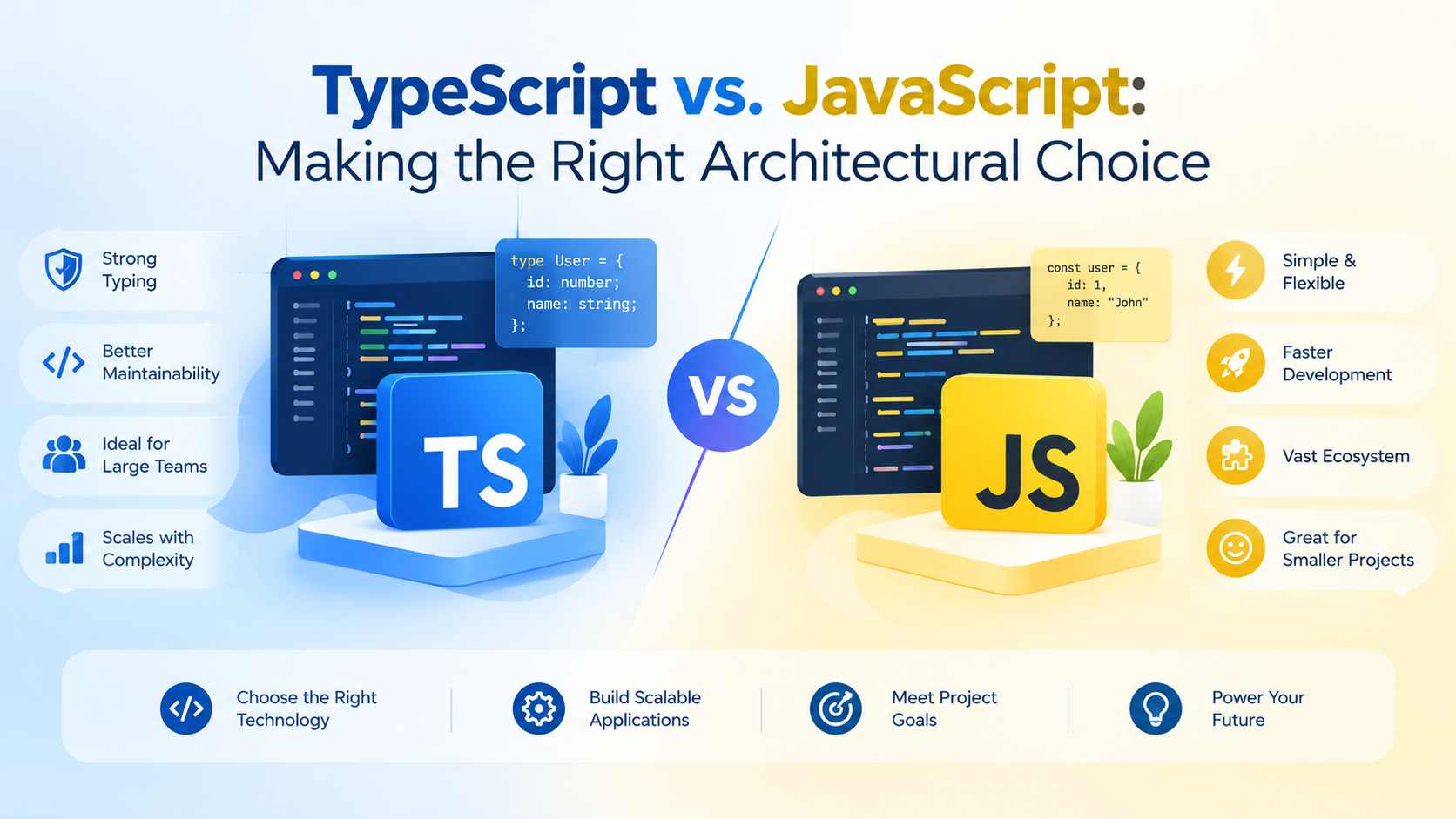
One of the most critical decisions engineering leaders face when planning web applications, SaaS platforms, or mobile backends is choosing between TypeScript vs. JavaScript. While JavaScript remains the native language of the web, TypeScript has emerged as the preferred choice for scaling multi-developer enterprise applications.
Understanding the Core Differences
- JavaScript (JS): A lightweight, dynamically typed programming language that runs natively in web browsers and server environments like Node.js. Variables can hold any data type during execution, enabling fast prototyping and rapid initial development.
- TypeScript (TS): An open-source, statically typed syntactic superset of JavaScript developed by Microsoft. It adds optional static typing, interface contracts, and compile-time type checking. Before execution, TypeScript transpiles into clean JavaScript, ensuring zero runtime performance penalty.
Feature JavaScript (JS), TypeScript (TS), Type Checking, Dynamic (checked at runtime). Static (checked at compile time) Error Discovery: Discovered during live execution Caught early in editor or CI/CD build refactoring Manual: higher risk of regressions Compiler-verified across codebase setup overhead zero setup; runs directly in runtimes Requires tsconfig.json a transpiler
Why Enterprise Teams Choose TypeScript
- Early Bug Detection: Static type checking catches up to 15% of runtime bugs before code is merged into production, preventing common errors like TypeError: Cannot read properties of undefined.
- Self-Documenting Code: Explicit interfaces act as living data contracts, speeding up developer onboarding and making large codebases easier to maintain.
- Confident Refactoring: Automated, compiler-verified refactoring allows developers to update complex business logic safely without introducing accidental breakages.
When Plain JavaScript Still Wins
Plain JavaScript remains ideal for rapid MVP prototyping, lightweight marketing landing pages, single-developer projects, or zero-build workflows where fast iteration takes priority over strict type safety.

 English
 Arabic
 Spanish
 Portuguese
 Deutsch
 Turkish
 Dutch
 Italiano
 Russian
 Romaian
 Portuguese (Brazil)
 Greek