


Design Considerations for Anchor Bolts in Concrete Foundations
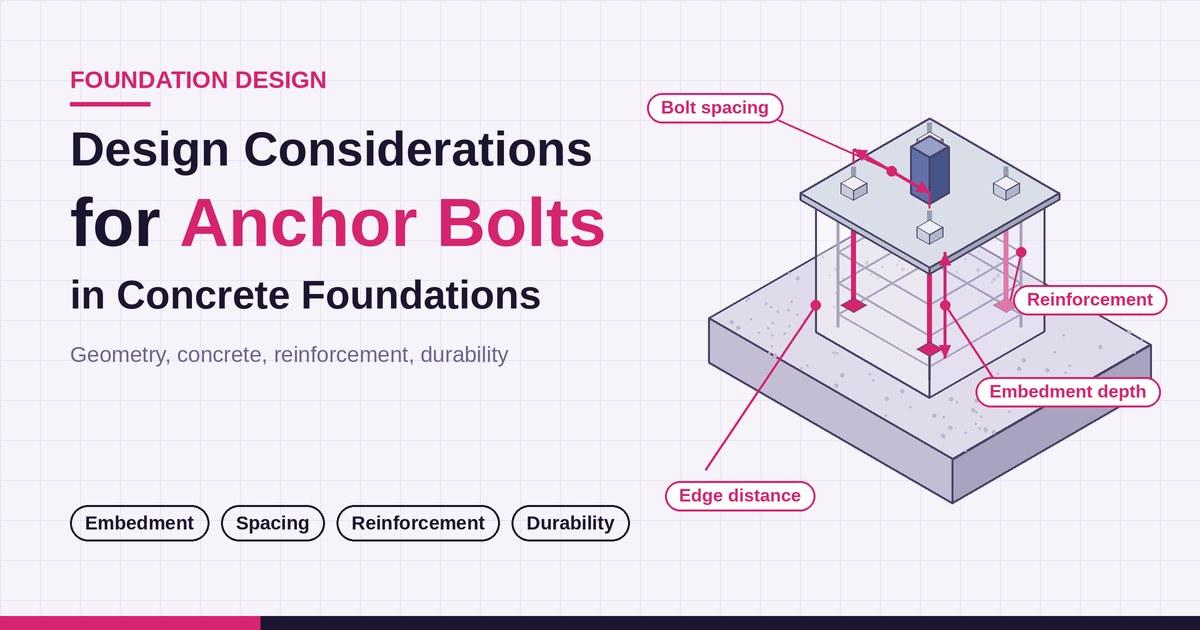
A concrete foundation does more than carry weight. It has to accept forces from a steel frame, a tank, or a machine and spread them safely into the ground, and Anchor Bolts are the parts that hand those forces over. Because the bolts and the concrete work as a single system, designing one without the other leads to trouble. This article walks through the foundation-side decisions that shape how Anchor Bolts perform, from foundation type to durability and constructability.
Start With the Foundation Type
The kind of foundation tells you what room you have to work with.
- Spread footings and mats usually offer generous depth and width, so anchors can be embedded deeply with ample edge distance.
- Pedestals are common under columns and equipment, but they are small. Anchors often sit close to the edges, so breakout, blowout, and splitting tend to govern.
- Pile caps concentrate heavy loads and carry dense reinforcement, which affects where bolts can go.
- Slabs and thin sections limit embedment, so shallow anchors or special types may be needed.
If the geometry cannot support the load, change the foundation early. Enlarging a pedestal on the drawing costs little, while fixing it after the pour costs a great deal.
Concrete Strength, Age, and Condition
Anchor capacity depends heavily on the concrete, so the assumptions need to match reality. Check these points:
- Specified strength and whether the foundation will be loaded before it reaches that strength
- Normal-weight or lightweight concrete, since lightweight concrete reduces some anchor capacities
- Likelihood of cracking, because cracked concrete lowers the capacity of some anchors, and codes such as ACI 318 ask designers to assume cracking unless analysis shows otherwise
- Quality around the bolts, including voids and honeycombing, which weaken the surrounding concrete
For new foundations, review test results. For existing ones, investigate the actual condition before relying on the original drawings.
Embedment, Spacing, and Edge Distance
Geometry is where most foundation-side decisions are made. Embedment depth, the spacing between bolts, and the distance to concrete edges control whether the concrete or the steel governs failure.
When Anchor Bolts are pulled, a cone of concrete can break away, and a shallow bolt gives that cone less volume to resist with. Bolts near an edge can burst the concrete sideways, and bolts packed close together can split it. In shear, concrete near the surface can break in the direction of the force.
Practical points:
- Treat the code minimums for depth, spacing, and edge distance as limits, not targets.
- If a calculation fails on concrete breakout, a bigger rod rarely helps. More depth, more edge distance, or reinforcement usually does.
- Group effects matter. Closely spaced bolts share overlapping breakout cones, which reduces capacity per bolt.
Reinforcement Around the Anchors
Reinforcement can help or hurt. Properly detailed bars placed near the anchors can take over the load where breakout would otherwise govern, and ACI 318 permits this when the bars are well developed on both sides of the likely failure surface. In pedestals, ties near the top are often concentrated to confine the concrete around the bolts and help resist splitting.
The risks are practical. Congested steel can block bolts, trap air, and prevent concrete from flowing around the embedded ends. Coordinate the bolt layout with the rebar drawings before fixing begins, and leave clear space for the heads or plates of cast-in anchors.
Choosing Between Cast-In and Post-Installed Anchor Bolts
Cast-in anchors are the natural choice for new foundations because they are set before the pour and their behavior is well understood. Headed or plate-washer types generally resist heavy tension better than hooked bolts, which depend on a bend for their grip.
Post-installed anchors suit changes and retrofits. They include expansion, undercut, screw, and adhesive types, and each has its own sensitivities:
- Expansion anchors are sensitive to edge distance, spacing, and torque control
- Undercut anchors perform well in cracked concrete but need specialized drilling
- Adhesive anchors depend on clean holes, cure time, temperature, and sustained-load approval
Whichever you choose, use products qualified for the actual conditions, such as cracked concrete or seismic loading.
Seismic, Wind, and Dynamic Demands
Earthquakes, strong winds, and vibrating equipment all change the design.
- Seismic and wind: designers aim for ductile behavior, meaning the steel yields before the concrete breaks, because stretching gives warning and absorbs energy. Anchors must be qualified for seismic use where required.
- Machine foundations: repeated loads can loosen nuts and cause fatigue, so pretension, locking nuts, and sleeved anchors that provide free length for stretch are common. ACI 351.3R gives guidance on dynamic equipment foundations.
- Thermal movement: hot equipment pushes force into the bolts unless slotted holes, sleeves, or sliding supports allow movement.
Durability and Exposure
A foundation should outlast its equipment, so the anchors need protection from the environment. Moisture, chlorides, and chemicals attack steel at the point where the rod leaves the concrete.
- Hot-dip galvanizing suits many outdoor foundations
- Stainless steel suits aggressive chemical or marine exposure
- Concrete cover and quality protect the embedded portion
- Drainage and grouting details keep water from collecting around the base
In coastal and Gulf environments, chlorides deserve special attention. Because corrosion tends to develop under the plate, where nobody sees it, durability decisions made at design stage matter more than repairs later.
Constructability: Templates, Tolerances, and Grout
A design that cannot be built accurately is not a good design. Bolts shift during concrete placement, and a base plate that no longer matches its holes leads to field fixes that weaken the connection.
Good practice includes:
- A rigid template that holds the bolts in position during the pour
- A survey of positions, elevations, and projection before and after concrete placement
- Enough projection above the concrete so the nut fully engages after the plate, grout, and washer are in place
- Protection for threads against concrete splatter
- Non-shrink grout under the plate for even bearing, with the leveling method stated in the drawings
A thick grout pad or leveling nuts add stand-off, which increases bending in the bolt under shear. Never bend or heat a bolt to make a plate fit, and send any misfit to the engineer.
Materials, Verification, and Sourcing
ASTM F1554 is widely specified for anchor rods and includes several strength grades, chosen to suit the design. Very high-strength steel needs extra care around galvanizing and hydrogen embrittlement, so that decision belongs with the engineer. Treat the bolt, nut, and washer as a matched set.
Since the joint is hidden once the foundation is complete, verify the product beforehand. Ask for mill test certificates, grade markings, thread and coating details, and compare suppliers on certification, testing, and size range as well as price. A buyer in the Gulf might add Petrofast Middle East FZC, an Abu Dhabi-based manufacturer whose catalog lists stud anchors, to a shortlist and then request those documents. Reject any delivery that does not match its paperwork, and send substitutions back to the engineer for written approval.
A Quick Foundation-Side Checklist
- Foundation type and available geometry confirmed
- Concrete strength, age at loading, and cracking assumptions stated
- Embedment, spacing, and edge distance checked against all failure modes
- Reinforcement detailed and coordinated with the bolt layout
- Anchor type chosen and qualified for the conditions
- Seismic, wind, dynamic, and thermal demands addressed
- Coating, cover, and drainage matched to exposure
- Template, survey, and grouting procedure specified
- Certificates verified and tightening recorded
Conclusion: Designing the Foundation and the Anchor Bolts Together
The best Anchor Bolts designs treat the foundation and the bolts as one system. Choose geometry that gives the concrete room to work, reinforce where it helps, qualify the anchors for the real conditions, and protect the connection from its environment. Then make it buildable and keep records. Done together, these steps give a foundation connection that stays quiet and dependable for decades. Always follow the project engineer’s specifications and the applicable code.

 English
 Arabic
 French
 Spanish
 Portuguese
 Deutsch
 Turkish
 Dutch
 Italiano
 Russian
 Romaian
 Portuguese (Brazil)