


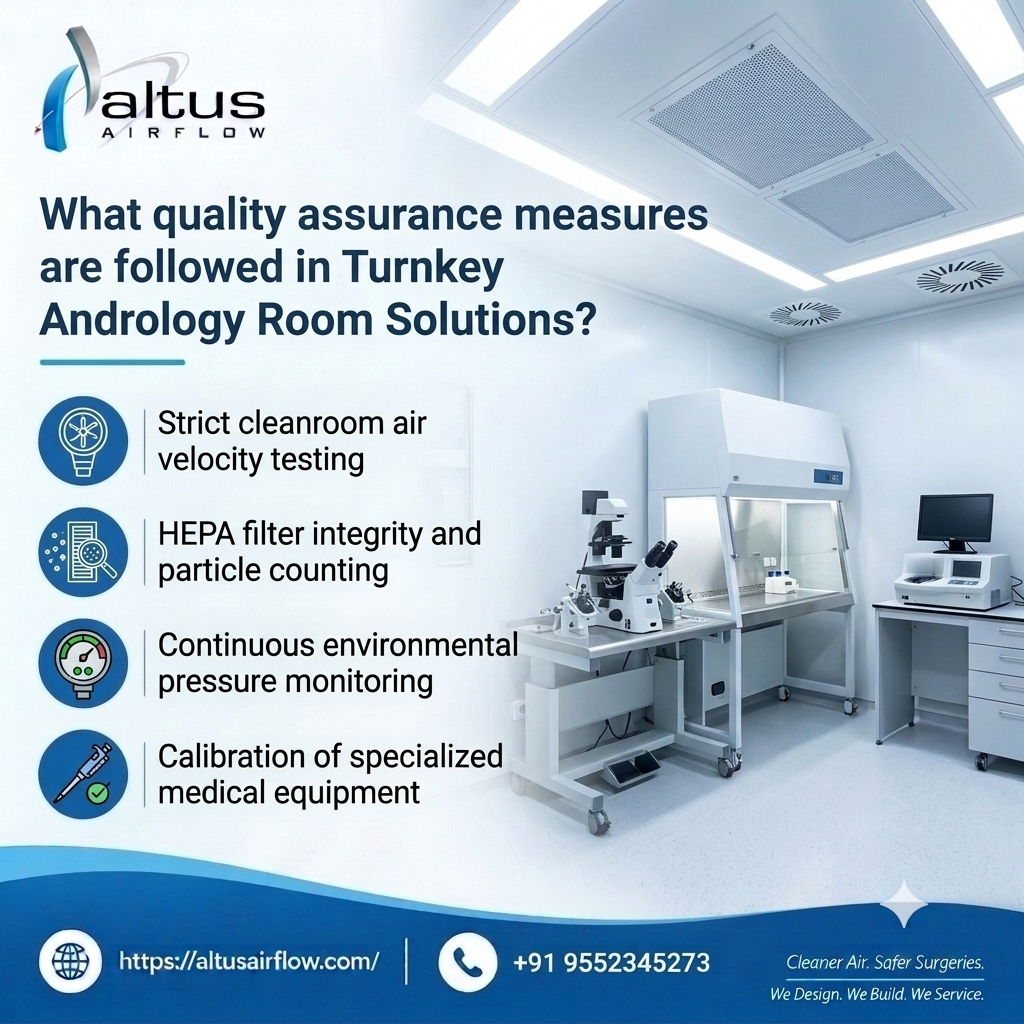
What Quality Assurance Measures Are Followed in Turnkey Andrology Room Solutions?
Introduction
Altus Airflow recognizes that quality assurance is essential when planning and developing specialized andrology laboratories. These facilities require suitable room layouts, hygienic finishes, reliable ventilation, correctly installed utilities, and carefully coordinated laboratory equipment. Turnkey Andrology Room Solutions bring these elements together through structured planning, material inspections, installation checks, and final commissioning. A systematic quality assurance approach helps identify defects early, verify that infrastructure meets approved specifications, and prepare the facility for reliable laboratory operations while supporting cleanliness, safety, and long-term maintainability.
1. Detailed Planning and Defined Quality Standards
Quality assurance begins before construction or installation starts. The project team must understand the laboratory's intended activities, including semen analysis, sperm preparation, sample processing, microscopy, and cryopreservation where applicable. Each activity may require specific equipment, utilities, environmental conditions, and workflow arrangements.
The design should be reviewed against the client's requirements, applicable building regulations, healthcare guidelines, and relevant technical standards. Drawings should identify room dimensions, equipment positions, electrical outlets, plumbing provisions where needed, ventilation arrangements, storage, and service access.
A quality plan should define inspection points, approval responsibilities, required documents, acceptance criteria, and procedures for handling defects. This prevents quality checks from being left until the end of the project.
The team should also establish a process for reviewing design changes. Changes to equipment dimensions, room layouts, or service locations can affect other parts of the installation. Reviewing these changes before implementation helps reduce rework and keeps the project aligned with its approved specifications.
A structured quality plan provides a reference against which the completed facility can be inspected and accepted.
2. Inspection of Construction Materials and Interior Finishes
The materials used in an andrology laboratory should support routine cleaning, durability, and the intended laboratory environment. Surfaces that crack, deteriorate, absorb contaminants, or are difficult to clean can create maintenance problems and complicate hygiene procedures.
Quality inspections should verify that flooring, wall panels, ceilings, worktops, doors, and other finishes match the approved specifications. Materials should be assessed for durability, resistance to suitable cleaning agents, and compatibility with the laboratory's operational requirements.
Flooring and wall junctions deserve particular attention. Gaps, damaged joints, and unfinished edges can collect dust and make cleaning more difficult. Properly sealed joints and well-detailed interfaces help create a more maintainable environment.
Where low-emission materials are specified, supplier documentation should be reviewed to confirm the relevant product characteristics. Adhesives, sealants, coatings, and furnishings should be selected with potential chemical emissions in mind, especially in areas where sensitive reproductive samples may be handled.
Incoming materials should also be checked for damage, incorrect quantities, and manufacturing defects. Any non-conforming item should be documented and resolved before it is incorporated into the laboratory.
3. Verification of Ventilation and Environmental Conditions
Ventilation is an important part of andrology laboratory design because environmental conditions can affect staff comfort, equipment operation, and laboratory procedures. The appropriate requirements depend on the activities performed, the facility's design, and applicable guidance.
Quality assurance should verify that the installed ventilation system matches the approved design. Checks may include inspection of ductwork, air-handling equipment, filters, supply and return outlets, control settings, and relevant service connections.
Where specified, commissioning may include measurements of airflow, room pressure relationships, temperature, and humidity. Any filtration or air-quality testing should follow the project's requirements and the characteristics of the installed system.
The design team should also consider potential sources of unwanted chemical emissions. Materials, cleaning products, equipment, and consumables may contribute to indoor pollutants. Suitable material selection, ventilation planning, and controlled use of chemicals can help manage these risks.
Test results should be documented and compared with predefined acceptance criteria. If the system does not perform as required, the cause should be investigated and corrective work completed before final acceptance.
Environmental monitoring requirements after handover should be defined according to the laboratory's needs rather than assuming that a single commissioning test guarantees performance indefinitely.
4. Electrical Systems and Equipment Installation Checks
Andrology laboratories depend on reliable electrical infrastructure for microscopes, centrifuges, incubators where used, computer systems, sample preparation equipment, and other instruments. Incorrect installation or inadequate power provision can interrupt operations and affect equipment performance.
Quality assurance should verify that outlets, circuits, distribution boards, earthing, protective devices, and essential power arrangements meet the approved electrical design and applicable safety requirements.
Equipment locations should be checked against the final layout to ensure that staff can use instruments safely and that service connections do not create unnecessary clutter. Sufficient clearance should be provided for cleaning, inspection, and maintenance.
Each item of equipment should be installed according to the manufacturer's instructions. Where applicable, acceptance checks should confirm correct operation, calibration status, software configuration, and suitability for the intended task before the equipment is placed into service.
Temperature-sensitive equipment may require alarm systems, monitoring devices, or backup arrangements based on the laboratory's risk assessment. The installation and operation of these systems should be verified where they form part of the approved scope.
Equipment registers, maintenance schedules, manuals, and relevant certificates should be compiled for handover. These records help laboratory managers maintain equipment performance and investigate problems throughout its service life.
5. Standard Operating Procedures and Documentation
A well-constructed laboratory still needs documented procedures to support consistent operations. Standard operating procedures (SOPs) describe how tasks should be performed, who is responsible, and what records must be maintained.
The World Health Organization's laboratory manual for semen examination provides standardized procedures and guidance on quality control, helping laboratories improve consistency and comparability of results.
Depending on the services offered, laboratory documentation may cover sample receipt, identification, examination, preparation, storage, result reporting, cleaning, equipment maintenance, and the management of errors.
Documents should have clear titles, version numbers, approval details, and review dates. Staff must be able to access the current approved versions, while outdated versions should be controlled to prevent accidental use.
Records should be accurate, legible, and traceable. If a deviation occurs, the laboratory should document what happened, assess the impact, and record any corrective action taken.
Documentation is not simply an administrative requirement. It provides evidence that the laboratory follows established processes and allows supervisors to investigate problems, evaluate performance, and identify opportunities for improvement.
6. Staff Training and Competency Assessment
Personnel competence is central to laboratory quality. Different tasks require specific knowledge and practical skills, and staff should be trained before independently performing assigned duties.
Training may cover equipment operation, sample identification, semen examination procedures, cleaning practices, biosafety, data entry, and the handling of non-conformities. The required training should reflect the employee's responsibilities and the tests performed by the laboratory.
Competency assessment should go beyond attendance at a training session. Depending on the task, it may include observation, review of completed work, comparison exercises, practical demonstrations, and assessment against defined criteria.
The WHO manual highlights the importance of training and quality control in improving consistency in semen examination. Variation between operators can affect results, making standardized procedures and ongoing competency review important.
Training records should identify the activity, date, trainer, assessment method, and outcome. Refresher training should be provided when procedures change, equipment is updated, or performance concerns arise.
A documented competency programme helps ensure that staff understand not only how to complete a task but also why each step matters for reliable results.
7. Internal Quality Control and External Quality Assessment
Quality assurance in an andrology laboratory extends beyond the physical room and its installed infrastructure. Laboratories must also assess whether their examination methods produce reliable and consistent results.
Internal quality control (IQC) involves ongoing checks performed within the laboratory to identify errors or unusual variation. The methods used should be appropriate to the examinations being performed and should have defined acceptance criteria.
For semen analysis, quality control may involve monitoring measurement consistency, reviewing results, comparing operators, and investigating unexpected shifts. Records should show what was checked, whether the results were acceptable, and what action was taken when a problem was identified.
External quality assessment (EQA) provides an additional way to compare laboratory performance with external targets or participating laboratories. Where an appropriate scheme is available, participation can help identify differences that may not be evident from internal checks alone.
The Association of Reproductive and Clinical Scientists' guidance on laboratory diagnostic andrology discusses audits, IQC, EQA, process validation, and performance indicators as elements of a quality management system.
These clinical quality activities are primarily the responsibility of the laboratory operator and its management. A turnkey infrastructure provider can support the environment in which they take place, but cannot replace the laboratory's own quality management responsibilities.
8. Equipment Calibration and Preventive Maintenance
Laboratory equipment must remain suitable for its intended purpose after installation. Incorrect readings, worn components, or poorly maintained instruments can affect examination results and interrupt routine work.
A preventive maintenance plan should identify the equipment covered, required maintenance activities, responsible personnel, and recommended service intervals. Calibration or performance verification should be completed where applicable to the instrument and its use.
The laboratory should retain relevant service reports, calibration certificates, equipment histories, and records of repairs. Instruments that fail acceptance criteria should be assessed before being returned to use.
The World Health Organization's laboratory quality management guidance emphasizes equipment management, maintenance, and processes for ensuring the validity of laboratory results.
Maintenance planning should also consider environmental and utility requirements. For example, equipment may depend on stable power, suitable room conditions, or reliable monitoring systems.
A documented maintenance programme supports equipment reliability, reduces avoidable downtime, and provides evidence that instruments are being managed systematically.
9. Audits, Non-Conformities, and Corrective Actions
Audits help determine whether the laboratory's processes meet established requirements. They can cover infrastructure maintenance, documentation, staff competency, equipment management, sample handling, and quality control activities.
An audit should use defined criteria and record the evidence reviewed. When a problem is found, the laboratory should document the non-conformity, assess its significance, and identify the cause before selecting corrective action.
For example, repeated equipment problems may indicate an inadequate maintenance schedule, while inconsistent test results may require a review of procedures, training, calibration, or internal quality control.
Corrective action should address the underlying cause where possible, not simply resolve the immediate symptom. Follow-up checks are necessary to confirm whether the action has been effective.
Quality indicators can also help identify recurring issues. Depending on the laboratory's services, these may include equipment downtime, reporting delays, training completion, audit findings, and internal or external quality-control performance.
Regular review supports continual improvement and helps the laboratory maintain an organized approach to quality management.
10. Final Inspection, Commissioning, and Handover
Before an andrology room is handed over, the project team should verify that the installed infrastructure matches the approved design and that outstanding defects have been addressed.
The final inspection may cover modular panels, flooring, doors, service connections, electrical systems, ventilation, lighting, and installed equipment within the agreed project scope. Testing should be completed according to the system requirements and relevant technical standards.
A snag list should identify incomplete work, assign responsibility for each item, and record closure. Required retesting should be completed after corrective work.
The handover package should include relevant drawings, equipment manuals, commissioning records, warranties, maintenance instructions, and certificates or test reports required by the contract.
The laboratory operator should also receive appropriate guidance on the installed systems and their maintenance requirements. Before clinical testing begins, the laboratory must establish its own operational procedures, staff competencies, quality control, and any applicable regulatory or accreditation requirements.
A thorough handover creates a documented basis for operating and maintaining the facility after construction is complete.
Conclusion
Quality assurance in an andrology room involves coordinated design reviews, material inspections, environmental verification, safe equipment installation, documented procedures, staff training, and ongoing performance checks. These measures help ensure that the facility is suitable for its intended use and can be maintained systematically after handover.
Altus Airflow supports the planning and coordination of specialized laboratory environments, with attention to installation quality and technical requirements. Through careful project documentation and structured inspections, Altus Airflow helps healthcare facilities establish a practical foundation for safe, maintainable, and quality-focused laboratory operations.
Frequently Asked Questions
1. What quality assurance measures are followed in Turnkey Andrology Room Solutions?
Turnkey Andrology Room Solutions may include design reviews, material inspections, ventilation verification, electrical safety checks, equipment acceptance testing, documentation, and final commissioning.
2. Why is quality assurance important in an andrology laboratory?
It helps maintain reliable infrastructure, consistent procedures, safe equipment operation, and dependable laboratory results.
3. Are equipment calibration and maintenance necessary?
Yes. Appropriate calibration, performance verification, and preventive maintenance help ensure equipment remains suitable for its intended use.
4. What is internal quality control in an andrology laboratory?
Internal quality control involves routine checks used to monitor examination performance and identify errors or unusual variation.
5. Why are staff competency assessments required?
They help verify that personnel can perform assigned tasks correctly and consistently according to approved procedures.
Read Our Previous Blog ---------------> How does a Modular Cardiac OT Engineering Company design energy-efficient cardiac OTs?

 English
 French
 Spanish
 Portuguese
 Deutsch
 Turkish
 Dutch
 Italiano
 Russian
 Romaian
 Portuguese (Brazil)
 Greek