


How to Budget for Branded Patch Merchandise
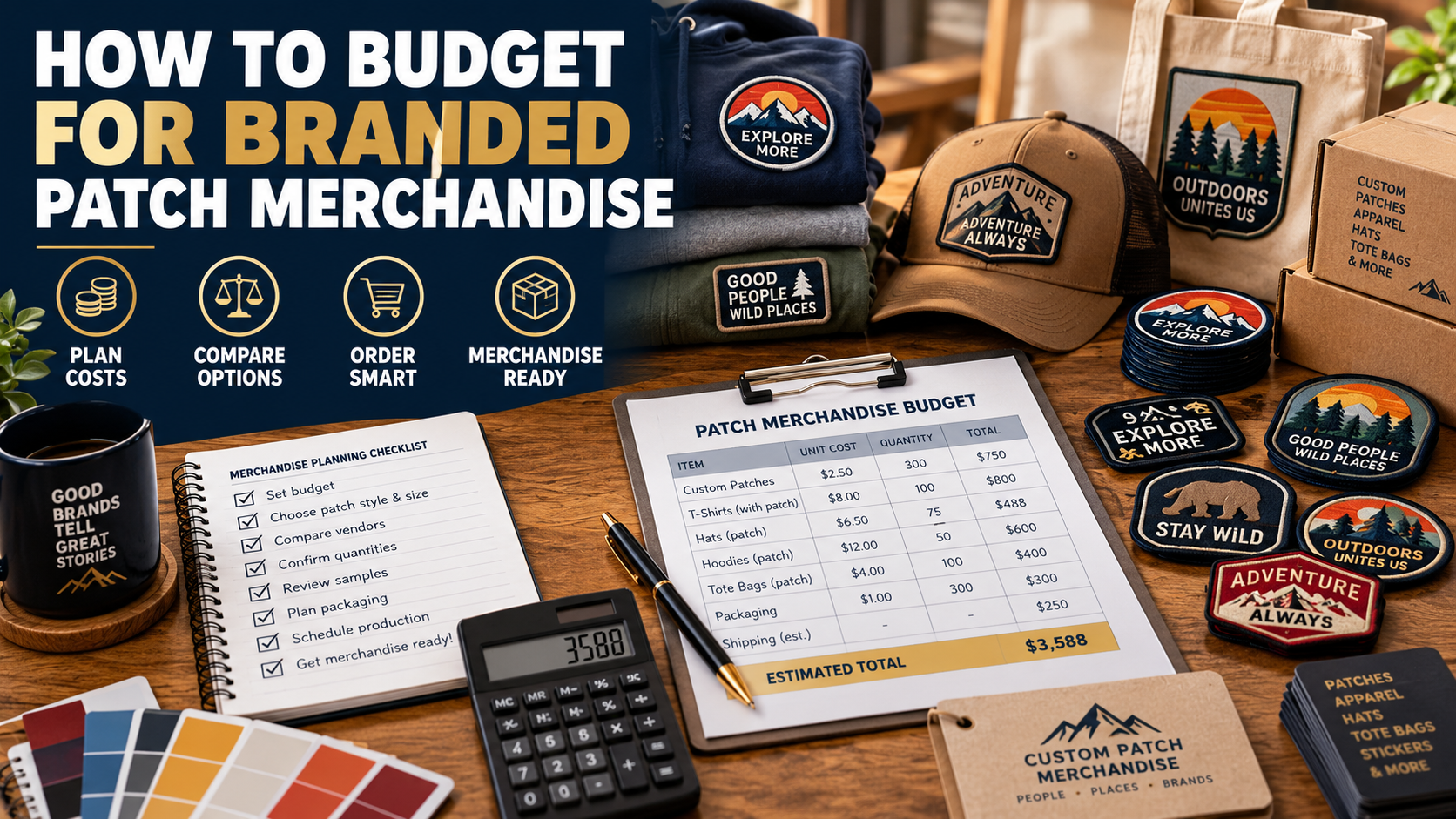
A company orders 500 embroidered patches for its new merchandise collection. The quoted price looks reasonable, but the final bill turns out higher than expected. Why? Nobody included the cost of attaching the patches to jackets, preparing packaging, or handling distribution.
It's a common budgeting oversight. Branded patch merchandise involves more than paying for the patches themselves. Materials, dimensions, quantities, attachment methods, and production schedules all influence how much a business ultimately spends.
Whether you're preparing merchandise for a product launch, employee uniforms, a trade show, or a retail collection, a realistic budget helps you control expenses without compromising the finished product.
Start With a Clear Merchandise Budget
Before contacting custom patch suppliers, decide how much your business can reasonably spend. Your budget should account for both manufacturing expenses and the work required to prepare finished merchandise.
A useful starting point is to identify the number of products requiring patches. Then calculate the maximum amount you can spend on each completed item.
For example, if you plan to produce 200 promotional tote bags, the budget should cover the bags, patches, attachment work, and any packaging needed for distribution.
Separate Essential Costs From Optional Upgrades
Not every design feature needs to be included in the initial production plan. Premium materials, unusual shapes, additional colors, and specialty packaging may increase the total cost.
Identify which features are necessary for your brand and which are simply desirable. This makes it easier to adjust specifications if supplier quotations exceed your budget.
A simple embroidered logo might meet the needs of a staff uniform, while a premium retail jacket may justify a more distinctive patch construction.
Understand What Affects Custom Patch Pricing
Custom patch prices aren't determined by quantity alone. Manufacturing methods, dimensions, artwork complexity, backing choices, and finishing requirements can all affect the quotation.
Two patches with the same dimensions may cost different amounts because their construction and design requirements aren't identical.
Patch Material and Manufacturing Method
Embroidered, woven, PVC, chenille, leather, and sublimated patches are produced using different methods. Each has particular design strengths and manufacturing considerations.
For example, a bold embroidered logo may be relatively straightforward to manufacture, while a highly detailed design might require finer woven construction or full-color printing.
Businesses unfamiliar with the available types of custom patches can compare material characteristics and design applications before finalizing their merchandise budget. Understanding these differences helps avoid choosing an expensive construction that offers little practical benefit for the intended product.
The best material isn't necessarily the cheapest or most premium option. It should match the artwork, intended use, and expected product lifespan.
Patch Size and Shape
Larger patches generally require more material and production work. The exact cost difference depends on the manufacturing method and design specifications.
A small company logo for a cap has different requirements from a large back patch intended for a jacket.
Unusual shapes can also influence manufacturing complexity. Ask suppliers to quote the actual dimensions rather than relying on general price ranges.
Artwork Complexity
Detailed lettering, multiple small design elements, and complicated color arrangements can affect production requirements.
Some designs may need simplification before they can be manufactured effectively using embroidery or molded PVC.
Preparing clean artwork early can reduce revision time and help suppliers provide more accurate quotations.
Calculate the Full Cost of Branded Patch Merchandise
A patch quotation represents only one component of the overall merchandise budget. Businesses should calculate the complete cost of each finished product before deciding whether a project is financially practical.
The total generally includes the base product, patch manufacturing, attachment, packaging, and distribution.
Example Budget for 250 Branded Jackets
The following example illustrates how a merchandise budget might be structured. All figures are hypothetical and do not represent current supplier prices.
| Expense | Cost per jacket | Total for 250 |
|---|---|---|
| Blank jacket | $18.00 | $4,500 |
| Custom embroidered patch | $1.80 | $450 |
| Patch attachment | $2.00 | $500 |
| Packaging | $0.70 | $175 |
| Estimated distribution | $1.50 | $375 |
| Total | $24.00 | $6,000 |
In this example, patches account for only a small portion of the merchandise budget. The jackets themselves represent the largest expense.
However, the attachment and distribution costs are also significant. Ignoring them would produce an unrealistic estimate.
This example demonstrates why purchasing decisions should be based on the complete finished-product cost rather than the patch price alone.
Compare Bulk Ordering Prices Before Committing
Larger patch orders may qualify for lower per-unit pricing because certain production expenses can be distributed across more pieces.
However, ordering additional patches only to reach a lower price tier doesn't always result in genuine savings.
Suppose your business needs 300 patches. A supplier might offer a better unit price at 500 pieces, but the additional inventory still requires money and storage space.
Request Quotes at Multiple Quantities
Ask suppliers to provide quotations for quantities close to your actual requirements.
If your projected demand is 300 pieces, comparing quotations for 250, 300, and 500 patches may reveal whether the higher quantity offers meaningful value.
For businesses comparing suppliers, understanding how to price a bulk custom patch project is an important step before committing to production. A detailed quote can clarify manufacturing costs, quantity discounts, backing options, and other project-specific requirements.
Make sure every supplier receives the same design specifications. Otherwise, differences in materials or dimensions may make the quotations difficult to compare.
Choose Patch Backing With Labor Costs in Mind
Backing affects both how a patch attaches to merchandise and how much preparation is required before distribution.
A backing option that appears inexpensive during manufacturing may involve additional labor when applied to hundreds of garments.
Sew-On Backing
Sew-on patches are attached through stitching, making them suitable for uniforms and merchandise requiring secure, long-term attachment.
However, businesses should include sewing labor in their budgets. Costs can vary depending on garment construction and the complexity of the attachment process.
Iron-On Backing
Iron-on patches use heat-activated adhesive and can be convenient for compatible fabrics.
They may reduce application time in some production workflows, but proper heat, pressure, and fabric compatibility are important.
Testing the application method before starting a large batch can prevent damage to garments or problems with adhesion.
Hook-and-Loop Backing
Hook-and-loop patches are removable and commonly used on compatible uniforms, bags, and accessories.
They may be practical when patches need to be replaced or exchanged, although the garment may also require a matching loop panel.
Include any additional garment preparation in your budget before selecting this option.
Build a Contingency Into Your Merchandise Budget
Even well-planned merchandise projects can encounter unexpected expenses. Artwork adjustments, quantity changes, attachment difficulties, or delivery requirements may increase costs.
A contingency allowance gives the purchasing team room to respond without immediately exceeding the approved budget.
For planning purposes, some businesses may choose to reserve around 5–10% of the estimated project cost. This is an illustrative budgeting approach, not a standard manufacturing requirement.
When a Contingency Becomes Useful
Consider a company ordering patches for a product launch. The initial design uses lettering that becomes difficult to read at the planned dimensions.
The supplier recommends enlarging the patch, which changes the manufacturing quotation. A contingency allowance may help cover this adjustment.
Unexpected garment replacement requirements or revised distribution arrangements can create similar challenges.
Avoid Common Budgeting Mistakes
The most expensive merchandise mistakes often begin with incomplete planning rather than poor supplier pricing.
Businesses sometimes focus on securing the lowest cost per patch while overlooking the expenses involved in preparing finished products.
Ordering More Patches Than Needed
A lower unit price can be attractive, particularly when suppliers offer quantity discounts. However, excess patches may remain unused if campaign demand falls short.
Base the order on realistic distribution estimates, confirmed product quantities, and expected replacement needs.
For repeat merchandise programs, consider whether future reorders are more practical than holding large amounts of inventory.
Selecting Materials Without Reviewing the Design
Not every patch material reproduces artwork in the same way.
Choosing embroidered patches for highly detailed artwork may result in simplification that changes the intended appearance. Selecting PVC for a design requiring subtle gradients can create similar limitations.
Review the artwork with the supplier before approving the material and pricing.
Leaving Attachment Costs Until the End
Businesses sometimes receive their patches and only then begin looking for someone to attach them to the merchandise.
This can delay completion and create unexpected labor costs.
Determine who will handle attachment, how the work will be completed, and what it will cost before ordering.
Plan Your Budget Around Production Deadlines
Delivery schedules can affect merchandise costs, especially when businesses require accelerated manufacturing or shipping.
A product launch with a fixed date leaves less room for artwork revisions, production delays, or unexpected delivery issues.
Start by identifying when the completed merchandise must be ready, not simply when the patches need to arrive.
Work Backward From Your Distribution Date
If branded jackets are required for a company event, allow time for patch production, shipping, garment attachment, quality checks, and packaging.
Confirm supplier lead times before approving the order. Production estimates may begin only after final artwork approval.
When possible, complete design decisions early to avoid rush-related expenses.
Measure the Value of Your Patch Merchandise
Not every merchandise program is intended to generate direct sales. Some businesses distribute branded patches as promotional gifts, while others use them on employee uniforms or retail products.
The way you evaluate results should reflect the original purpose.
Retail Merchandise
For merchandise sold to customers, calculate the total cost per finished item and compare it against the intended selling price.
Consider marketplace fees, shipping expenses, potential returns, and other selling costs before estimating profit margins.
A patch that improves the product's appearance may support its market positioning, but the selling price must still make financial sense.
Promotional Merchandise
For giveaways, measure distribution costs alongside the campaign's objectives.
If the merchandise supports an event or promotional campaign, tracking how many items were distributed and the enquiries generated afterward can provide useful context.
These measurements won't always prove that patches directly caused new sales, but they can help inform future purchasing decisions.
Employee Merchandise
For staff uniforms, value may come from consistent appearance, easier employee identification, and durable clothing.
The budget should consider replacement frequency and maintenance requirements rather than focusing exclusively on the initial purchase cost.
A Simple Budget Checklist Before Ordering
Before approving your branded patch merchandise project, confirm the following:
-
Project quantity: Determine how many finished products are needed.
-
Patch specifications: Finalize material, dimensions, shape, and artwork.
-
Supplier pricing: Compare complete quotations at relevant quantities.
-
Attachment costs: Include sewing, heat application, or other required labor.
-
Merchandise costs: Account for blank garments or accessories.
-
Packaging and distribution: Include all costs needed to deliver finished products.
-
Contingency: Reserve an appropriate allowance for unexpected changes.
-
Production schedule: Confirm delivery dates and approval requirements.
Keeping these details in one spreadsheet makes it easier to compare suppliers and update the budget as specifications change.
Final Thoughts
Budgeting for branded patch merchandise requires more than finding an affordable patch supplier. Material choices, order quantities, attachment requirements, and production schedules all affect the complete project cost.
Businesses can make better purchasing decisions by comparing detailed quotations and calculating expenses per finished product rather than per patch alone.
A realistic budget also leaves room for design adjustments and unexpected requirements. With clear specifications and careful planning, custom patches can become a practical part of a merchandise program without creating unnecessary financial surprises.

 English
 Arabic
 French
 Spanish
 Portuguese
 Deutsch
 Turkish
 Dutch
 Italiano
 Russian
 Romaian
 Portuguese (Brazil)