


3D Bioprinting Market Analysis Highlights Emerging Healthcare Technologies
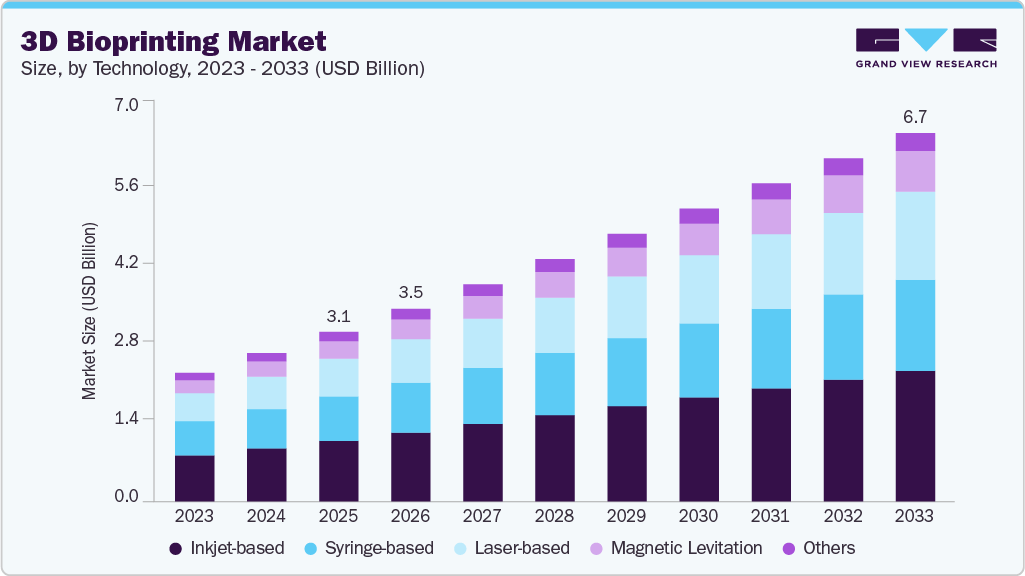
3D bioprinting is emerging as an important technology in biomedical research, regenerative medicine, and advanced healthcare. By depositing living cells and biomaterials in carefully controlled patterns, the technology enables researchers to develop tissue models and explore potential applications in personalized medicine, drug testing, and tissue engineering.
According to Grand View Research, the global 3D bioprinting market was valued at USD 3.1 billion in 2025 and is projected to reach USD 6.7 billion by 2033. Technological advancements, research investment, and the need for more realistic biological models are contributing to market expansion.
Tissue Engineering and Personalized Medicine Drive Innovation
The growing interest in regenerative medicine is supporting research into bioprinted tissues and potential organ substitutes. Researchers are investigating how printed biological structures could help repair damaged tissues and support the development of patient-specific treatments. Progress in bioinks, cell viability, and printing precision is expanding the possibilities for creating complex tissue structures.
Personalized medicine is another important area of development. Bioprinted models can help researchers study how biological tissues respond to different treatments, potentially supporting more tailored approaches to healthcare. The technology is also being explored in drug discovery and toxicity testing, where tissue models may help scientists evaluate treatment responses before advancing to later stages of development.
Inkjet-Based Technology Holds the Largest Share
Inkjet-based technology held the largest market share in 2025. Its precision, cost-effectiveness, printing speed, and ability to deposit living cells with limited material waste support its use in tissue engineering and drug screening. Compatibility with different bioinks also makes the technology useful across research and development environments.
Magnetic levitation is expected to register the fastest growth during the forecast period. It supports scaffold-free tissue formation and encourages cell-to-cell interactions, making it relevant to research seeking to reproduce natural tissue structures. Continued improvements in precision and scalability may further strengthen its role in advanced biomedical applications.
Go Deeper! Ask Prism AI about the 3D Bioprinting Market.
Medical Applications Lead Market Adoption
The medical segment held the largest application share in 2025. Applications include tissue engineering, organ generation research, prosthetics, implants, and other medical uses. Demand is supported by the need for advanced therapeutic approaches, improved disease models, and more individualized healthcare solutions.
Bioprinting is also attracting attention in pharmaceutical research because realistic tissue models can help investigators study disease mechanisms and evaluate drug responses. Consumer and personal product testing is expected to grow at the fastest rate, supported by interest in human tissue models for testing cosmetics and personal care products and reducing reliance on animal testing.
Request a Sample Report to Explore Detailed Market Insights and Industry Analysis.
3D Bioprinting Market: Key Highlights
· Market size in 2025: USD 3.1 billion
· Estimated market size in 2026: USD 3.5 billion
· Projected market size by 2033: USD 6.7 billion
· Forecast CAGR from 2026 to 2033: 9.7%
· Largest technology segment in 2025: Inkjet-based bioprinting
· Largest application segment in 2025: Medical
· Leading regional market: North America, with a 28.7% revenue share in 2025
North America Leads While Latin America Develops
North America accounted for 28.7% of global market revenue in 2025. Research infrastructure, investment in biotechnology, and collaboration among universities, healthcare institutions, and private companies support the region's leading position. The United States is an important contributor, with research activity focused on regenerative medicine, drug discovery, and personalized healthcare.
Latin America's 3D bioprinting market is developing at a moderate pace. Improving research capabilities and growing interest in advanced healthcare technologies are encouraging adoption. Universities and healthcare institutions are collaborating on tissue engineering and drug-testing applications. However, limited infrastructure and funding continue to influence the pace of market expansion.
Asia Pacific is also gaining momentum as research activity, biotechnology startups, and investment in advanced healthcare technologies increase across the region.
Research Collaboration and Commercialization Challenges
Collaboration between academic institutions, biotechnology companies, and healthcare providers remains important for translating laboratory advances into practical applications. Innovation in bioinks, printing methods, automation, and digital modeling is helping researchers explore more complex biological structures.
However, commercialization remains challenging. Regulatory requirements, product safety, ethical considerations, development costs, and the complexity of working with living cells can extend development timelines. Continued research, investment, and clearer regulatory pathways will be important to expanding the use of 3D bioprinting beyond specialized research environments.
FAQs
1. What is the projected size of the 3D bioprinting market by 2033?
The market was valued at USD 3.1 billion in 2025 and is projected to reach USD 6.7 billion by 2033, growing at a CAGR of 9.7% from 2026 to 2033.
2. Which technology and application segments led the market in 2025?
Inkjet-based technology held the largest share by technology, while the medical segment held the largest share by application.
Key 3D Bioprinting Companies:
· VivoSim Labs, Inc. (formerly Organovo Holdings, Inc.)
· CELLINK
· 3D Systems, Inc.
· Desktop Metal, Inc. (Nano Dimension Ltd.)
· Aspect Biosystems Ltd.
· regenHU
· CYFUSE
· CollPlant
About us:
Grand View Research, a market research and consulting company, provides syndicated research reports, customized research reports, and consulting services. Grand View Research database is used by the world's renowned academic institutions and Fortune 500 companies to understand the global and regional business environment. Our database features thousands of statistics and in-depth analysis on 46 industries in 25 major countries worldwide.

 English
 Arabic
 French
 Portuguese
 Deutsch
 Turkish
 Dutch
 Italiano
 Russian
 Romaian
 Portuguese (Brazil)
 Greek