


How AI Models Represent Knowledge and Make Predictions
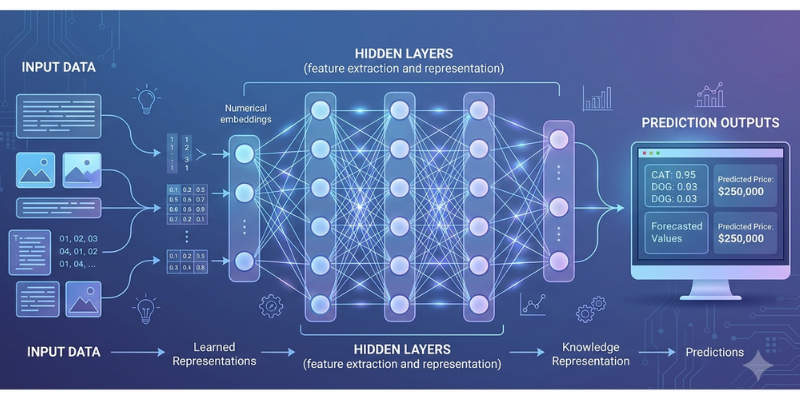
Artificial Intelligence (AI) is changing how computers process information, recognize patterns, and make predictions. From answering questions to recommending products, AI models use learned knowledge to produce useful results. Understanding how AI models represent knowledge and make predictions helps beginners understand the technology behind modern AI applications. If you want to build a strong foundation in artificial intelligence, consider enrolling in an AI Course in Kolkata at FITA Academy to explore essential AI concepts and their practical applications.
How AI Models Represent Knowledge
AI models do not understand knowledge in exactly the same way humans do. Instead, they represent information using mathematical structures, numerical values, and patterns learned from training data. These representations help models identify relationships between words, images, objects, and other types of information.
For example, an AI model trained on pictures of cats and dogs can learn visual patterns that distinguish the two animals. It may recognize features such as ear shapes, body structures, and facial patterns. The model stores these learned patterns in its internal parameters, which help it process new images.
The Role of Data in Building AI Knowledge
Data is the foundation of most AI models. During training, a model processes examples and adjusts its internal values to identify useful patterns. The quality, quantity, and variety of training data influence how well the model learns.
For instance, a language model trained on large collections of text can learn relationships between words, sentence structures, and common expressions. Similarly, an image recognition model learns visual features from labeled or unlabeled images, depending on its training method. Better training data can support more reliable results, although it cannot guarantee perfect predictions.
How Neural Networks Store Learned Information
Neural networks are an important part of modern AI. They contain interconnected units arranged in layers that process information and learn patterns. Each connection has a numerical value called a weight, while other parameters help control how information moves through the network.
During training, the model adjusts these values to reduce errors and improve its performance. Over time, the network develops internal representations that help it identify patterns in new inputs. These representations are not stored facts in the same way as entries in a traditional database. Instead, knowledge is distributed across learned numerical parameters.
How AI Models Make Predictions
Once training is complete, an AI model can use its learned patterns to process new information. This process is called inference. The model takes an input, carries out mathematical computations, and generates an output based on its training.
For example, a weather prediction model may analyze historical weather records and current conditions to estimate future temperatures. A language model may use the words in a prompt to predict which token is most likely to come next. These predictions depend on patterns learned during training rather than human-like understanding.
The Importance of Embeddings and Probability
Embeddings help AI models represent information as numerical vectors. These vectors capture useful relationships between words, sentences, images, or other data. Similar concepts may have embeddings that are closer together in a mathematical space, making it easier for a model to compare their meanings or features.
Probability also plays an important role in prediction. A language model can assign different probabilities to possible next tokens and select one according to its generation settings. Learning how these mechanisms work can help you understand modern language models, chatbots, and content generation tools. To explore these concepts in greater depth, the Generative AI Course in Kolkata can help you study generative models, language processing, and practical AI techniques.
Factors That Affect Prediction Accuracy
AI predictions are not always correct. Incomplete training data, biased examples, unfamiliar inputs, and changing real-world conditions can reduce accuracy. A model may also produce convincing answers that contain incorrect information.
To improve reliability, developers evaluate models using appropriate test data and performance metrics. They may also update training datasets, adjust model parameters, and monitor results after deployment. Understanding these limitations is essential when using AI in areas that require accurate and dependable information.
AI models represent knowledge through learned numerical patterns, internal parameters, and mathematical relationships. They use these representations to process new inputs and make predictions. Concepts such as neural networks, embeddings, training data, and probability explain how this process works. Understanding these fundamentals provides a useful starting point for exploring machine learning, generative AI, and other intelligent technologies.

 Arabic
 French
 Spanish
 Portuguese
 Deutsch
 Turkish
 Dutch
 Italiano
 Russian
 Romaian
 Portuguese (Brazil)
 Greek