


What Digital Integration Features Are Available in a Modular Cardiac Operation Theatre?
Introduction
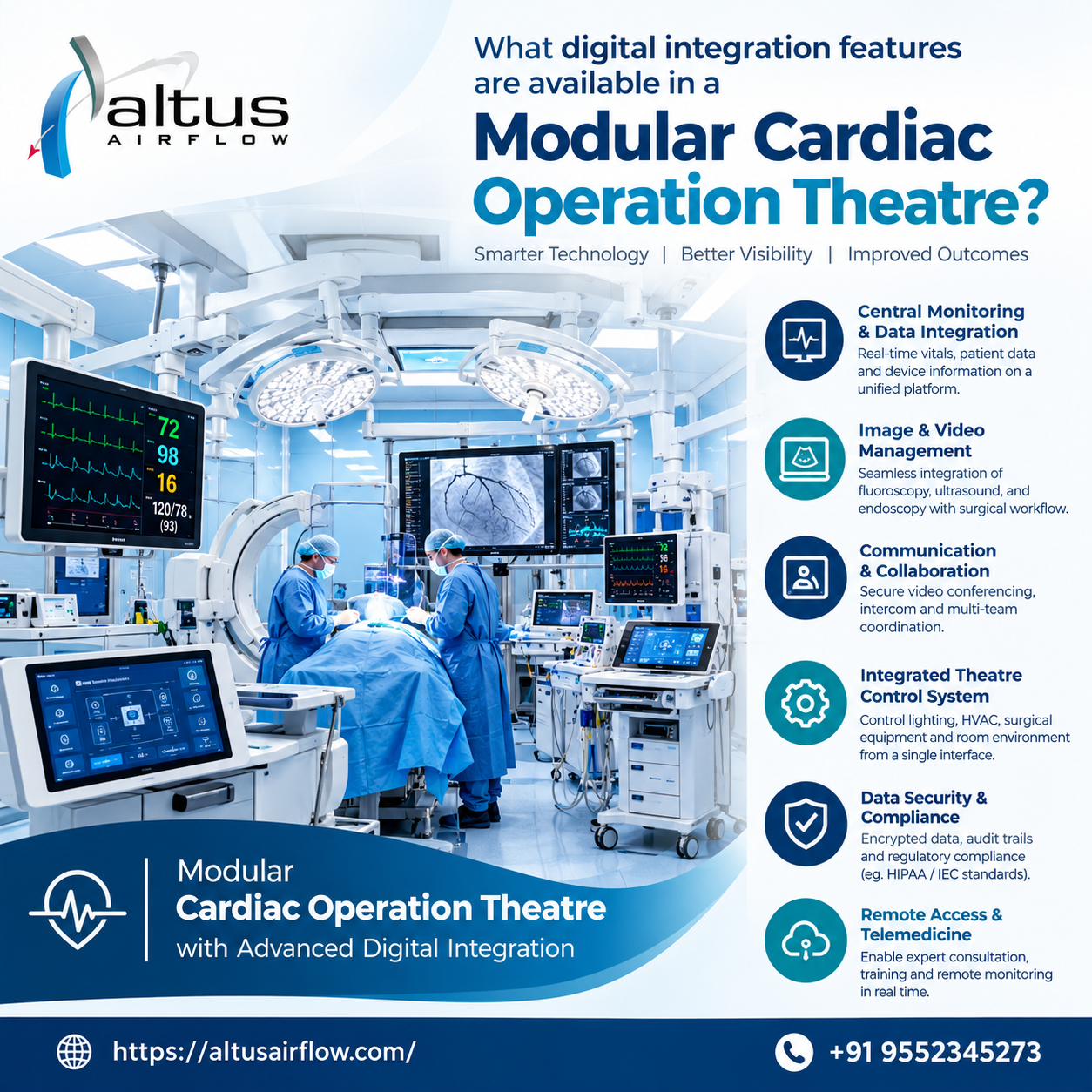
Altus Airflow supports healthcare facilities in planning modern operating environments that combine modular infrastructure, advanced equipment, and digital technology. A Modular Cardiac Operation Theatre can incorporate integrated surgical displays, patient monitoring systems, medical equipment connectivity, smart lighting controls, HVAC monitoring, and digital documentation tools. These features help surgical teams access essential information, coordinate procedures, and monitor operating conditions. Effective integration requires careful planning of electrical services, network connectivity, equipment compatibility, cybersecurity, and system testing to support reliable operation in a demanding cardiac surgical environment.
1. Integrated Surgical Displays and Information Systems
Digital displays are an important feature of modern cardiac operating theatres. They allow surgical teams to view relevant clinical information without relying on separate, disconnected screens throughout the room.
Depending on the hospital’s requirements, displays may present live imaging, echocardiography results, fluoroscopy images, endoscopic feeds, patient monitoring data, and information from compatible surgical devices. The exact configuration depends on the procedures performed and the equipment available.
A centralized audiovisual integration system can route selected information to designated displays. For example, a surgeon may need access to imaging while other team members monitor vital signs or review relevant procedural information. The ability to select and distribute sources can help reduce unnecessary movement and improve access to information.
Display placement is equally important. Screens should be positioned to provide clear visibility while avoiding interference with surgical lights, medical gas outlets, ceiling-mounted equipment, and staff movement. Adjustable mounts can help accommodate different procedures and team preferences.
The integration plan should also consider image resolution, latency, supported signal formats, network requirements, and compatibility with existing hospital systems. Testing must confirm that the correct sources appear on the intended displays and that the system performs reliably under expected operating conditions.
2. Real-Time Patient Monitoring Integration
Cardiac surgery requires continuous observation of patient condition throughout the procedure. Digital integration can help bring information from compatible monitoring equipment into a coordinated clinical environment.
Patient monitoring systems may measure parameters such as heart rate, electrocardiography, oxygen saturation, blood pressure, temperature, and other values relevant to the patient’s condition. Additional information may come from anesthesia workstations and specialized cardiac equipment, depending on the procedure.
Integration can allow authorized clinicians to view selected data on dedicated displays or compatible central monitoring platforms. This can reduce the need to consult multiple independent screens and may help teams maintain awareness of important changes.
However, integrating monitoring systems does not replace direct clinical assessment or the independent safety functions of medical devices. Each monitor must continue to operate according to its intended purpose, and alarms must remain appropriately configured.
During project planning, the hospital should identify which devices need to exchange information, which data must be visible, and whether interfaces are supported by the manufacturers. The installation team should coordinate network connections, display routing, power requirements, and equipment positioning.
Testing should verify that data appears accurately, alarm notifications behave as intended, and communication failures are handled according to established procedures. Clinical staff should receive training before the integrated arrangement is introduced into routine use.
3. Integration With Cardiac Imaging Equipment
Cardiac procedures may involve advanced imaging systems that provide clinicians with detailed anatomical and procedural information. Depending on the theatre’s clinical scope, these may include fluoroscopy systems, echocardiography equipment, ultrasound devices, and other compatible imaging technologies.
Digital integration can make selected imaging feeds available on appropriately positioned surgical displays. This can help authorized team members review relevant information without needing to move toward the source equipment.
A coordinated design considers the physical footprint of imaging systems, their movement requirements, cable routing, ceiling clearances, and access for servicing. Equipment must be arranged so that displays remain visible without obstructing surgical access or creating unnecessary congestion.
Compatibility is a key consideration. Imaging systems may use different video formats, interfaces, and communication protocols. The integration design should specify supported connections and any required interface equipment before installation begins.
Where medical images need to be stored or transferred, the hospital may require integration with its picture archiving and communication system (PACS) or other approved information platforms. The project team should verify that data transfer and image retrieval meet the hospital’s requirements.
Commissioning should include testing of image quality, source selection, display routing, and relevant connections. The final configuration should be documented so that staff can operate the system consistently and technical teams can troubleshoot faults efficiently.
4. Smart Surgical Lighting and Control Panels
Smart lighting systems can give surgical teams more convenient control over illumination within the operating theatre. Depending on the selected equipment, controls may support light intensity adjustment, positioning functions, and selected operating modes.
In cardiac surgery, appropriate illumination is essential for visibility and accurate work. Lighting should be designed to minimize unwanted shadows and glare while accommodating the positioning of surgical staff and equipment.
Integrated control panels may bring together selected functions such as surgical lighting, room illumination, display controls, and other compatible theatre features. The available functions depend on the system design and should be clearly defined during planning.
A modular control arrangement can simplify access to frequently used functions, but it must remain intuitive. Controls should be labelled clearly, positioned for convenient use, and designed to avoid accidental operation.
The engineering team should coordinate lighting equipment with ceiling structures, medical pendant systems, ventilation outlets, and other overhead installations. Poor coordination can restrict movement or create maintenance difficulties.
Testing should verify the operation of lighting controls, intensity settings, positioning mechanisms, and any specified backup functions. The hospital should also establish maintenance procedures and ensure that clinical staff understand the available controls.
5. Digital HVAC and Environmental Monitoring
Environmental control is essential in a cardiac operating theatre. HVAC systems help manage air distribution, filtration, temperature, humidity, and room pressure relationships according to the theatre’s design requirements.
Digital monitoring can make selected environmental readings available through local displays or a building management system (BMS). Depending on the installed configuration, monitored parameters may include room temperature, relative humidity, differential pressure, and filter-related indicators.
A connected system can help facilities personnel identify deviations and review historical trends. Where alarms are configured, the system may notify designated staff when a monitored value moves outside its established limits.
These capabilities support oversight but do not automatically guarantee environmental safety. Sensors must be suitable for the intended measurements, correctly positioned, and verified according to the maintenance and commissioning plan.
The design should distinguish between systems that monitor conditions and systems that actively control them. A display showing a pressure difference does not necessarily mean that the system can correct an abnormal reading without intervention.
For a Modular Cardiac Operation Theatre, digital HVAC integration should be coordinated with ventilation design, electrical infrastructure, control interfaces, and maintenance access. Testing should verify sensor readings, alarm behaviour, communication pathways, and relevant control functions.
The hospital should establish procedures for responding to environmental deviations and document the actions taken when readings fall outside approved limits.
6. Medical Equipment Connectivity and Interoperability
A cardiac operating theatre may contain anesthesia workstations, infusion pumps, electrosurgical devices, patient monitors, imaging systems, and other specialized equipment. Digital integration aims to connect compatible systems while preserving each device’s intended function and safety controls.
Interoperability refers to the ability of different devices and software platforms to exchange or use information correctly. It depends on compatible hardware interfaces, communication protocols, software versions, and appropriate configuration.
When planning connectivity, the project team should create an equipment schedule that identifies the devices involved, required data connections, network arrangements, and responsibility for installation and testing. Manufacturers should confirm whether the proposed interfaces are supported.
Cable management is another important consideration. Connections must be arranged to reduce trip hazards, avoid interference with equipment movement, and allow appropriate cleaning and maintenance. Wireless connections may be suitable for selected applications, but they must meet the hospital’s reliability and cybersecurity requirements.
Not every device needs to be connected to a common platform. Unnecessary integration can increase complexity, so the hospital should prioritize connections that provide clear clinical or operational value.
Testing should confirm that information is transmitted accurately, devices remain functional, and failures do not create unsafe dependencies. The hospital should also document which systems are connected and how faults are escalated.
7. Digital Documentation and Hospital Information Systems
Digital documentation can help hospitals organize procedural records and connect operating theatre activities with wider clinical information systems.
Depending on the hospital’s infrastructure, the theatre may interface with an electronic health record (EHR), hospital information system (HIS), PACS, or operating room management platform. These systems can support access to approved patient information, procedural schedules, imaging records, and other relevant documentation.
Integration must follow the hospital’s policies for patient identification, access permissions, data accuracy, and record retention. Clinical information should be displayed only to authorized users, and the system should maintain appropriate audit records where required.
The project team should identify which information needs to be available inside the theatre and which systems are responsible for storing the official record. This avoids unnecessary duplication and helps clarify responsibility for data management.
Technical planning should include network availability, interface specifications, access controls, backup arrangements, and downtime procedures. If a digital platform becomes unavailable, staff must know how to continue essential activities safely under approved hospital procedures.
Before handover, representative workflows should be tested from beginning to end. This may include accessing the correct patient record, retrieving relevant images, and confirming that information is saved or transferred to the intended system.
8. Cybersecurity and Network Reliability
As operating theatres become more digitally connected, cybersecurity and network reliability become important parts of engineering design. Connected medical devices and information platforms can create additional risks if access and communication are not properly managed.
Hospitals should coordinate with their IT and biomedical engineering teams to establish secure network architecture, access permissions, software maintenance responsibilities, and incident-response procedures. Controls may include network segmentation, authenticated access, appropriate encryption, security updates, and monitoring for unusual activity.
The design should also consider what happens if a network connection fails. Critical equipment should not depend on an unverified network function to perform its essential safety role. Independent device alarms and safety features must remain available as intended by the manufacturer.
Power continuity should be reviewed for equipment that requires uninterrupted operation. Backup power and recovery arrangements should follow the hospital’s risk assessment and applicable requirements.
Cybersecurity testing and configuration reviews should be conducted by appropriately qualified personnel. Changes to software, network settings, or connected equipment should be managed through a controlled process.
Clear documentation helps hospital teams maintain the system over time and understand which devices, interfaces, and software platforms are included in the integrated environment.
9. Commissioning, Testing, and Staff Training
Digital integration is not complete when the equipment has been installed and powered on. Commissioning should verify that the combined systems perform according to their approved specifications and intended use.
The testing plan may include:
-
Verification of display routing and image quality.
-
Checks of patient monitoring data and alarm behaviour.
-
Testing of supported medical equipment interfaces.
-
Confirmation of HVAC sensor readings and environmental alarms.
-
Verification of relevant control panels and lighting functions.
-
Testing of data transfer to approved hospital systems.
-
Review of network access, backup arrangements, and fault procedures.
Acceptance criteria should be defined before testing begins. Any failed test must be investigated, corrected, and repeated as appropriate. The team should document the test methods, results, outstanding issues, and final acceptance status.
Staff training is equally important. Surgeons, nurses, anesthetists, technicians, and facilities personnel may interact with different parts of the integrated system. Training should match each person’s responsibilities and cover normal operation, alarm response, troubleshooting, and escalation procedures.
The hospital should receive operating manuals, equipment records, network documentation where appropriate, maintenance schedules, and details of technical support arrangements.
10. Planning a Future-Ready Digital Cardiac Theatre
Digital technology evolves, so the theatre’s infrastructure should accommodate reasonable future changes. Planning may include sufficient electrical capacity, appropriate network pathways, accessible service routes, and modular arrangements that support equipment upgrades where feasible.
The hospital should prioritize technologies according to clinical requirements, interoperability, reliability, lifecycle costs, and support availability. Purchasing equipment with overlapping functions or incompatible interfaces can increase complexity without improving theatre performance.
A coordinated project approach helps align modular wall and ceiling systems, medical pendants, HVAC infrastructure, displays, electrical services, and digital controls. This reduces conflicts between equipment installations and makes future maintenance more manageable.
Modular Cardiac Operation Theatre planning should also include clear responsibility for software configuration, equipment integration, cybersecurity, commissioning, staff training, and ongoing support. The exact scope depends on the project contract and the capabilities of the selected suppliers.
By documenting requirements early and testing the integrated environment thoroughly, hospitals can establish a more organized digital operating theatre that supports clinical teams and facility management.
Conclusion
Digital integration can make a cardiac operating theatre more coordinated by bringing together surgical displays, patient monitoring, imaging, smart lighting, environmental monitoring, medical equipment connectivity, and hospital information systems. Successful implementation depends on compatible equipment, reliable infrastructure, secure data handling, documented testing, and effective staff training.
Altus Airflow supports healthcare facilities with coordinated planning for modular operating theatre infrastructure and associated technical systems. Contact Altus Airflow to discuss your cardiac operating theatre requirements and explore a solution that aligns digital integration, environmental controls, equipment placement, and future expansion needs. With a clearly defined scope and careful commissioning, hospitals can plan an operating environment designed around their clinical and operational priorities.
Frequently Asked Questions
1. What digital features can be integrated into a Modular Cardiac Operation Theatre?
A Modular Cardiac Operation Theatre can incorporate surgical displays, patient monitoring, imaging connectivity, smart lighting controls, HVAC monitoring, digital documentation, and compatible medical equipment interfaces.
2. Can cardiac theatre displays show live medical imaging?
Yes. Compatible integration systems can route live imaging feeds to designated displays, subject to equipment compatibility and the hospital’s configuration.
3. Can HVAC systems be monitored digitally?
Yes. Suitable sensors and control systems can monitor parameters such as temperature, humidity, and room pressure, with alerts where configured.
4. Why is cybersecurity important in a digital operating theatre?
Cybersecurity helps protect patient information, connected medical devices, and hospital systems from unauthorized access and avoidable disruption.
5. Is staff training required after digital integration?
Yes. Staff need training on system operation, alarm response, approved workflows, and procedures for technical failures.
Read Our Previous Blog ---------------> How does a Modular IVF Lab Engineering Company improve contamination control?

 English
 Arabic
 Spanish
 Portuguese
 Deutsch
 Turkish
 Dutch
 Italiano
 Russian
 Romaian
 Portuguese (Brazil)
 Greek